
Canto 10
Canto 10
Chapter 47: The Gopî Reveals Her Emotions: The Song of the Bee
(1-2) S'rî S'uka said: 'When the women of Vraja saw him, the servant of Krishna, with his long arms, with his lotus eyes, wearing a yellow garment and a lotus garland, with his effulgent lotuslike countenance and polished earrings, they were quite astonished and wondered where this handsome, young man came from and to whom he belonged who wore clothes and ornaments like those of Krishna. Talking like this they all eagerly crowded around him who enjoyed the protection of the lotus feet of Uttamas'loka [the Lord Praised in the Scriptures]. (3) With due respect bowing down before him in humility and shyly smiling with their glances, sweet words and such, they asked it him, after first having taken him separate and offered him a seat, for they had understood that he was an envoy of the Husband of the Goddess of Fortune. (4) 'We know that you arrived here as the personal associate of the chief of the Yadus who, as your Master, has sent you here to satisfy His parents. (5) We really would not know why else He should have thought of this cow place. Even for a sage the bonds of affection with one's relatives are difficult to relinquish. (6) The interest in others manifested out of self-interest proves itself as friendship for as long as it takes; it is a pretense as good as the interest of bees for flowers or of men for women. (7) Prostitutes abandon a penniless man, citizens deny an incompetent king, graduates leave behind their teacher and priests leave [their attendants] after being compensated. (8) Birds abandon a tree rid of its fruits and guests leave the house where they ate. Animals leave the forest that burned down and a lover likewise leaves the woman he enjoyed to unite with.'
(9-10) Now that Uddhava, the messenger of Krishna, had arrived in their midst, the gopîs, who thus with their words, bodies and minds were focussed on Krishna, put aside their worldly concerns. Without restraint they sang and cried in the constant remembrance of the youth and childhood activities of their Sweetheart. (11) One gopî [noted as Râdhâ, see also *] seeing a honeybee as she meditated on the association with Krishna, imagined it to be a messenger sent by her Beloved and spoke as follows. (12) The gopî said: 'Oh honeybee, you friend of a cheater, do not touch my feet with your whiskers still carrying the kunkum from His garland, the powder that rubbed off from the breasts of a rival lover. One who sends a messenger like you is derided in the assembly of the Yadus. Let the Lord of Madhu [Himself] be of mercy with the women [instead] [prajalpa **]! (13) One time He made us drink the nectar of His bewildering lips and then suddenly abandoned us like we were some flowers. I wonder why the goddess of fortune [Padmâ] serves His lotus feet just like you [oh bee]. That must be so because her mind, alas, has been stolen by Krishna's chitchat [parijalpa ***]. (14) Oh mister sixlegs, dear bee, why are you singing so busily about the Master of the Yadus in front of us who are old friends of this Friend of Vijaya [Arjuna] and who left behind their homes? You better sing of His topics before His [new] girlfriends, the pain of whose breasts He [now has] relieved. His sweethearts will provide you the charity you seek [vijalpa *4]. (15) What women in heaven, on earth and below, would not be available to Him who, so unattainable, can deceive you with His charming smiles and arching eyebrows? When the wife of the Fortunate One is of worship in the dust of His feet, what then would be our value? Luckily for those feeling bad about it, there is the sound vibration [to be chanted of] 'Uttamas'loka' [ujjalpa *5]. (16) Keep your little head away from my feet! I know you, you expert who as a messenger from Mukunda learned the diplomacy of flatter! Why should I make amends with Him who, so ungrateful, has abandoned us, we who for His sake in this life have left behind their children, husbands and everything else [sañjalpa *6]? (17) Against all rules He [as Râma, see 9.10 & 11] as cruel as a hunter shot the king of the monkeys [Vâlî], was conquered by a woman [Sîtâ], disfigured a woman driven by lust [S'ûrpanakhâ, the sister of Râvana] and, after consuming His tribute, [as Vâmana] bound up Bali like a crow [see 8.21]. Therefore enough of all friendliness with that Black Boy who impossibly can be given up when we keep talking about His stories [avajalpa *7]. (18) Those ears are freed from all sins, that just once enjoyed but a drop of the nectar of the pastimes that He constantly performed. Such a person is completely liberated from the duality, wherefrom any [personal, material] sense of duty is instantly ruined. For that reason many people here [in Vrindâvana], by therewith rejecting their miserable homes and families, end up wretched and, just like birds, practice the livelihood of begging [abhijalpa *8]. (19) We, taking His deceptive words for true, just like the black deer's foolish doe wives who trust the hunter's song, repeatedly experienced this sharp p ain of lust that was caused by the touch of His fingernails. Oh messenger, I beg you, talk of something else [ajalpa *9]! (20) My sweet little friend, have you been sent back here by my Beloved? Please ask me what you want, you are to be honored by me, my dearest. Why are you here raising in us these [amorous] feelings for Him that are so impossible to relinquish? For is, oh gentle one, His consort the goddess of fortune S'rî, not always present with Him on His chest [pratijalpa *10]? (21) What a pity that the son of Nanda resides in Mathurâ now. Does He think so now and then of the household affairs of His father, His friends and the cowherd boys, oh great soul? Or else, does He still talk about us, His maidservants? When will He lay His aguru-scented hand on our heads [sujalpa *11]?'
(22) S'rî S'uka said: 'Uddhava, having heard how the cowherd girls were longing to see Krishna, in order to pacify them thereupon related to them the message of their Sweetheart. (23) S'rî Uddhava said: 'You have dedicated your minds unto the Supreme Lord Vâsudeva and are thus honorable to all people because you, oh good selves, therewith fulfilled your life's purpose [of giving shape to the emotions of relating to Him]. (24) By means of donations, vows [of poverty, celibacy and fasting], sacrifices, using prayer beads [japa], studying and by turning inward, concentrating and meditating, as also by other kinds of auspicious practices [see also yama, niyama, vidhi and bhâgavata dharma], bhakti, devotional service unto Krishna, is realized. (25) The unexcelled [standard of] devotion unto the Supreme Lord Uttamas'loka, which by you good people fortunately has been established, is even hard to attain for the sages. (26) To your great fortune you have chosen to leave your sons, husbands, physical comforts, relatives and homes, for the sake of that superior, male personality called Krishna. (27) By the wholehearted love, which ruled you because of your separation from Adhokshaja [the Transcendental Lord], oh glorious souls, you have done me [the Lord and everyone] a great favor. (28) Please, good ladies, listen to the message that I for the sake of your happiness, as a faithful servant of my master, brought to you from your Beloved.
(29) The Supreme Lord has said: 'You women are actually never separated from Me, ever being present as the Soul of All. Just as all the elements, the ether, the fire, the air, the water and the earth are part of all beings, I am there as the union of all the elements of the mind, the life air, the senses and the natural modes. (30) By means of Myself I create, destroy and sustain Myself within Myself, through the power of My deluding potency consisting of the material elements, the senses and the modes of nature. (31) The soul full of pure spiritual knowledge, which separately exists free from the association of the modes, is perceived [as the constant witness] in the operations of deep seep, dream sleep and waking consciousness. (32) The mind by which one meditates on the objects of the senses, constitutes a mirage, just as a dream constitutes an illusion when one wakes up. Staying alert one should bring under control that what [in the mind] gathers from the input of the senses [compare B.G. 2: 68 and 6: 35-36]. (33) Just as the ocean is the end station for all the rivers, this [insight] is the end conclusion of all Vedic literatures, analysis and yoga, of all intelligent people, renunciation, penance, sense control and truthfulness [compare B.G. 2: 70]. (34) The fact then that I, so dear to your eyes, am situated so far away from you, is according to My wish that your mind - that is subjected to attraction - meditates on Me. (35) The mind of a woman remains more absorb ed when her lover is far away, than when she has him present before her eyes. (36) Because in the constant remembrance of Me your minds are totally absorbed in Me and free from all restlessness, you will see Me appear soon. (37) Those remaining here in Vraja while I was sporting at night in the forest [see 10.29: 9] and for that reason did not experience the râsa dance, were as fortunate to achieve Me by thinking of My lustre.'
(38) S'rî S'uka said: 'The women of Vraja hearing the instructions thus imparted by their Beloved, pleased as they were to have their memories revived by the message, thereupon addressed Uddhava. (39) The gopîs said: 'Kamsa, the enemy of the Yadus, the cause of the suffering, together with his followers has fortunately been killed. What a blessing that Acyuta at present lives happily with His well-wishers who [therewith] achieved everything they desired. (40) Oh gentle soul, maybe the elder brother of Gada [Krishna, see 9.24: 46] gives the women of the city, affectionately revering Him bashfully with inviting smiles and glances, the love that belongs to us. (41) How can our Darling, so expert in all matters of love, not be bound by the bewildering gestures and words of the city women, who [just like us] are also constantly of worship? (42) And... does Krishna, oh pious soul, remember us; does He ever mention us, village girls, when He freely talks in the company of the city women? (43) Does He still remember those nights in which He enjoyed in Vrindâvana, that place so enchanting because of the lotus, the jasmine and the moon? He at the time with tinkling ankle bells danced with us, His beloved girlfriends, who glorified Him for His attractive stories. (44) Will that descendant of Das'ârha return to this place and with His touch bring back to life us, who are tormented by the sorrow He gave rise to Himself? Will He do that just as Indra with his clouds would [replenish] a forest? (45) But why would Krishna come here, now that He, surrounded by all His well-wishers, is happy having attained a kingdom, having killed His enemies and having married the daughters of kings? (46) What purpose would there, for us forest-dwellers or for other women, be to fulfill unto Him, the great Soul and husband of the goddess of fortune, whose every desire is already fulfilled? He is complete in Himself! (47) The greatest happiness is found in non-expectancy, so even the unchaste Pingalâ stated [a courtesan, see 11.8]. Yet, for us focused on Krishna who very well know this, it is most difficult not to cherish any hope. (48) Who is capable of forgetting the intimate talks with Uttamas'loka, He from whose body the goddess never moves away despite Him not desiring her? (49) In the company of Sankarshana, oh prabhu, Krishna with the cows and the sounds of the flute wandered through the different places in the forest, by the rivers and the hills. (50) Ah, time and again those places, carrying the glory of His footprints, remind us of the son of Nanda we can never forget. (51) Oh, how can we ever forget Him with our hearts being stolen by His lovely gait, His playful glances, His generous smiles and nectarean wor ds? (52) Oh Master, Master of the Goddess and Master of Vraja; oh Destroyer of the Suffering, oh Govinda, lift Gokula out of the ocean of misery it is submerged in!'
(53) S'rî S'uka said: 'With their fever of separation removed by Krishna's messages, they thereupon worshiped him, Uddhava, recognizing him as Adhokshaja Himself. (54) Remaining there for some months he, singing about the topics of Krishna's pastimes, gave joy to Gokula by dispelling the sorrow of the gopîs. (55) All the days that Uddhava dwelled in Nanda's cowherd village, passed for the residents of Vraja in a single moment, because they were filled with discussions about Krishna. (56) Seeing the rivers, forests, mountains, valleys and flowering trees, the servant of the Lord took pleasure in reminding the people of Vraja of Krishna. (57) Whitnessing how confused and such the gopîs were in their absorption in Krishna, Uddhava was extremely pleased and offered them all respect while singing the following: (58) 'On this earth these young cowherd women are the only ones [of real success] in acquiring a body, for they achieved the perfection of an exclusive love for Govinda, the Soul of All - a love that is desired by sages, by ourselves and by those afraid of a material existence. Of what use would the [three] brahminical births be [of deriving an existence from one's parents, one's guru and one's sacrifices] for someone who has a taste for the topics of the Unlimited Lord? (59) What is one compared to these women who, impure in their conduct towards Krishna, wander through the forests? What is one's position compared to this stage of perfect love for the Supreme Soul? For the soul who is of constant worship, even when not being very learned, most certainly the Lord directly bestows the highest good, the good that, being imbibed, works like the king of all medicines [that is: irrespective the person]. (60) The blessing the Vraja ladies during the râsa dance found in the embrace of Uttamas'loka, was not bestowed on the goddess on His chest who is so intimately associated with Him, was not His mercy for the heavenly damsels with their lotus flower scent and luster, nor was it granted to any other kind of woman [10.33]. (61) Oh, let me be devoted to the dust of the lotus feet of the gopîs in Vrindâvana! Let me be any of the bushes, creepers or herbs there [in relation] to them, to those women who in worship of the feet of Mukunda, whom one seeks with the help of the Vedas, abandoned the path of civil correctitude and left behind the family members that are so difficult to give up. (62) The feet of the Supreme Lord where the goddess, Lord Brahmâ and the other gods with all their desires fulfilled, just like accomplished masters of yoga, can only dream of, were by Krishna in the gathering of the râsa dance placed on their breasts, so that they by embracing them could overcome their anguish. (63) I offer my obeisances again and again to the dust of the feet of the women of Nanda's cowherd village, whose loud chanting of Krishna's glories purifies the three worlds.'
(64) S'rî S'uka said: '[Uddhava,] the descendant of Das'ârha thereupon took leave of Yas'odâ, Nanda, the gopas and the gopîs, mounted his chariot and was about to leave. (65) But when he left, Nanda and the others approached him with various items of worship in their hands and said, affectionately and with tears in their eyes: (66) 'May our mental activities be founded on Krishna's lotus feet, may our words be an expression of His names and may our bodies when they bow down and such, do so for His sake. (67) May there wherever we for our work have to wander to the Lord's disposition, may there with whatever we do and give away in charity, be the attachment to Krishna, our Lord.'
(68) After the gopas thus had honored him with Krishna bhakti, oh first among men, Uddhava returned to Mathurâ, the city that [now] enjoyed the protection of Krishna. (69) After bringing Krishna his obeisances, he told Him about the intense devotion of the residents of Vraja, and next gave Vasudeva, Balarâma and the king [Ugrasena], the gifts sent along for them.'


Third revised edition, loaded March 11, 2021.
Previous Aadhar edition and Vedabase links:
S'rî S'uka said: 'When the women of Vraja saw him, the servant of Krishna, with his long arms, with his lotus eyes, wearing a yellow garment and a lotus garland, with his effulgent lotuslike countenance and polished earrings, they were quite astonished and wondered where this handsome, young man came from and to whom he belonged who wore clothes and ornaments like those of Krishna. Talking like this they all eagerly crowded around him who enjoyed the protection of the lotus feet of Uttamas'loka [the Lord Praised in the Scriptures].S'rî S'uka said: 'When the women of Vraja saw him, the servant of Krishna, with his long arms, being so young, with his lotus eyes, wearing a yellow garment and a lotus garland and with his effulgent lotuslike countenance and polished earrings, wondered they quite astonished from where this handsome man had come and to whom he, wearing Krishna's clothes and ornaments, belonged. With all of them talking like this crowded they eagerly around him who was sheltered by the lotus feet of Uttamas'loka [the Lord Praised in the Scriptures]. (Vedabase)
With due respect bowing down before him in humility and shyly smiling with their glances, sweet words and such, they asked it him, after first having taken him separate and offered him a seat, for they had understood that he was an envoy of the Husband of the Goddess of Fortune.
In proper respect bowing down to him in humility and shyly smiling with their glances, sweet words and all, inquired they with him, having taken him separate seated on a pillow, for they had understood that he was an envoy of the Master of the Goddess of Fortune. (Vedabase)
'We know that you arrived here as the personal associate of the chief of the Yadus who, as your Master, has sent you here to satisfy His parents.
'We know that you arrived here as the personal associate of the chief of the Yadus who as your Master has sent you here to satisfy by your mediation His parents. (Vedabase)
We really would not know why else He should have thought of this cow place. Even for a sage the bonds of affection with one's relatives are difficult to relinquish.
We wouldn't know what there would be else for Him worth to remember in these cow pastures; the bonds of affection with one's relatives are even for a sage difficult to relinquish. (Vedabase)
The interest in others manifested out of self-interest proves itself as friendship for as long as it takes; it is a pretense as good as the interest of bees for flowers or of men for women.
The interest in others manifests itself as friendship for as long as it takes; it is a pretense as good as the interest that bees show for flowers or that men show for women. (Vedabase)
Prostitutes abandon a penniless man, citizens deny an incompetent king, graduates leave behind their teacher and priests leave [their attendants] after being compensated.
Prostitutes abandon a penniless man, citizens an incompetent king, graduates abandon their teacher and priests one abandons after compensating them. (Vedabase)
Birds abandon a tree rid of its fruits and guests leave the house where they ate. Animals leave the forest that burned down and a lover likewise leaves the woman he enjoyed to unite with.'
Birds do so with a tree rid of the fruits and guests with the house where they ate; animals abandon the forest that burned down and likewise does a lover so once he has enjoyed an enamored woman.' (Vedabase)
Now that Uddhava, the messenger of Krishna, had arrived in their midst, the gopîs, who thus with their words, bodies and minds were focussed on Krishna, put aside their worldly concerns. Without restraint they sang and cried in the constant remembrance of the youth and childhood activities of their Sweetheart.
The gopîs with Uddhava, the messenger of Krishna, having arrived in their midst, did so with their speech, bodies and minds aiming at Krishna, put aside their worldly concerns, singing and crying without restraint in the intense memory of the youth and childhood activities of their Sweetheart. (Vedabase)
One gopî [noted as Râdhâ, see also *] seeing a honeybee as she meditated on the association with Krishna, imagined it to be a messenger sent by her Beloved and spoke as follows.
One [noted as Râdhâ, see also *] seeing a honeybee while meditating the association with Krishna imagined it a messenger sent by her Beloved and spoke the following. (Vedabase)
The gopî said: 'Oh honeybee, you friend of a cheater, do not touch my feet with your whiskers still carrying the kunkum from His garland, the powder that rubbed off from the breasts of a rival lover. One who sends a messenger like you is derided in the assembly of the Yadus. Let the Lord of Madhu [Himself] be of mercy with the women [instead] [prajalpa **]!
The gopî said: 'O honeybee, you friend of a cheater, don't touch my feet with your whiskers carrying the kunkum from His garland that rubbed off from the breasts of our rival; He who has sent a messenger such as you is derided in the assembly of the Yadus - let the Lord of Madhu [Himself instead] be of mercy with the women! [prajalpa **] (Vedabase)
One time He made us drink the nectar of His bewildering lips and then suddenly abandoned us like we were some flowers. I wonder why the goddess of fortune [Padmâ] serves His lotus feet just like you [oh bee]. That must be so because her mind, alas, has been stolen by Krishna's chitchat [parijalpa ***].
Once He made us drink the nectar from His bewildering lips, but He has suddenly abandoned us like we were some flowers; I wonder why, like you [o bee], the goddess of fortune [Padmâ] serves His lotus feet - that must be so because, alas, by the chitchat of Krishna her mind has been stolen [parijalpa ***]. (Vedabase)
Oh mister sixlegs, dear bee, why are you singing so busily about the Master of the Yadus in front of us who are old friends of this Friend of Vijaya [Arjuna] and who left behind their homes? You better sing of His topics before His [new] girlfriends, the pain of whose breasts He [now has] relieved. His sweethearts will provide you the charity you seek [vijalpa *4].
O mister sixlegs, why are you singing here so much about the Master of the Yadus in front of us, old friends of the Friend of Vijaya [Arjuna], who abandoned their homes; you better sing of His topics before the [present] girlfriends of whom He [now has] relieved of the pain of their breasts - His sweethearts will provide you the charity you seek [vijalpa *4]. (Vedabase)
What women in heaven, on earth and below would not be available to Him who, so unattainable, can deceive you with His charming smiles and arching eyebrows? When the wife of the Fortunate One is of worship in the dust of His feet, what then would be our value? Luckily for those feeling bad about it, there is the sound vibration [to be chanted of] 'Uttamas'loka' [ujjalpa *5].
What women in heaven, on earth and below would not be available to Him so deceptive with His charming smiles and arching eyebrows; what is, when the wife of the Fortunate One is of worship with the dust of the feet, the value of us, we for whom being so wretched indeed He at least is there by the sound of 'Uttamas'loka' [ujjalpa *5]? (Vedabase)
Keep your little head away from my feet! I know you, you expert who as a messenger from Mukunda learned the diplomacy of flatter! Why should I make amends with Him who, so ungrateful, has abandoned us, we who for His sake in this life have left behind their children, husbands and everything else [sañjalpa *6]?
Keep your head off my foot! I know you, you expert who as a messenger from Mukunda learned the diplomacy of flatter! Why should I reconcile with Him who so ungrateful abandoned us, who for His sake in this life have abandoned their children, husbands and everything else [sañjalpa *6]? (Vedabase)
Against all rules He [as Râma, see 9.10 & 11] as cruel as a hunter shot the king of the monkeys [Vâlî], was conquered by a woman [Sîtâ], disfigured a woman driven by lust [S'ûrpanakhâ, the sister of Râvana] and, after consuming His tribute, [as Vâmana] bound up Bali like a crow [see 8.21]. Therefore enough of all friendliness with that Black Boy who impossibly can be given up when we keep talking about His stories [avajalpa *7].
Against the rules shot He [as Râma, see 9.10 & 11] as cruel as a hunter the king of the monkeys [Vâlî], was He won by a woman [Sîtâ], did He disfigure a woman driven by lust [S'ûrpanakhâ, the sister of Râvana] and did He, after consuming His tribute [as Vâmana], bind Bali up like a crow [see 8.21]; so therefore enough of that Black Boy whom of all friendships is so hard to give up with us losing ourselves in the topics about Him [avajalpa *7]. (Vedabase)
Those ears are freed from all sins, that just once enjoyed but a drop of the nectar of the pastimes that He constantly performed. Such a person is completely liberated from the duality, wherefrom any [personal, material] sense of duty is instantly ruined. For that reason many people here [in Vrindâvana], by therewith rejecting their miserable homes and families, end up wretched and, just like birds, practice the livelihood of begging [abhijalpa *8].
The ears, just once partaking in a drop of the nectar of the pastimes He constantly performed, do remove one entirely from the duality and ruin the personal duties right away, because of which, rejecting their miserable homes and families, many people out here like birds pursue the livelihood of begging [abhijalpa *8]. (Vedabase)
We, taking His deceptive words for true, just like the black deer's foolish doe wives who trust the hunter's song, repeatedly experienced this sharp pain of lust that was caused by the touch of His fingernails. Oh messenger, I beg you, talk of something else [ajalpa *9]!
We, taking His deceptive speech for true, as foolish doe wives of the black deer trusting the hunter's song, repeatedly experienced this sharp pain of lust caused by the touch of His fingernails; o messenger, I beg, speak of another subject [âjalpa * 9]! (Vedabase)
My sweet little friend, have you been sent back here by my Beloved? Please ask me what you want, you are to be honored by me, my dearest. Why are you here raising in us these [amorous] feelings for Him that are so impossible to relinquish? For is, oh gentle one, His consort the goddess of fortune S'rî, not always present with Him on His chest [pratijalpa *10]?
O sweet friend, have you by my Beloved once again been sent here - please choose whatever you wish, you are to be honored by me my dearest - why are you with us here raising this conflict of feelings with Him that is so impossible to give up; o gentle one, isn't there always present at His side His consort, the goddess of fortune S'rî, to His chest [pratijalpa * 10]? (Vedabase)
What a pity that the son of Nanda resides in Mathurâ now. Does He think so now and then of the household affairs of His father, His friends and the cowherd boys, oh great soul? Or else, does He still talk about us, His maidservants? When will He lay His aguru-scented hand on our heads [sujalpa *11]?'
It certainly is regrettable that the son of Nanda now resides in Mathurâ; does He remember the household affairs of His father, His friends and the cowherd boys so now and then, o great soul, or..., does He still in talks relate to us, the maidservants? When do we have a chance that He will lay His aguru-scented hand on our heads [sujalpa * 11]?' (Vedabase)
S'rî S'uka said: 'Uddhava, having heard how the cowherd girls were longing to see Krishna, in order to pacify them thereupon related to them the message of their Sweetheart.
S'rî S'uka said: 'Uddhava, having heard how the cowherd girls were hankering for the sight of Krishna, next in order to pacify them spoke of the messages of their Sweetheart. (Vedabase)
S'rî Uddhava said: 'You have dedicated your minds unto the Supreme Lord Vâsudeva and are thus honorable to all people because you, oh good selves, therewith fulfilled your life's purpose [of giving shape to the emotions of relating to Him].
S'rî Uddhava said: 'You who in this manner dedicated your minds unto the Supreme Lord Vâsudeva, are for sure to be worshiped by all people, because you fulfilled the purpose of your good selves [of modeling the emotions of relating to Him]. (Vedabase)
By means of donations, vows [of poverty, celibacy and fasting], sacrifices, using prayer beads [japa], studying and by turning inward, concentrating and meditating, as also by other kinds of auspicious practices [see also yama, niyama, vidhi and bhâgavata dharma], bhakti, devotional service unto Krishna, is realized.
By donating, vows [of poverty, celibacy and fasting], sacrifices, the rosary [japa], by study, and by turning inward concentrating and meditating, and by all kinds of other auspicious practices [see also yama, niyama, vidhi and bhâgavata dharma] is indeed unto Krishna the bhakti, the devotional service, realized. (Vedabase)
The unexcelled [standard of] devotion unto the Supreme Lord Uttamas'loka, which by you good people fortunately has been established, is even hard to attain for the sages.
By your good selves unto the Supreme Lord, who is glorified in sublime poetry, have you - and my congratulations for that - established an unequaled devotion hard to attain even for the sages. (Vedabase)
To your great fortune you have chosen to leave your sons, husbands, physical comforts, relatives and homes, for the sake of that superior, male personality called Krishna.
To your good fortune you chose to leave your sons, husbands, physical comforts, relatives and homes to associate with that superior male personality named Krishna. (Vedabase)
By the wholehearted love, which ruled you because of your separation from Adhokshaja [the Transcendental Lord], oh glorious souls, you have done me [the Lord and everyone] a great favor.
By the rightful claim of your wholehearted love in separation from Adhokshaja, o glorious ones, have you done me [the Lord and everyone] a great favor. (Vedabase)
Please, good ladies, listen to the message that I for the sake of your happiness, as a faithful servant of my master, brought to you from your Beloved.
Please, good ladies, hear what the message from your Beloved for you is for the reason of which I, as a faithful servant of my master's orders, came here. (Vedabase)
The Supreme Lord has said: 'You women are actually never separated from Me, ever being present as the Soul of All. Just as all the elements, the ether, the fire, the air, the water and the earth are part of all beings, I am there as the union of all the elements of the mind, the life air, the senses and the natural modes.
The Supreme Lord has said: 'You women are actually never separated from Me, who is ever present as the Soul of All; just as all the elements, the ether, the fire, the air, the water and the earth are part of all beings, am I likewise, to the elements of the mind, the life air, the senses, and their natural modes [guna, rasa and jalpa] there as their harbor. (Vedabase)
By means of Myself I create, destroy and sustain Myself within Myself, through the power of My deluding potency consisting of the material elements, the senses and the modes of nature.
Within Me do I Myself by means of Myself create, destroy and sustain through the power of My deluding potency that is made up by the elements, the senses and the modes. (Vedabase)
The soul full of pure spiritual knowledge, which separately exists free from the association of the modes, is perceived [as the constant witness] in the operations of deep sleep, dream sleep and waking consciousness.
The soul full of pure spiritual knowledge is, concerning the effect of the modes of nature, uninvolved in what is perceived by the functions of deep sleep, dream sleep and waking consciousness. (Vedabase)
The mind by which one meditates on the objects of the senses, constitutes a mirage, just as a dream constitutes an illusion when one wakes up. Staying alert one should bring under control that what [in the mind] gathers from the input of the senses [compare B.G. 2: 68 and 6: 35-36].
What one meditates by the senses that run after the objects is as false as a dream is when one wakes up; staying alert should one bring under control that what [in the mind] gathers from the input of the senses [compare B.G. 2: 68 and 6: 35-36]. (Vedabase)
Just as the ocean is the end station for all the rivers, this [insight] is the end conclusion of all Vedic literatures, analysis and yoga, of all intelligent people, renunciation, penance, sense control and truthfulness [compare B.G. 2: 70].
This, like all rivers ending in the ocean, is of the intelligent the end conclusion to all vedic studies, yoga, analysis, renunciation, penance, sense control and truthfulness [compare B.G. 2: 70]. (Vedabase)
The fact then that I, so dear to your eyes, am situated so far away from you, is according to My wish that your mind - that is subjected to attraction - meditates on Me.
The fact then that I, who is so dear to your eyes, indeed am situated so far away from you, is according My wish that you, in your solicitude towards Me, are attracted to Me in the mind. (Vedabase)The mind of a woman remains more absorbed when her lover is far away, than when she has him present before her eyes.
For the minds of women remain absorbed when the one dearest to them is far away and not so much the minds of those who have him present directly before their eyes. (Vedabase)
Because in the constant remembrance of Me your minds are totally absorbed in Me and free from all restlessness, you will see Me appear soon.
Your minds totally absorbed in Me will - because of the constant remembrance of Me - having given up on all the restlessness, soon obtain Me. (Vedabase)
Those remaining here in Vraja while I was sporting at night in the forest [see 10.29: 9] and for that reason did not experience the râsa dance, were as fortunate to achieve Me by thinking of My lustre.'
Those remaining here in Vraja while I was sporting at night in the forest [see 10.29: 9] and for that reason not experienced the râsa dance, were as fortunate to achieve Me by thinking of My heroic acts.' (Vedabase)
S'rî S'uka said: 'The women of Vraja hearing the instructions thus imparted by their Beloved, pleased as they were to have their memories revived by the message, thereupon addressed Uddhava.
S'rî S'uka said: 'The women of Vraja hearing the instructions this way imparted by their Beloved, next addressed Uddhava, pleased as they were to have their memories revived by the message. (Vedabase)
The gopîs said: 'Kamsa, the enemy of the Yadus, the cause of the suffering, together with his followers has fortunately been killed. What a blessing that Acyuta at present lives happily with His well-wishers who [therewith] achieved everything they desired.
The gopîs said: 'Fortunately has the cause of the suffering, the enemy of the Yadus Kamsa, together with his followers been killed. How good it is that Acyuta at present happily lives with His well-wishers who have attained all they desired. (Vedabase)
Oh gentle soul, maybe the elder brother of Gada [Krishna, see 9.24: 46] gives the women of the city, affectionately revering Him bashfully with inviting smiles and glances, the love that belongs to us.
O gentle one, perhaps is the elder brother of Gada [Krishna, see 9.24: 46] giving the women of the city the love that belongs to us, we who revere Him affectionately and bashful with inviting smiles and glances. (Vedabase)
How can our Darling, so expert in all matters of love, not be bound by the bewildering gestures and words of the city women, who [just like us] are also constantly of worship?
How will our Darling, so versed in all the matters of love, not become bound by the bewildering gestures and words of the city women, who are also [just as we] constantly of worship? (Vedabase)
And... does Krishna, oh pious soul, remember us; does He ever mention us, village girls, when He freely talks in the company of the city women?
And... does Krishna, o pious one, remember us; does He ever mention us, village girls, when He freely talks in the company of the city women? (Vedabase)
Does He still remember those nights in which He enjoyed in Vrindâvana, that place so enchanting because of the lotus, the jasmine and the moon? He at the time with tinkling ankle bells danced with us, His beloved girlfriends, who glorified Him for His attractive stories.
Does He recall those nights in which He enjoyed in Vrindâvana that place so enchanting because of the lotus, the jasmine and the moon, when He with tinkling ankle bells danced with us, His beloved girlfriends, who ever glorify Him with the charming stories about Him? (Vedabase)
Will that descendant of Das'ârha return to this place and with His touch bring back to life us, who are tormented by the sorrow He gave rise to Himself? Will He do that just as Indra with his clouds would [replenish] a forest?
Will that descendant of Das'ârha come over here to bring, perhaps with His touch, back to life us who are tormented with the sorrow He Himself gave rise to, just like Indra would do to [replenish] a forest with his clouds? (Vedabase)
But why would Krishna come here, now that He, surrounded by all His well-wishers, is happy having attained a kingdom, having killed His enemies and having married the daughters of kings?
But why would Krishna come over here now that He, surrounded by all His well-wishers, is happy having attained a kingdom, killed His enemies and married the daughters of kings? (Vedabase)
What purpose would there, for us forest-dwellers or for other women, be to fulfill unto Him, the great Soul and husband of the goddess of fortune, whose every desire is already fulfilled? He is complete in Himself!
What unto Him, the great Soul and husband of the goddess of fortune whose every desire is already fulfilled, would there be to fulfill as a purpose for us, forest-dwellers, or for other women; He's complete in Himself! (Vedabase)
The greatest happiness is found in non-expectancy, so even the unchaste Pingalâ stated [a courtesan, see 11.8]. Yet, for us focused on Krishna who very well know this, it is most difficult not to cherish any hope.
The highest happiness indeed is found in not hoping for anything, so even stated Pingalâ [a courtesan, see 11.8], yet for us who aware of that are focused on Krishna is it difficult not to hope. (Vedabase)
Who is capable of forgetting the intimate talks with Uttamas'loka, He from whose body the goddess never moves away, despite Him not desiring her?
Who is able to put out of his mind the thought of the intimate talks with Uttamas'loka, from whose body the goddess, even though He's not desiring her, never moves away? (Vedabase)
In the company of Sankarshana, oh prabhu, Krishna with the cows and the sounds of the flute wandered through the different places in the forest, by the rivers and the hills.
With Sankarshana for His companion lived Krishna, o prabhu, by the rivers, the hills and places in the forest, the cows and the sounds of the flute. (Vedabase)
Ah, time and again those places, carrying the glory of His footprints, remind us of the son of Nanda we can never forget.
Ah!, over and over do those places with the divine markings of His feet remind us of the son of Nanda we really can never forget. (Vedabase)
Oh, how can we ever forget Him with our hearts being stolen by His lovely gait, His playful glances, His generous smiles and nectarean words?
O, how can we, whose hearts were stolen by His gait, His playful glances, His generous charming smiles and nectarean words, forget Him? (Vedabase)
Oh Master, Master of the Goddess and Master of Vraja; oh Destroyer of the Suffering, oh Govinda, lift Gokula out of the ocean of misery it is submerged in!'
O Master, Master of the Goddess, Master of Vraja, o Destroyer of the Suffering, o Govinda lift Gokula up from the ocean of misery it is submerged in!' (Vedabase)
S'rî S'uka said: 'With their fever of separation removed by Krishna's messages, they thereupon worshiped him, Uddhava, recognizing him as Adhokshaja Himself.
S'rî S'uka said: 'They, with their fever of separation removed by Krishna's messages, then worshiped him recognizing him as Adhokshaja Himself. (Vedabase)
Remaining there for some months he, singing about the topics of Krishna's pastimes, gave joy to Gokula by dispelling the sorrow of the gopîs.
Remaining there for some months singing the topics of Krishna's pastimes, gave he joy to Gokula dispelling the sorrow of the gopîs. (Vedabase)
All the days that Uddhava dwelled in Nanda's cowherd village, passed for the residents of Vraja in a single moment, because they were filled with discussions about Krishna.
All the days that Uddhava dwelled in Nanda's cowherd village passed for the residents of Vraja in a single moment, because they were all filled with discussions about Krishna. (Vedabase)
Seeing the rivers, forests, mountains, valleys and flowering trees, the servant of the Lord took pleasure in reminding the people of Vraja of Krishna.
Seeing the rivers, forests, mountains, valleys and flowering trees, took the servant of the Lord pleasure in inspiring the people of Vraja about Krishna. (Vedabase)
Witnessing how confused and such the gopîs were in their absorption in Krishna, Uddhava was extremely pleased and offered them all respect while singing the following:
Noticing all this and more of the gopîs' total absorption in Krishna and their agitation to it, was Uddhava extremely pleased and sang he, offering them all respect, the following: (Vedabase)
'On this earth these young cowherd women are the only ones [of real success] in acquiring a body, for they achieved the perfection of an exclusive love for Govinda, the Soul of All - a love that is desired by sages, by ourselves and by those afraid of a material existence. Of what use would the [three] brahminical births be [of deriving an existence from one's parents, one's guru and one's sacrifices] for someone who has a taste for the topics of the Unlimited Lord?
'These women, with success maintaining their bodies on this earth as cowherd women exclusively for Govinda, the Soul of All, all by themselves achieved perfection in their loving ecstasy - a love that is desired as well as by us as by the sages who fear a material existence; what use is it to be blessed with the [three] births of a brahmin [from his mother, his guru and his sacrifices] if one has the taste for the topics of the Unlimited Lord? (Vedabase)
What is one compared to these women who, impure in their conduct towards Krishna, wander through the forests? What is one's position compared to this stage of perfect love for the Supreme Soul? For the soul who is of constant worship, even when not being very learned, most certainly the Lord directly bestows the highest good, the good that, being imbibed, works like the king of all medicines [that is: irrespective the person].
Where is one compared to these women who, impure in their conduct towards Krishna, wander in the forests; what is one's position compared to this stage of perfect love for the Supreme Soul? - most certainly is the Controller of the one who is of constant worship, even when he's not very learned, directly bestowing the highest good, the good that imbibed works like the very best of all medicines [that is: irrespective the person]. (Vedabase)
The blessing the Vraja ladies during the râsa dance found in the embrace of Uttamas'loka, was not bestowed on the goddess on His chest who is so intimately associated with Him, was not His mercy for the heavenly damsels with their lotus flower scent and luster, nor was it granted to any other kind of woman [10.33].
The Vraja ladies in this being blessed by the embrace of Uttamas'loka in the râsa dance was, o pity, not reserved for the goddess on His chest who is so intimately related, this was not the favor for the women of heaven with their scent and luster of a lotus flower, and much less was it granted to others of worldly beauty [10.33]. (Vedabase)
Oh, let me be devoted to the dust of the lotus feet of the gopîs in Vrindâvana! Let me be any of the bushes, creepers or herbs there [in relation] to them, to those women who in worship of the feet of Mukunda, whom one seeks with the help of the Vedas, abandoned the path of civil correctitude and left behind the family members that are so difficult to give up.
Oh, let me be devoted to the dust of the lotus feet of the gopîs in Vrindâvana, let me be any of the bushes, creepers or herbs [there in relation] to them who, in worship of the feet of Mukunda, for whom one searches with the help of the Vedas, gave up the family members so difficult to leave behind and the path of civil correctitude. (Vedabase)
The feet of the Supreme Lord where the goddess, Lord Brahmâ and the other gods with all their desires fulfilled, just like accomplished masters of yoga, can only dream of, were by Krishna in the gathering of the râsa dance placed on their breasts, so that they by embracing them could overcome their anguish.
The feet of the Supreme Lord of which the goddess, the unborn one, and the other gods, even being accomplished as masters of yoga, can only think of, were by them indeed in the gathering of the râsa dance placed on their breasts, so that by that embrace their anguish was vanquished. (Vedabase)
I offer my obeisances again and again to the dust of the feet of the women of Nanda's cowherd village, whose loud chanting of Krishna's glories purifies the three worlds.'
To the dust of the feet of the cowherd women of Vraja, of whose loud chanting the stories of Krishna the three worlds are purified, my respects again and again.' (Vedabase)
S'rî S'uka said: '[Uddhava,] the descendant of Das'ârha thereupon took leave of Yas'odâ, Nanda, the gopas and the gopîs, mounted his chariot and was about to leave.
S'rî S'uka said: 'Then taking permission to leave of the gopîs, of Yas'odâ and Nanda as also of the gopas, mounted the descendant of Das'ârha, ready to take off, his chariot. (Vedabase)
But when he left, Nanda and the others approached him with various items of worship in their hands and said, affectionately and with tears in their eyes:
Approaching him, as he was riding out, with various items of worship in their hands, spoke Nanda and the others affectionately with tears in their eyes. (Vedabase)
'May our mental activities be founded on Krishna's lotus feet, may our words be an expression of His names and may our bodies when they bow down and such, do so for His sake.
'May our minds always take to the shelter of the lotus feet of Krishna, may our words express His names, and may our bodies bowing down and all of that, so act for His sake. (Vedabase)
May there wherever we for our work have to wander to the Lord's disposition, may there with whatever we do and give away in charity, be the attachment to Krishna, our Lord.'
Wherever we for our work to the will of the Controller are being made to wander, may there, of what we do and give away in charity, be the auspiciousness of our attachment to Krishna our Lord.' (Vedabase)
After the gopas thus had honored him with Krishna bhakti, oh first among men, Uddhava returned to Mathurâ, the city that [now] enjoyed the protection of Krishna.
After the gopas thus had honored him with Krishna bhakti, o first among men, turned Uddhava back to Mathurâ, the city that now enjoyed the protection of Krishna. (Vedabase)
After bringing Krishna his obeisances, he told Him about the intense devotion of the residents of Vraja, and next gave Vasudeva, Balarâma and the king [Ugrasena], the gifts sent along for them.'
Before Krishna falling down to pay his respects, told he Him of the intense devotion of the residents of Vraja and gave he the gifts he had brought with him to Vasudeva, Balarâma and the king [Ugrasena].' (Vedabase)*: To substantiate the claim that this concerns Râdhâ, quotes S'rîla Jîva Gosvâmî the following verses from the Agni Purâna: "At dawn the gopîs inquired from Krishna's servant, Uddhava, about the Lord's pastimes and recreation. Only S'rîmatî Râdhârânî, immersed in thought of Krishna, withdrew Her interest in the talks. Then Râdhâ, who is worshiped by the residents of Her Vrindâvana village, spoke up in the midst of Her girlfriends. Her words were full of pure transcendental knowledge and expressed the ultimate portion of the Vedas."
**: S'rîla Vis'vanâtha Cakravartî points out that this and the following nine verses exemplify ten kinds of impulsive speech [citra-jalpa or strange chatter] spoken by a lover as expressions of godconscious folly or divine madness [divyonmâda]. S'rîla Rûpa Gosvâmî in the Ujjvala-nîlamani (14.182) says to this expression: "Prajalpa is speech that denigrates the tactlessness of one's lover with expressions of disrespect. It is spoken in a mood of envy, jealousy and pride."
***: Ujjvala-nîlamani (14.184): 'Parijalpa is that speech which, through various devices, shows one's own cleverness by exposing the mercilessness, duplicity, unreliability and so on of one's Lord.'
*4: Ujjvala-nîlamani (14.186): "According to learned authorities, vijalpa is sarcastic speech that is addressed to the killer of Agha and that openly expresses jealousy while at the same time hinting at one's angry pride."
*5: Ujjvala-nîlamani (14.188): "The declaration of Lord Hari's duplicitous nature in a mood of spite born of pride, together with jealously spoken insults directed against Him, has been termed ujjalpa by the sages."
*6: Ujjvala-nîlamani (14.190): "The learned describe sañjalpa as that speech which decries with deep irony and insulting gestures the beloved's ungratefulness and so on."
*7: Ujjvala-nîlamani (14.192): "Saintly persons have concluded that when a lover, impelled by jealousy and fear, declares that Lord Hari is unworthy of her attachment because of His harshness, lustiness and dishonesty, such speech is called avajalpa."
*8: Ujjvala-nîlamani (14.194): "When a lover indirectly states with remorse that her beloved is fit to be given up, such speech, uttered like the plaintive crying of a bird, is called abhijalpa."
*9: Ujjvala-nîlamani (14.196): "A statement spoken in disgust, describing how the male lover is deceitful and brings one misery, and also implying that He gives happiness to others, is known as âjalpa."
*10: Ujjvala-nîlamani (14.198): "When the lover humbly states that although she is unworthy of attaining her beloved she cannot give up hoping for a conjugal relationship with Him, such words, spoken with respect for her beloved's message, are called pratijalpa."
S'rîla Vis'vanâtha Cakravartî explains that the goddess of fortune, S'rî, has the power to assume many different forms. Thus when Krishna enjoys other women, she stays on His chest in the form of a golden line. When He is not consorting with other women, she puts aside this form and gives Him pleasure in Her naturally beautiful form of a young woman.
*11: Ujjvala-nîlamani (14.200): "When, out of honest sincerity, a lover questions S'rî Hari with gravity, humility, unsteadiness and eagerness, such speech is known as sujalpa."

De
tekst en de audio worden aangeboden onder de
Creative Commons Attribution-Noncommercial-Share Alike
3.0 Unported License.
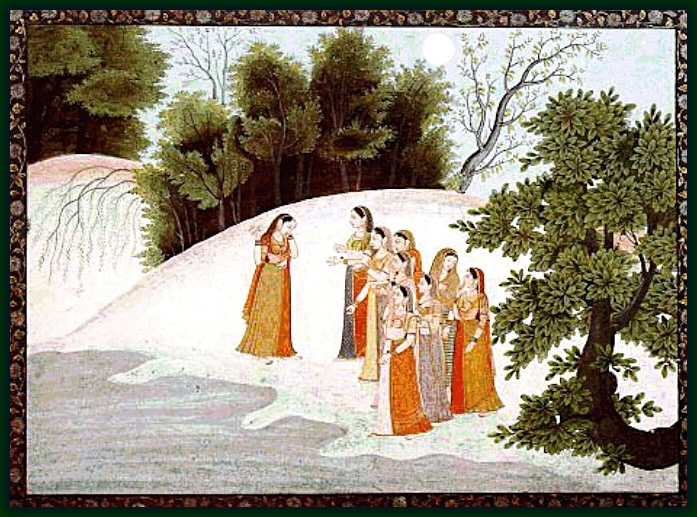
The first
two paintings on this page are classical Rajasthani pictures of
Radha and the Gopis in separation.
Source: Sri
Nathji
galleries.
Production: Filognostic
Association of The Order of Time.

Feed-back | Links | Downloads | Music | Pictures | What's New | Search | Donations



 Text 1-2