

Canto 10
Canto 10
Chapter 29: The Râsa Play: Krishna Meets and Escapes the Gopîs at Night
(1) The son of Vyâsa said: 'Even though Krishna was the Supreme Lord, He, resorting to His inner potency [see yoga-mâyâ], decided to enjoy those nights in autumn when He saw the jasmine flowers blossoming. (2) The king of the stars [the moon] at the time painted with his action the face of the east red, thus giving comfort to all who longed for him, just like a lover approaching his beloved ends her grief when he after a long time shows up again. (3) Krishna saw how the kumuda lotuses opened to the full disc of the moon, that glowed as red as the fresh kunkuma on the face of the goddess of fortune. He saw how the forest was reddened by the gentle rays of that light, and sweetly played His flute that enchanted the minds of the [gopîs with their] beautiful eyes. (4) That song being heard by the women of Vraja awakened Cupid in their hearts, so that each of them, unknown to the others, with her mind seized by Krishna and with earrings swinging in the haste, went to the place where He, her boyfriend, was situated. (5) Some left behind the cows while they were milking them, some abandoned in their eagerness the milk they had on the stove, while others went away without taking the cake out of the oven. (6-7) Some put aside the children they were feeding milk, and dressed up without thinking of the service they would render to their husbands. Some left during their meals, some while they were oiling themselves, were smearing their bodies or were making up their eyes. Others went to Krishna with their clothes and ornaments in disarray. (8) They were checked by their husbands, fathers, brothers and other relatives but, enchanted by Govinda they, with their hearts stolen, did not turn around [to their duties]. (9) Some gopîs who could not get away, stayed at home and closed their eyes to meditate on being [transcendentally] connected in love with Him [see footnote* and 10.1: 62-63]. (10-11) The intolerable, intense agony of being separated from their Beloved One, drove away all bad-mindedness. At the same time their material virtue was also reduced to zero because of the joy they obtained from meditating on Acyuta's embrace. Despite the fact that He was the Supreme Soul, they thought of Him as their paramour. Getting His direct association though their karmic bonds were counteracted so that they immediately gave up their physical interest ruled by the natural modes.'
(12) S'rî Parîkchit said: 'They only knew Krishna as their beloved one, and not as the Absolute Truth, oh sage. How could there, for them being so mindful of the material affair, be an end to the mighty current of the gunas?'
(13) S'rî S'uka said: 'I spoke to you about this before [in 3.2: 19 and in 7.1: 16-33]. When the king of Cedi [S'is'upâla] could attain perfection even by hating the Lord of the Senses, what then would that mean for those dear to the Lord in the Beyond? (14) The personal appearance of the Supreme, Imperishable and Inscrutable Lord who, free from the modes, is the controller of the modes, is there to lead humanity to the perfection of life, oh King. (15) They who towards Him are constantly of lust, anger, fear, affection, unity or friendship will surely achieve absorption in Him. (16) You should not be surprised about this [fact] concerning the Unborn Supreme Personality, the master of all masters of yoga, Krishna, by whose grace this world finds liberation. (17) When the Supreme Lord saw the girls of Vraja coming to Him, He, the best of all speakers, used charming words that confused them. (18) The Supreme Lord said: 'All of you, be welcome, oh fortunate ladies. What can I do to please you? Please tell Me whether Vraja is all right and for what reason you came here. (19) This night is full of ugly fearsome creatures, so please return to Vraja, oh slender girls. You women should not hang around here. (20) Your mothers, fathers, sons, brothers and husbands undoubtedly are looking for you and cannot find you. Do not make your families afraid. (21-22) You have seen Râkâ [the goddess of the full moon day] resplendent with her moonlight. You have seen the forest full of flowers, which is even more pleasurable by the breeze, coming from the Yamunâ, that plays through the leaves of the trees. Go therefore, without delay, back to the cowherd village. You must serve your husbands, oh chaste ladies, the calves and the children are crying for you to give them milk. (23) Or else, if you have come with your hearts overtaken by your love for Me, that is indeed praiseworthy of you, for all living beings have affection for Me. (24) For women it indeed is the highest dharma to be diligently of service to her husband, to be simple and honest towards the relatives, and to take good care of her family. (25) Unless he fell down [from his belief or being unfaithful] a husband, even being bad-tempered, unfortunate, old, decrepit, sickly and poor, must not be rejected by women who want to go to heaven [see also 9.14: 37 and B.G. 1: 40]. (26) For a well-educated woman to go astray dishonorably in adultery, is in all cases a contemptible weakness that creates fear and harms the reputation. (27) By listening, being in My presence [with the deity and the devotees], by meditation and by narrating [proclaiming and publishing], one is of love for Me, not so much with physical proximity. Therefore, please return to your homes [see also 10.23: 33].'
(28) S'rî S'uka said: 'The gopîs thus hearing the not so pleasant words of Govinda, being dejected because they were disappointed in their strong desires, felt an anxiety that was hard to overcome. (29) Saddened letting their faces hang down and their bimba-red lips dry up, they sighed while scratching the ground with their feet. With their tears spoiling their make-up and washing away the kunkum on their breasts, they silently carried the burden of their great distress. (30) Their Beloved One, not so loving at all, had addressed them contrarily, while they for His sake had desisted from all their material desires. They wiped their tears and stopped their crying and then, with their voices choked up in the attachment, in agony said something back. (31) The beautiful gopîs said: 'You, oh Mighty One, oh Goodness, should not speak so harshly. Please reciprocate with our devotion at Your feet for which we have denounced everything else. Do not play so hard-to-get rejecting us. Be just like the Godhead, the Original Personality who reciprocates with those who desire liberation. (32) Oh dearest one, You as the Knower of the Dharma spoke to us about the duty of women, that would consist of faithfulness to her husband, children and relatives. So be it, but is it not so that You, oh Lord, the Godhead, the most appreciated one, who as the Soul for all embodied beings is the closest relative, are the real object of this instruction? (33) The experts are constantly of service to You, who always endear them as their very own Self. So, what do our husbands, children and relatives mean to us who give us trouble? Have mercy with us, oh Supreme Controller, do not take away the by us for so long entertained hopes for You, oh Lotus-eyed One! (34) You easily stole our minds that were absorbed in our households, as also our hands that were engaged in household duties. Our feet will not move one step away from Your feet. How can we go back to Vraja, what should we do instead? (35) Please, oh Dearest One, pour the flood of the nectar of Your smiling glances and melodious songs, which [by the flute] escape from Your lips, over the fire in our hearts. Otherwise we will place our bodies in the fire that burns of separation, and by meditation on Your feet attain Your abode, oh Friend. (36) Oh You with Your lotus eyes, for the goddess of fortune it is a festival whenever she resides at the base of Your feet, the feet that now are held dear by [us] the people dwelling in the forest. Touching them we, being filled by Your joy, from that moment on will never be able to stand in the direct presence of any other man! (37) The goddess of fortune, who together with Tulasî-devî has achieved a position on Your chest, is served by servants, and the other gods try to acquire her look of approval. But the same way as even she desires the dust of Your lotus feet, we also have sought the shelter of the dust of Your feet. (38) Therefore be of mercy with us, oh Vanquisher of all Distress. Renouncing our homes we have approached Your feet in the hope to worship You. Please allow us to serve You, oh gem of all people, oh You with Your beautiful smiles and glances for which our hearts have burned with an intense desire. (39) Seeing Your face encircled by Your hair, the beauty of Your earrings at Your cheeks, the nectar of Your smiling lips, the glances that make one fearless, Your two mighty arms, and with seeing Your chest, the only source of pleasure for the goddess, we are delivered as Your servants. (40) Which woman within the three worlds, oh dearest, would, completely being bewildered by the drawn-out melody lines of the song of Your flute, not deviate in her civil conduct, after seeing this grace of the three worlds, this beautiful form because of which [even] the cows, the birds, the trees and the deer manifested a shiver of joy? (41) You clearly have taken birth as the Godhead, the remover of the fear and distress of the people of Vraja, as no one else but the Original Personality who protects all the gods and worlds. Therefore, oh Friend of the Distressed, kindly place Your lotuslike hand on the burning breasts and heads of Your maidservants.'
(42) S'rî S'uka said: 'Having heard the gopîs' despondent words, the Lord of all the Lords of Yoga full of mercy smiled, He who had been satisfied despite His ever being satisfied within. (43) Being together with all of them He - like the spotted deer - was as splendid as the blemished moon surrounded by the stars. As the Infallible Lord who is so magnanimous in His glances and proofs of affection, He made their faces blossom with His broad smiles that beamed His jasmine-like teeth. (44) Being sung and singing Himself as the commander of hundreds of women moving among them, He wore the five-colored [Vaijayantî] garland with which He increased the beauty of the forest. (45-46) Together with the gopîs He arrived at the riverbank that, served by the waves, was cool with its [wet] sand and was pleasant with the fragrance of the lotuses that was carried by the wind. Together with the Vraja beauties awakening Cupid, He took pleasure in throwing His arms around them in embraces. That way touching their hair, belts, thighs and breasts with His hands, He, challenging striking them with His fingernails, glanced at them and played and laughed with them. (47) This way receiving from Krishna, the Supreme Personality of Godhead, the special attention of the Greater Soul, they, getting proud, considered themselves the best of all women on earth. (48) Observing that they, due to their fortune, were caught in an intoxicated state of self-conceit, Lord Kes'ava, as a form of grace, disappeared from the spot in order to abate it.'

Third revised edition, loaded October 27, 2020.
Previous Aadhar edition and Vedabase links:
The son of Vyâsa said: 'Even though Krishna was the Supreme Lord, He, resorting to His inner potency [see yoga-mâyâ], decided to enjoy those nights in autumn when He saw the jasmine flowers blossoming.The son of Vyâsa said: 'Even though He was the Supreme Lord, decided He, resorting to His inner potency [see yoga-mâyâ], to enjoy those nights in autumn when the jasmine flowers are blossoming. (Vedabase)
The king of the stars [the moon] at the time painted with his action the face of the east red, thus giving comfort to all who longed for him, just like a lover approaching his beloved ends her grief when he after a long time shows up again.
At the time painted the king of the stars [the moon] with his hands the face of the east red thus giving comfort to all who longed for him, just like a lover approaching his beloved ends the grief when he after a long time is seen again. (Vedabase)
Krishna saw how the kumuda lotuses opened to the full disc of the moon, that glowed as red as the fresh kunkuma on the face of the goddess of fortune. He saw how the forest was reddened by the gentle rays of that light, and sweetly played His flute that enchanted the minds of the [gopîs with their] beautiful eyes.
Seeing how the kumuda lotuses opened to his full round face that, alike the face with fresh kunkuma of the goddess of fortune, with its light reddened the forest, played He, colored by the gentle rays of that light, His flute sweetly enchanting the eyes of charm [of the gopîs]. (Vedabase)
That song being heard by the women of Vraja awakened Cupid in their hearts, so that each of them, unknown to the others, with her mind seized by Krishna and with earrings swinging in the haste, went to the place where He, her boyfriend, was situated.
Hearing that song aroused Cupid with the women of Vraja and with their minds seized by Krishna went each of them unknown to the others, with earrings swinging in the haste, to where He, their boyfriend, was. (Vedabase)
Some left behind the cows while they were milking them, some abandoned in their eagerness the milk they had on the stove, while others went away without taking the cake out of the oven.
Some left in the middle of milking the cows, some abandoned in their eagerness the milk they had on the stove while others went without taking the cake out of the oven. (Vedabase)
Some put aside the children they were feeding milk, and dressed up without thinking of the service they would render to their husbands. Some left during their meals, some while they were oiling themselves, were smearing their bodies or were making up their eyes. Others went to Krishna with their clothes and ornaments in disarray.
Some put aside the children they were feeding milk and dressed up forgetting the service to their husbands, some left in the middle of having their dinner, some oiled, painted themselves and made up their eyes while others went to Krishna with their clothes and ornaments in disarray. (Vedabase)
They were checked by their husbands, fathers, brothers and other relatives but, enchanted by Govinda they, with their hearts stolen, did not turn around [to their duties].
They, checked by their husbands, fathers, brothers and other relatives did, enchanted by Govinda with their hearts stolen, not turn back [to their duties]. (Vedabase)
Some gopîs who could not get away, stayed at home and closed their eyes to meditate on being [transcendentally] connected in love with Him [see footnote* and 10.1: 62-63].
Some gopîs who didn't manage to get away, staying home closed their eyes and meditated connected in that love [see footnote* and 10.1: 62 & 63]. (Vedabase)
The intolerable, intense agony of being separated from their Beloved One, drove away all bad-mindedness. At the same time their material virtue was also reduced to zero because of the joy they obtained from meditating on Acyuta's embrace. Despite the fact that He was the Supreme Soul, they thought of Him as their paramour. Getting His direct association though their karmic bonds were counteracted so that they immediately gave up their physical interest ruled by the natural modes.'
The intolerable, intense agony of being separated from their Beloved removed all the bad minding while the good of them was reduced to zero because of the joy obtained in meditating the embrace of the Infallible One. Even though He was the Supreme Soul thought they Him to be their paramour, but nevertheless getting His direct association gave they, with their bonds cut, immediately up their existence the way it is determined by the material qualities.' (Vedabase)
S'rî Parîkchit said: 'They only knew Krishna as their beloved one, and not as the Absolute Truth, oh sage. How could there, for them being so mindful of the material affair, be an end to the mighty current of the gunas?'
S'rî Parîkchit said: 'They knew Krishna only as their beloved but not as the Absolute Truth, o sage, how could there for them being so mindful of the material affair be the ending of the mighty current of the gunas?' (Vedabase)
S'rî S'uka said: 'I spoke to you about this before [in 3.2: 19 and in 7.1: 16-33]. When the king of Cedi [S'is'upâla] could attain perfection even by hating the Lord of the Senses, what then would that mean for those dear to the Lord in the Beyond?
S'rî S'uka said: 'About this I spoke to you before [in 3.2: 19 and in 7.1: 16-33]: when the king of Cedi [S'is'upâla] could attain perfection even hating the Lord of the Senses, what then would it be for those who are dear to Him, the Lord in the Beyond? (Vedabase)
The personal appearance of the Supreme, Imperishable and Inscrutable Lord who, free from the modes, is the controller of the modes, is there to lead humanity to the perfection of life, oh King.
For the purpose of humanity its highest benefit, o King, is there the personal appearance of the Supreme, Imperishable, Inscrutable Lord who, being free from the modes, is the Controller of the Modes. (Vedabase)
They who towards Him are constantly of lust, anger, fear, affection, unity or friendship will surely achieve absorption in Him.
They who constantly exhibit lust, anger, fear, affection, unity and goodwill with the Lord are sure to achieve absorption in Him. (Vedabase)
You should not be surprised about this [fact] concerning the Unborn Supreme Personality, the master of all masters of yoga, Krishna, by whose grace this world finds liberation.
You shouldn't be astonished by this in regard to the Supreme Personality Unborn for He is the master of all masters of yoga by whom this world finds liberation. (Vedabase)
When the Supreme Lord saw the girls of Vraja coming to Him, He, the best of all speakers, used charming words that confused them.
When the Supreme Lord saw the girls of Vraja arriving near Him spoke He, the best of all speakers, with a wealth of words that bewildered them. (Vedabase)
The Supreme Lord said: 'All of you, be welcome, oh fortunate ladies. What can I do to please you? Please tell Me whether Vraja is all right and for what reason you came here.
The Supreme Lord said: 'Be welcome all of you, o fortunate ladies, what can I do to please you? Please tell Me whether Vraja is all right and for what reason you came here. (Vedabase)
This night is full of ugly fearsome creatures, so please return to Vraja, oh slender girls. You women should not hang around here.
This night is full of creatures fearsome in appearance, so please return to Vraja o slender girls, you women shouldn't hang around here. (Vedabase)
Your mothers, fathers, sons, brothers and husbands undoubtedly are looking for you and cannot find you. Do not make your families afraid.
Undoubtedly it is so that your mothers, fathers, sons, brothers and husbands looking for you can't find you; don't give rise to anxity with your kin. (Vedabase)
You have seen Râkâ [the goddess of the full moon day] resplendent with her moonlight. You have seen the forest full of flowers, which is even more pleasurable by the breeze, coming from the Yamunâ, that plays through the leaves of the trees. Go therefore, without delay, back to the cowherd village. You must serve your husbands, oh chaste ladies, the calves and the children are crying for you to give them milk.
You've seen Râka (the goddess of the day of the full moon) resplendent by her moonlight, you've seen the forest full of flowers even more pleasurable by the breeze blowing from the Yamunâ that plays through the leaves of the trees. Go now, without delay, back to the cowherd village, you must serve your husbands, o chaste ones, the calves and the children are crying for you to give them milk. (Vedabase)
Or else, if you have come with your hearts overtaken by your love for Me, that is indeed praiseworthy of you, for all living beings have affection for Me.
Or else, if you have come with your hearts overtaken by your love for Me, is that indeed laudable of you since all living beings have affection for Me. (Vedabase)
For women it indeed is the highest dharma to be diligently of service to her husband, to be simple and honest towards the relatives, and to take good care of her family.
For women it indeed is the highest dharma to be diligently of service to her husband, to be simple and honest towards the relatives and to take good care of her family. (Vedabase)
Unless he fell down [from his belief or being unfaithful] a husband, even being bad-tempered, unfortunate, old, decrepit, sickly and poor, must not be rejected by women who want to go to heaven [see also 9.14: 37 and B.G. 1: 40]
Provided he didn't fall [from his belief or being unfaithful] should a husband bad-hearted, unfortunate, old, retarded, sickly and poor even by women who desire heaven not be rejected [see also 9.14: 37 and B.G. 1: 40]. (Vedabase)
For a well-educated woman to go astray dishonorably in adultery, is in all cases a contemptible weakness that creates fear and harms the reputation.
To be astray weak in adultery is for a woman of class in all cases something contemptible: it harms the reputation, creates fear, and gives trouble. (Vedabase)
By listening, being in My presence [with the deity and the devotees], by meditation and by narrating [proclaiming and publishing], one is of love for Me, not so much with physical proximity. Therefore, please return to your homes [see also 10.23: 33].'
By listening, being in the presence [of the deity and the devotees], by meditation and by subsequent chanting is one of love for Me; not so much with being physically close to Me; therefore please return to your homes [see also 10.23: 33].' (Vedabase)
S'rî S'uka said: 'The gopîs thus hearing the not so pleasant words of Govinda, being dejected because they were disappointed in their strong desires, felt an anxiety that was hard to overcome.
S'rî S'uka said: 'The gopîs thus hearing the words of Govinda unpleasant to them felt, dejected of being disappointed in their strong desires, an anxiety hard to overcome. (Vedabase)
Saddened letting their faces hang down and their bimba-red lips dry up, they sighed while scratching the ground with their feet. With their tears spoiling their make-up and washing away the kunkum on their breasts, they silently carried the burden of their great distress.
Letting their faces hang down in sorrow and their bimba-red lips dry up sighing, stood they scratching the ground and bore they, with their tears spoiling their make-up and washing away the kunkum on their breasts, silently the burden of their great distress. (Vedabase)
Their Beloved One, not so loving at all, had addressed them contrarily, while they for His sake had desisted from all their material desires. They wiped their tears and stopped their crying and then, with their voices choked up in the attachment, in agony said something back.
With their Beloved not so loving at all addressing them to the contrary, while they for His sake had desisted from all their material desires, wiped they their tears arresting their crying and said they next with their voices choked up in the attachment in agony something back to Him. (Vedabase)
The beautiful gopîs said: 'You, oh Mighty One, oh Goodness, should not speak so harshly. Please reciprocate with our devotion at Your feet for which we have denounced everything else. Do not play so hard-to-get rejecting us. Be just like the Godhead, the Original Personality who reciprocates with those who desire liberation.
The beautiful gopîs said: 'Your good self, o Mighty One, shouldn't speak so harshly renouncing all sorts of sensual pleasure; please reciprocate with our devotion at Your feet, do not play so hard-to-get rejecting us, be just like the Godhead, the Original Personality who reciprocates with those who desire liberation. (Vedabase)
Oh dearest one, You as the Knower of the Dharma spoke to us about the duty of women, that would consist of faithfulness to her husband, children and relatives. So be it, but is it not so that You, oh Lord, the Godhead, the most appreciated one, who as the Soul for all embodied beings is the closest relative, are the real object of this instruction?
O dearest, You as the Knower of the Dharma thus spoke of the duty of women which would be her loyalty to husband, children and relatives, so be it, but isn't it so that You, o Lord, are the real object of this instruction; You, the Godhead most dear who for all embodied beings are the closest relative in being the soul? (Vedabase)
The experts are constantly of service to You, who always endear them as their very own Self. So, what do our husbands, children and relatives mean to us who give us trouble? Have mercy with us, oh Supreme Controller, do not take away the by us for so long entertained hopes for You, oh Lotus-eyed One!
The experts indeed give evidence of the attraction to You who eternally endears them as their very own Self, so what therefore of our husbands, children and relatives who give us trouble? Have mercy with us, o Supreme Controller, do not cut the hopes for You down that we entertained for so long, o Lotus-eyed One. (Vedabase)
You easily stole our minds that were absorbed in our households, as also our hands that were engaged in household duties. Our feet will not move one step away from Your feet. How can we go back to Vraja, what should we do instead?
With ease You stole our minds, which were absorbed in our households, as well as our hands that were busy in household duties; our feet will not move one step away from Your feet - how can we go back to Vraja, what then should we do instead? (Vedabase)
Please, oh Dearest One, pour the flood of the nectar of Your smiling glances and melodious songs, which [by the flute] escape from Your lips, over the fire in our hearts. Otherwise we will place our bodies in the fire that burns of separation, and by meditation on Your feet attain Your abode, oh Friend.
Please, o Dearest, pour the flood of the nectar of Your smiling glances and melodious songs rising from Your lips, over the fire within our hearts; otherwise will we with meditation place our bodies in the fire that burns of separation and go for the abode of Your feet, o Friend. (Vedabase)
Oh You with Your lotus eyes, for the goddess of fortune it is a festival whenever she resides at the base of Your feet, the feet that now are held dear by [us] the people dwelling in the forest. Touching them we, being filled by Your joy, from that moment on will never be able to stand in the direct presence of any other man!
O You with Your lotus-like eyes, for the goddess of fortune is it a festival to be at the base of Your feet that, at times held dear by the people dwelling in the forest, we now will touch and from that moment on will we, filled by Your joy, for sure never be able to stand in the direct presence of any other man! (Vedabase)
The goddess of fortune, who together with Tulasî-devî has achieved a position on Your chest, is served by servants, and the other gods try to acquire her look of approval. But the same way as even she desires the dust of Your lotus feet, we also have sought the shelter of the dust of Your feet.
Like the goddess, who together even with Tulasî-devî desiring the dust of the lotus feet, has obtained her position at Your bosom and for whose glance upon them, as it is, the others of enlightenment do endeavor to serve as servants, do we likewise also seek the dust of Your feet. (Vedabase)
Therefore be of mercy with us, oh Vanquisher of all Distress. Renouncing our homes we have approached Your feet in the hope to worship You. Please allow us to serve You, oh gem of all people, oh You with Your beautiful smiles and glances for which our hearts have burned with an intense desire.
Therefore be of mercy with us, o Vanquisher of all Distress, Your feet we approached renouncing our homes in the hope to worship You, with Your beautiful smiles and glances for which our hearts have burned with an intense desire; o gem of all people, please allow us to serve. (Vedabase)
Seeing Your face encircled by Your hair, the beauty of Your earrings at Your cheeks, the nectar of Your smiling lips, the glances that make one fearless, Your two mighty arms, and with seeing Your chest, the only source of pleasure for the goddess, we are delivered as Your servants.
Seeing Your hair around Your face, Your earrings, the beauty of Your cheeks and the nectar of Your lips smiling, the glances that make one fearless, the two of Your mighty arms and looking at Your chest, the only source of pleasure for the goddess, we are delivered as Your servants. (Vedabase)
Which woman within the three worlds, oh dearest, would, completely being bewildered by the drawn-out melody lines of the song of Your flute, not deviate in her civil conduct, after seeing this grace of the three worlds, this beautiful form because of which [even] the cows, the birds, the trees and the deer manifested a shiver of joy?
What woman within the three worlds, o dearest, would not be completely bewildered by the melody lines of the songs You draw from Your flute and then not deviate in civil conduct upon seeing this grace of the three worlds, this beautiful form of which (even) the cows, the birds, the trees and the deer carry a thrill of joy. (Vedabase)
You clearly have taken birth as the Godhead, the remover of the fear and distress of the people of Vraja, as no one else but the Original Personality who protects all the gods and worlds. Therefore, oh Friend of the Distressed, kindly place Your lotuslike hand on the burning breasts and heads of Your maidservants.'
You, just as the Godhead, the Original Personality, protecting all gods and worlds, have taken birth as the Godhead, the evident remover of the fear and distress of the people of Vraja, therefore kindly place, o Friend of the Distressed, Your lotuslike hand on the burning breasts and heads of Your maidservants.' (Vedabase)
S'rî S'uka said: 'Having heard the gopîs' despondent words, the Lord of all the Lords of Yoga full of mercy smiled, He who had been satisfied despite His ever being satisfied within.
S'rî S'uka said: 'Having heard the gopîs' despondent words laughed full of mercy the Lord of all the Lords of Yoga who had been satisfied despite of His ever being satisfied within. (Vedabase)
Being together with all of them He - like the spotted deer - was as splendid as the blemished moon surrounded by the stars. As the Infallible Lord who is so magnanimous in His glances and proofs of affection, He made their faces blossom with His broad smiles that beamed His jasmine-like teeth.
With them all together was He as splendid as the deerlike spotted moon surrounded by the stars, and made He as the Infallible Lord so magnanimous in His glances and proofs of affection their faces blossom with His broad smiles that beamed His jasmine-like teeth. (Vedabase)
Being sung and singing Himself as the commander of hundreds of women moving among them, He wore the five-colored [Vaijayantî] garland with which He increased the beauty of the forest.
Being sung and singing Himself as the commander of hundreds of women wore He the five-colored [Vaijayantî] garland by which He beautified the forest in which He moved about. (Vedabase)
Together with the gopîs He arrived at the riverbank that, served by the waves, was cool with its [wet] sand and was pleasant with the fragrance of the lotuses that was carried by the wind. Together with the Vraja beauties awakening Cupid, He took pleasure in throwing His arms around them in embraces. That way touching their hair, belts, thighs and breasts with His hands, He, challenging striking them with His fingernails, glanced at them and played and laughed with them.
Together with the gopîs He arrived at the river bank that, served by the waves, was cool with its sand and was pleasant of the fragrance of the lotuses carried by the wind. With the Vraja beauties stirring up Cupid took He pleasure in throwing His arms around them in embraces and that way touching their hair, belts, thighs and breasts with His hands, playfully stroking them with His fingernails and glancing at them, chatted He with them and laughed He. (Vedabase)
This way receiving from Krishna, the Supreme Personality of Godhead, the special attention of the Greater Soul, they, getting proud, considered themselves the best of all women on earth.
This way receiving from Krishna, the Supreme Personality of Godhead, the special attention of the Greater Soul, considered they themselves, growing proud, the best of all women on earth indeed. (Vedabase)
Observing that they, due to their fortune, were caught in an intoxicated state of self-conceit, Lord Kes'ava, as a form of grace, disappeared from the spot in order to abate it.'
Observing that they due to their fortune were in an intoxicated state of false pride, disappeared, by way of His grace, Lord Kes'ava from the spot with the purpose of bringing that pride down.' (Vedabase)
*: The different types of gopîs suggested here are also mentioned in the Padma Purâna:
gopyas tu s'rutayo jñeyâ
rishi-jâ gopa-kanyakâh
deva-kanyâs' ca râjendra
na mânushyâh kathañcana'It is understood that some of the gopîs are personified Vedic literatures (s'ruti-cârî), while others are reborn sages (rishi-cârî), daughters of cowherds (gopa-kanyâs), or demigod maidens (deva-kanyâs). But by no means, my dear King, are any of them ordinary humans.' There is also mention of sâdhana-siddhas and nitya-siddhas: those perfect of spiritual discipline and those born that way.


The text and audio are offered under the conditions of
the
Creative
Commons Attribution-Noncommercial-Share Alike 3.0 Unported
License.
The first
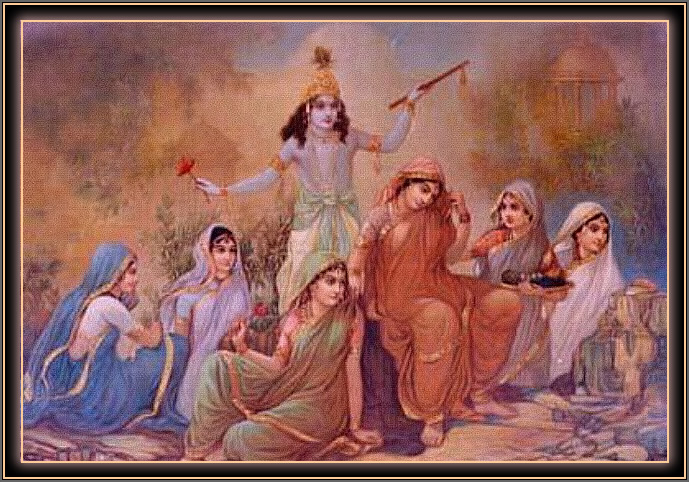
painting on this page is of Raja
Ravi
Varma.
Production: Filognostic
Association of The Order of Time.

Feed-back | Links | Downloads | Music | Pictures | What's New | Search | Donations




 Text 1