
Chapter 7: Krishna Kicks the Cart, Defeats Trinâvarta and Shows Yas'odâ the Universe
(1-2) The honorable king said: 'The different pastimes of the avatâras of the Supreme Lord that offer us the image of the Lord, our Controller, are most pleasing to our ears and inspiring to our minds, oh master. Whoever hears about them will find his existence very soon purified from the propensity for dissatisfaction and, as a person who is devoted to the Lord, also find friendship with His people [Vaishnavas]. If you like, please speak to us about everything pertaining to Him. (3) Tell us more about the wonderful pastimes of Krishna who, imitating the human way, in the form of a child assumed His position on this earth.' [*]
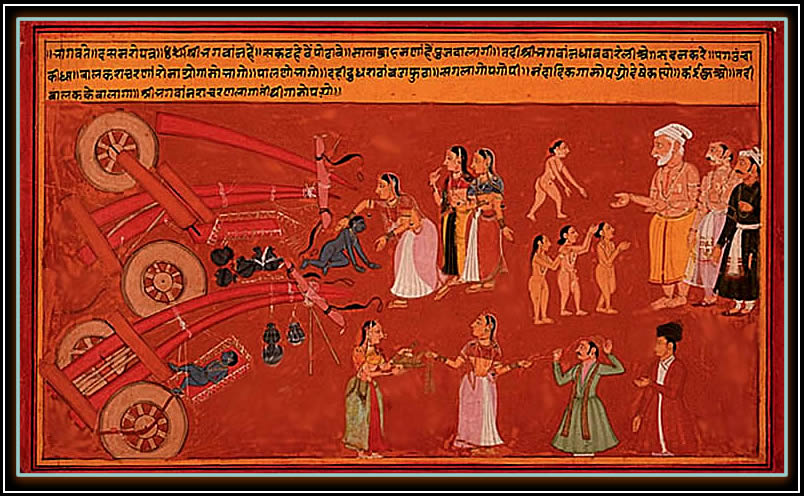
(4) S'rî S'uka said: 'One day, when the moon stood in the constellation of Rohinî [after three months], He could turn Himself on His back in His crib. To celebrate this the mothers organized a celebration with a washing ritual. They gathered with music and song, and while mother Yas'odâ performed the bathing ceremony, hymns were chanted by the brahmins. (5) After Nanda's wife and the other members of the household had finished the bathing, the brahmins, who performed their auspicious mantras, were respectfully honored with food, garments, garlands and cows. Seeing that the child had become sleepy, it was laid aside for the time being. (6) While busily engaged for the utthâna [or 'turning upward'] ceremony she, providing the guests from all over Vraja to their liking, did not hear any of the cries of her child that, wailing to be fed, angrily kicked around its legs. (7) The cart underneath He was put was hit by His delicate feet that were as tender as a new leaf. It turned over so that all the bowls, plates and the sweetness they contained fell to the ground, the wheels and axle got dislocated and the pole was broken [**]. (8) All the men and women of Vraja who, being invited by Yas'odâ and Nanda, had assembled for the utthâna ceremony, witnessed that wondrous event and wondered how the cart out of its own could have been damaged so badly. (9) The children told the dumbfounded gopas and gopîs that it suffered no doubt that, as soon as the child started to cry, it with one leg had dashed it apart. (10) They, unaware of the inconceivable power of that small baby, could not believe it. The gopas thought that all that they had heard was but child prattle. (11) Mother Yas'odâ, picked up her crying son and offered Him her breast. Thinking it had been an unfavorable planet, she called for the brahmins to perform a ceremony with Vedic hymns. (12) After a couple of strong gopas had reassembled the cart and had placed the pots and everything back on it, the priests with curds, rice, kus'a grass and water performed the rituals for the fire sacrifice. (13-15) The blessings of those who endowed with the perfect truth are free from discontent, untruth, false pride, envy, violence and self-conceit, never go in vain [see also B.G. 18: 42]. With this in mind Nanda took care of the child by asking those fine brahmins to sing auspicious hymns and purify it according to the Sâma, Rig and Yajur Veda with the help of water mixed with herbs. When the child had been bathed he, the leading cowherd, held a fire sacrifice and devoutly served the souls of rebirth a most excellent meal. (16) To assure his son of all of the best, he - to the blessing they also gave him - donated in charity the best quality milk cows that were nicely decorated with flowers and golden chains. (17) The scholars, being joined with whatever they pronounce, bring one, as experts in the mantras, all the blessings because the valid words they use never at any time will be fruitless.
(18) One day [with Him about a year old] when Yas'odâ fondled Him as He sat on her lap, she could no longer bear the child's weight because He became as heavy as a mountain peak. (19) Astonished about the pressing weight the gopî put the child on the floor. Next she turned to Nârâyana and engaged herself in her worldly duties. (20) The child sitting there was swept away [though] by a demon named Trinâvarta, a servant sent by Kamsa who had assumed the form of a whirlwind. (21) Producing a tremendous noise it massively roaring covered all of Gokula with dust that penetrated every nook and corner, so that everything was hidden from sight. (22) For an hour or so all of the cow land was plunged in darkness by the heavy dust. Yas'odâ could not find her son on the spot where she had put Him down. (23) The people could not see themselves or each other anymore because of the sands blown up and were disturbed and confused. (24) The woman, helpless because of the dust clouds of the strong whirlwind, saw nothing and thus she, in fear about her son, lamented pitifully and fell to the ground like a cow that has lost her calf. (25) When the fierce dust storm of the whirlwind had ceased and she could not find Nanda's son, the other gopîs, with their faces full of tears, all in sympathy wailed along with her crying. (26) After Trinâvarta had assumed the form of the whirlwind and thus had swept away Krishna, he, reaching the top of the atmosphere, could not get higher with Him getting heavier and mightier and so he lost his strength. (27) Taking Him, who strangled his neck, for an incredibly heavy rock that exceeded his power, he could not get rid of this wonderful child. (28) Grasped by the throat he was powerless. His eyes popped out while he choked and lifeless, together with the child, fell down to the ground in Vraja. (29) The gathered sobbing gopîs saw him, fallen out of the sky, lying on a slab of stone with all his limbs broken, like Tripura pierced by the arrows of S'iva [see 7.10]. (30) They were totally surprised to find Krishna in good health sitting on the chest of the man-eater who had transported Him through the sky. All the gopîs and gopas rejoiced most happily that He was saved from the mouth of death and that they had gotten Him back. (31) [They said:] 'How greatly wonderful this baby that, being seized by the ogre, left us but has returned unscathed! Now that this nasty and violent demon has been killed because of his sins, the innocent, even-minded people are relieved of their fears. (32) Of what austerity have we been, what was our worship for the One in the Beyond? What was the pious work, the public service, the charity, or any other benevolent activity for our fellow man that we performed, as a result of which the child, that was practically lost, is present here again to the fortune and pleasure of all His folk?' (33) Having witnessed all these different wonderful events in the great forest, the herdsman Nanda over and over stood amazed how true the words of Vasudeva had been [see also verse 10.6: 32].
(34) One day the mother pulled the little boy on her lap to nurse Him from her breast, from which because of her great love the milk was oozing. (35-36) Oh King, when He was done and mother Yas'odâ, patting softly to help Him, looked the satisfied and smiling child in the face, she had, when He yawned, the following vision: she saw the sky, the planets and the earth, the luminaries in all directions, the sun and the moon. She saw fire, the air and the seas with the continents, the mountains, their daughters the rivers, the forests and all creatures moving and not moving [see also B.G. 11]. (37) Thus all of a sudden seeing the entire universe, oh King, she in great amazement stifled with deer-like eyes and started to tremble all over.'

Third revised edition, loaded May 18, 2020.
Previous Aadhar edition and Vedabase links:
The honorable king said: 'The different pastimes of the avatâras of the Supreme Lord that offer us the image of the Lord, our Controller, are most pleasing to our ears and inspiring to our minds, oh master. Whoever hears about them will find his existence very soon purified from the propensity for dissatisfaction and, as a person who is devoted to the Lord, also find friendship with His people [Vaishnavas]. If you like, please speak to us about everything pertaining to Him.The honorable king said: 'The different pastimes of the avatâras of the Supreme Lord presenting us the image of the Lord, our Controller, are most pleasing to our ears and inspiring to our minds, o master. Whoever hears of them will in the ground of his being very soon find purification from the unsavory, ardent desires and as a person devotional with the Lord as well find friendship with the people who embrace Him as the one and only. If you like, please speak to us about all pertaining to Him. (Vedabase)
Tell us more about the wonderful pastimes of Krishna who, imitating the human way, in the form of a child assumed His position on this earth.' [*]
Tell us more about Krishna; the pastimes in which He here in our human society acted mimicking a human child are so wonderful!' [*] (Vedabase)
S'rî S'uka said: 'One day, when the moon stood in the constellation of Rohinî [after three months], He could turn Himself on His back in His crib. To celebrate this the mothers organized a celebration with a washing ritual. They gathered with music and song, and while mother Yas'odâ performed the bathing ceremony, hymns were chanted by the brahmins.
S'ri S'uka said: 'At the time the moon stood in the constellation of Rohinî [after three months] could He turn Himself upward in His crib and was a celebration with a washing ritual organized by the mothers who gathered with music, song and hymns that were chanted by the brahmins while mother Yas'odâ performed the bathing ceremony. (Vedabase)
After Nanda's wife and the other members of the household had finished the bathing, the brahmins, who performed their auspicious mantras, were respectfully honored with food, garments, garlands and cows. Seeing that the child had become sleepy, it was laid aside for the time being.
After Nanda's wife and the other members of the household were done were the brahmins who had done their duty presented with food, garments, garlands and cows and was the child, with drowsy eyes, for the time being laid down. (Vedabase)
While busily engaged for the utthâna [or 'turning upward'] ceremony she, providing the guests from all over Vraja to their liking, did not hear any of the cries of her child that, wailing to be fed, angrily kicked around its legs.
To the utthâna [or 'turning upward'] ceremony busy with providing the guests from all over Vraja to their liking, did she truly not hear any of the cries of her child which wailing to be fed angrily kicked around its legs. (Vedabase)
The cart underneath He was put was hit by His delicate feet that were as tender as a new leaf. It turned over so that all the bowls, plates and the sweetness they contained fell to the ground, the wheels and axle got dislocated and the pole was broken [*].
Struck by His delicate feet tender as a leaf turned the cart underneath He was put over so that all the bowls and plates and sweetness they contained fell to the ground, the wheels and axle got dislocated and the pole was broken [**]. (Vedabase)
All the men and women of Vraja who, being invited by Yas'odâ and Nanda, had assembled for the utthâna ceremony, witnessed that wondrous event and wondered how the cart out of its own could have been damaged so badly.
All the ladies and men of Vraja who with Yas'odâ and Nanda first had assembled for the utthâna ceremony, witnessing that wondrous event marveled on how the cart by itself indeed could have been damaged so badly. (Vedabase)
The children told the dumbfounded gopas and gopîs that it suffered no doubt that, as soon as the child started to cry, it with one leg had dashed it apart.
The children told the dumbfounded gopas and gopîs that it suffered no doubt that, as soon as the child cried, it with one leg had dashed it apart. (Vedabase)
They, unaware of the inconceivable power of that small baby, could not believe it. The gopas thought that all that they had heard was but child prattle.
Unaware of the inconceivable power of that small baby couldn't they believe it; the gopas thought it was all child prattle what they said. (Vedabase)
Mother Yas'odâ, picked up her crying son and offered Him her breast. Thinking it had been an unfavorable planet, she called for the brahmins to perform a ceremony with Vedic hymns.
Mother Yas'odâ, picking up her crying son, thinking it had been a bad planet, called for the learned to perform a ceremony with vedic hymns and gave the child her breast. (Vedabase)
After a couple of strong gopas had reassembled the cart and had placed the pots and everything back on it, the priests with curds, rice, kus'a grass and water performed the rituals for the fire sacrifice.
After some stout gopas had put the cart back together again and had placed the pots and everything back on it, performed the priests with curds, rice, kus'a grass and water the rituals for the fire sacrifice. (Vedabase)
The blessings of those who endowed with the perfect truth are free from discontent, untruth, false pride, envy, violence and self-conceit, never go in vain [see also B.G. 18: 42]. With this in mind Nanda took care of the child by asking those fine brahmins to sing auspicious hymns and purify it according to the Sâma, Rig and Yajur Veda with the help of water mixed with herbs. When the child had been bathed he, the leading cowherd, held a fire sacrifice and devoutly served the souls of rebirth a most excellent meal.
Of those endowed with the perfect truth who are free from discontent, untruth, false pride, envy, violence and self-conceit do the blessings never go in vain [see also B.G. 18: 42]. With this in mind taking care of the child according the Sâma, Rig and Yajur Veda and purifying it with the help of water mixed with herbs, asked Nanda, the leading cowherd so liberal and good, after the child was bathed, those finest twice-born for auspicious hymns to be sung and were those souls of rebirth after the oblations by him served with a most excellent meal. (Vedabase)
To assure his son of all of the best, he - to the blessing they also gave him - donated in charity the best quality milk cows that were nicely decorated with flowers and golden chains.
To assure his son all the best gave he them - to the welcome they prepared him also - the best quality of milk cows nicely decorated with flowers, and golden chains. (Vedabase)
The scholars, being joined with whatever they pronounce, bring one, as experts in the mantras, all the blessings because the valid words they use never at any time will be fruitless.
The sages joined in whatever they pronounce bring one, as experts in the mantras, all the blessings because the valid words they use for sure never at any time will be fruitless. (Vedabase)
One day [with Him about a year old] when Yas'odâ fondled Him as He sat on her lap, she could no longer bear the child's weight because He became as heavy as a mountain peak.
One day [with Him about a year old] when Yas'odâ with Him sitting on her lap was fondling Him, could she, because He became as heavy as a mountain peak, no longer bear the child's weight. (Vedabase)
Astonished about the pressing weight the gopî put the child on the floor. Next she turned to Nârâyana and engaged herself in her worldly duties.
With Him to her astonishment being as heavy as the universe [see garimâ] placed the gopî Him reluctantly on the ground, turned she to Nârâyana and engaged she in household duties. (Vedabase)
The child sitting there was swept away [though] by a demon named Trinâvarta, a servant sent by Kamsa who had assumed the form of a whirlwind.
As the child sat there was it swept away by a Daitya in the form of a whirlwind named Trinâvarta, who was a hireling sent by Kamsa. (Vedabase)
Producing a tremendous noise it massively roaring covered all of Gokula with dust that penetrated every nook and corner, so that everything was hidden from sight.
Vibrating with a heavy sound covered he massively roaring all of Gokula with dust penetrating every nook and corner and was everything hidden from sight. (Vedabase)
For an hour or so all of the cow land was plunged in darkness by the heavy dust. Yas'odâ could not find her son on the spot where she had put Him down.
For an hour or so was all of the cowland by the heavy dust plunged in darkness and could Yas'odâ not spot her son where she had put Him on the ground. (Vedabase)
The people could not see themselves or each other anymore because of the sands blown up and were disturbed and confused.
Not seeing themselves or each other anymore were the people by the sands thrown up disturbed and confused. (Vedabase)
The woman, helpless because of the dust clouds of the strong whirlwind, saw nothing and thus she, in fear about her son, lamented pitifully and fell to the ground like a cow that has lost her calf.
The helpless woman thus by the clouds of dust of the strong whirlwind seeing nothing, worrying about her son lamented pitifully and fell to the ground like a cow having lost her calf. (Vedabase)
When the fierce dust storm of the whirlwind had ceased and she could not find Nanda's son, the other gopîs, with their faces full of tears, all in sympathy wailed along with her crying.
Hearing her crying the other gopis all with their faces full of tears wailed along crying in sympathy on not finding Nanda's son when the fierce duststorm of the whirlwind had ceased. (Vedabase)
After Trinâvarta had assumed the form of the whirlwind and thus had swept away Krishna, he, reaching the top of the atmosphere, could not get higher with Him getting heavier and mightier and so he lost his strength.
The force of Trinâvarta having assumed the form of the whirlwind wore off when, having swept away Krishna, reaching the top of the sky he couldn't get higher with Him getting heavier and mightier (Vedabase)
Taking Him, who strangled his neck, for an incredibly heavy rock that exceeded his power, he could not get rid of this wonderful child.
Finding Him, heavy as a stone, overruling his fury had he with Krishna who strangled his neck to give it up incapacitated as he was in front of the wondrous babe. (Vedabase)
Grasped by the throat he was powerless. His eyes popped out while he choked and lifeless, together with the child, fell down to the ground in Vraja.
With Him grasping him by the throat popped out the eyes of the demon as he choked and lifeless together with the child fell to the ground. (Vedabase)
The gathered sobbing gopîs saw him, fallen out of the sky, lying on a slab of stone with all his limbs broken, like Tripura pierced by the arrows of S'iva [see 7.10].
The gathered sobbing gopîs saw that terror with all his limbs broken, fallen from the sky down upon a slab of rock, like Tripura felled by the arrows of S'iva [see 7.10]. (Vedabase)
They were totally surprised to find Krishna in good health sitting on the chest of the man-eater who had transported Him through the sky. All the gopîs and gopas rejoiced most happily that He was saved from the mouth of death and that they had gotten Him back.
Totally surprised to find Krishna in good health sitting on the chest of the man-eater who had transported Him into the sky, picked they Him who was saved from the mouth of death up and delivered they, as Nanda's gopîs and gopas overjoyed rejoicing in bliss over the retrieval, Him to His mother. (Vedabase)
[They said:] 'How greatly wonderful this baby that, being seized by the ogre, left us but has returned unscathed! Now that this nasty and violent demon has been killed because of his sins, the innocent, even-minded people are relieved of their fears.
[They said:] 'How greatly wonderful indeed this baby that, taken away by the ogre, left us but now has returned unscathed; now that that nasty demon by his own sins has been killed in contest may any devout soul find relief in sameness and fearlessness. (Vedabase)
Of what austerity have we been, what was our worship for the One in the Beyond? What was the pious work, the public service, the charity, or any other benevolent activity for our fellow man that we performed, as a result of which the child, that was practically lost, is present here again to the fortune and pleasure of all His folk?'
Of what prolonged austerity have we been, what was our worship for the One in the Beyond, and what was the public service [pûrta], service in piety [ishta], charity [datta] or other love for our fellow man as a result of which the child that was practically lost, again to our piety is present here to the fortune and pleasure of all His folk?' (Vedabase)
Having witnessed all these different wonderful events in the great forest, the herdsman Nanda over and over stood amazed how true the words of Vasudeva had been [see also verse 10.6: 32].
Having witnessed the different amazing events in the great forest repeated the herdsman Nanda over and over in astonishment how true the words of Vasudeva had been [see also verse 10.6: 32]. (Vedabase)
One day the mother pulled the little boy on her lap to nurse Him from her breast, from which because of her great love the milk was oozing.
One day the mother hoisted the little one up on her lap to feed Him from her breast, from which of her great affection oozed the milk. (Vedabase)
Oh King, when He was done and mother Yas'odâ, patting softly to help Him, looked the satisfied and smiling child in the face, she had, when He yawned, the following vision: she saw the sky, the planets and the earth, the luminaries in all directions, the sun and the moon. She saw fire, the air and the seas with the continents, the mountains, their daughters the rivers, the forests and all creatures moving and not moving [see also B.G. 11].
O King, when it was almost done and mother Yas'odâ looked the satisfied and smiling child in the face as she patted it softly, saw she when it yawned the following: the sky, the planets and the earth, the luminaries in all directions, the sun and the moon, fire, the air and the seas with the continents, the mountains, their daughters the rivers, the forests and all creatures moving and nonmoving [see also B.G. 11]. (Vedabase)
Thus all of a sudden seeing the entire universe, oh King, she in great amazement stifled with deer-like eyes and started to tremble all over.'
When she all of a sudden saw the entire universe, o King, started she in great amazement, stifled with deer-like eyes, to tremble all over.' (Vedabase)
*: At the beginning of this chapter, two extra verses sometimes appear:
evam bahûni karmâni
gopânâm s'am sa-yoshitâm
nandasya gehe vavridhe
kurvan vishnu-janârdanah"In this way, to chastise and kill the demons, the child Krishna demonstrated many activities in the house of Nanda Mahârâja, and the inhabitants of Vraja enjoyed these incidents."
evam sa vavridhe vishnur
nanda-gehe janârdanah
kurvann anis'am ânandam
gopâlânâm sa-yoshitâm"To increase the transcendental pleasure of the gopas and the gopîs, Krishna, the killer of all demons, was thus raised by His father and mother, Nanda and Yas'odâ."
S'rîpâda Vijayadhvaja Tîrtha also adds another verse after the third verse in this chapter:
vistareneha kârunyât
sarva-pâpa-pranâs'anam
vaktum arhasi dharma-jña
dayâlus tvam iti prabho"Parîkchit Mahârâja then requested S'ukadeva Gosvâmî to continue speaking such narrations about the pastimes of Krishna, so that the King could enjoy from them transcendental bliss."
**: Svâmî Prabhupâda comments: 'Krishna had been placed underneath a household handcart, but this handcart was actually another form of the S'akathâsura, a demon who had come there to kill the child. Now, on the plea of demanding to suck His mother's breast, Krishna took this opportunity to kill the demon. Thus He kicked S'akathâsura just to expose him. Although Krishna's mother was engaged in receiving guests, Lord Krishna wanted to draw her attention by killing the S'akathâsura, and therefore He kicked that cart-shaped demon.'

The
text and audio are offered under the conditions of the
Creative
Commons Attribution-Noncommercial-Share Alike
3.0
Unported License.
The first picture
is titled: 'Krishna Breaks the Cart', Folio from a
Bhagavata Purana (Ancient Stories of the Lord),
India, Rajasthan, Mewar, Udaipur, South Asiacirca 1725.
Courtesy LACMA
The second picture is titled: 'Krishna Kills The Tornado Demon
Trinavarta'.
Folio from a Bhagavata Purana (Ancient Stories of the Lord), India,
Gujarat, c. 1625-1650.
Courtesy: LACMA.
Production: Filognostic
Association
of The
Order of Time.

Feed-back | Links | Downloads | Music | Pictures | What's New | Search | Donations




 Text
1-2
Text
1-2