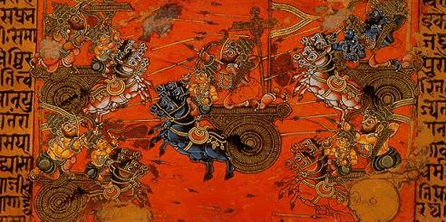
Filognostic* understanding of the Bhagavad Gîtâ of
Order
Text 1
Arjuna said:
'The words that You spoke in Your favoring me concerning the
confidential subject of the spiritual supreme - through them my
illusion is removed.
FILOGNOSTIC
TRANSLATION
Arjuna said: 'By the words of
what you said with the purpose of favoring me concerning the
confidentiality of the spiritual supreme, my illusion has been removed.
(Sanskrit & tradition)
Text 2
I heard from
You in detail about the appearance and disappearance of all living
entities, oh lotus eyed one, and also about Your inexhaustible glories.
FILOGNOSTIC
TRANSLATION
I heard from you in detail about
the appearance and disappearance of the living beings, oh lotus-eyed
one, and you also spoke about your inexhaustible glories. (Sanskrit & tradition)
Text 3
Even when You
have spoken about this of Yours as it is, oh Supreme Lord, I wish to
see
Your divine form, oh Highest Personality.
FILOGNOSTIC
TRANSLATION
After all your words concerning
yourself, oh best of all persons, I cherish the wish to see your divine
form the way it is, oh controller in the beyond. (Sanskrit & tradition)
Text 4
If You think
that it as such can be seen by me oh master, Lord of Yoga, then You
show
me Your universal Self.'
FILOGNOSTIC
TRANSLATION
So if you deem it possible for me
to have that vision, oh master and controller of the unification
within,
then show me your imperishable self!' (Sanskrit & tradition)
Text 5
The Supreme
Lord said: 'Oh son of Prithâ, behold the hundreds and thousands
of
the variegated divine of My diverse forms and colors.
FILOGNOSTIC
TRANSLATION
The fortunate one said: 'Behold,
oh son of Prithâ, the hundreds and thousands of my different,
divine forms in all shapes and colors. (Sanskrit & tradition)
Text 6
Just see the
[twelve] Âdityas, [eight] Vasus, [eleven] Rudras, [two] As'vins [
demigods for the longevity], [fourty-nine] Maruts as also the many of
all the wonders you did not see before, oh best of the Bhâratas.
FILOGNOSTIC
TRANSLATION
See the personalities of wisdom,
the personalities of wealth, the destroyers in the service of God, the
healthcare agents, the gods and much more of the wonders you've never
seen before, oh best one of the Kuru dynasty. (Sanskrit & tradition)
Text 7
See here and
now the universe completely, all at the same time, with all that moves
and not moves, in this body of Mine, oh conqueror of sleep, and also
whatever else you wish to see.
FILOGNOSTIC
TRANSLATION
See here and now the completeness
of the universe, with all that moves and not moves, rolled into one,
within this one body of mine, oh conqueror of sleep, as also whatever
more you wish to see. (Sanskrit
&
tradition)
Text 8
But certainly
you will never be able to see Me with your normal eyes; divine eyes I
give you to perceive My Divine Union.'
FILOGNOSTIC
TRANSLATION
But of course you will not be
able to see me as such with your own eyes, so I'll grant you the divine
vision. Now witness the supreme union of my control!' " (Sanskrit & tradition)
Text 9
Sañjaya
said: "Oh King, after having spoken thus, the Great Lord of Yoga, the
Supreme Personality, showed Arjuna the beyond of the Universal Form.
FILOGNOSTIC
TRANSLATION
Sañjaya said: "Oh King,
having spoken thus, the great lord in the unification of consciousness showed Prithâ's
son
the
beyond
of
his
form of control. (Sanskrit
&
tradition)
Text 10-11
Many mouths,
eyes and many diverse wonderful sights, many divine ornaments, and a
variety of uplifted weapons, heavenly garlands, the wear of dresses
with divine fragrances and ointments, were all wonderful and shining,
extending to all sides.
FILOGNOSTIC
TRANSLATION
Many mouths, eyes and many
diverse wonderful sights, many divine ornaments, and a variety of
weapons ready for battle; heavenly flowers worn, all kinds of dresses
and suits, and even divine, fragrant ointments, all wonderful and
splendrous, could be seen extending to all sides. (Sanskrit & tradition)
Text 12
If there were
the light of the simultaneous presence of many thousands of suns in the
sky, such might resemble the effulgence of Him, the Greatness of the
Soul.
FILOGNOSTIC
TRANSLATION
The effulgence that he, the
greatness of the soul, had, resembled the light of thousands of suns,
all at the same time present in the sky. (Sanskrit & tradition)
Text 13
There Arjuna
then could, in the universal form of the God of Gods, see in one the
complete universe divided in many.
FILOGNOSTIC
TRANSLATION
Right there Arjuna could see, in
the one universal form of the God of gods, all the diversity of the
complete universe in one. (Sanskrit
&
tradition)
Text 14
Thereafter,
being overwhelmed with wonder and his hair standing on end, the
conqueror of wealth offered the God with folded hands his obeisances,
bowing his head and began to speak.
FILOGNOSTIC
TRANSLATION
Thereupon, with his hair standing
on end, the conqueror of wealth began, overwhelmed by wonder, to pray,
meanwhile with folded hands offering the godhead his respect. (Sanskrit & tradition)
Text 15
Arjuna said:
'I see all the gods and all living entities assembled in Your body, oh
Lord; Lord Brahmâ seated on the lotus and Lord S'iva, and also
the great sages and all serpents.
FILOGNOSTIC
TRANSLATION
Arjuna said: 'I see, oh God, all
the gods assembled in Your body, as also all other living entities;
I see the Lord Brahmâ with the many faces and Lord S'iva sitting
in the lotus position, as also all the seers and the serpent egos of
divinity. (Sanskrit & tradition)
Text 16
Many arms,
trunks, mouths and eyes I see, on all sides I see an unlimited form
with no end, no middle nor again Your beginning, oh Lord of the
Universe, oh Universal Form.
FILOGNOSTIC
TRANSLATION
In Your universal form, oh Lord
of
the creation, I see a multitude of faces, trunks, mouths and eyes on
all sides, as part of an unlimited form which, indeed, has no
beginning, no end nor a middle. (Sanskrit
& tradition)
Text 17
With crowns,
maces and discs and an effulgence on all sides I have difficulty seeing
You glowing everywhere as the immeasurable blazing fire of the
radiating sun.
FILOGNOSTIC
TRANSLATION
I see headdresses, weapons, and
jewelry, and find it difficult to keep that vision in check which is
glowing on all sides with an effulgence as immeasurable as the blazing
fire of the radiating sun. (Sanskrit
&
tradition)
Text 18
You are to be
understood as the Infallible Supreme of this universe, You are the
basis of the beyond, You are the inexhaustible maintainer of all
religion and the eternal Original Personality You are -that is what I
think.
FILOGNOSTIC
TRANSLATION
You must be understood as the
infallible supreme of this universe, the transcendental foundation, You
are the inexhaustible maintainer of the path of righteousness, of
dharma; You are the eternal original personality, that is what You are
in my opinion! (Sanskrit & tradition)
Text 19
Without a
beginning, middle or end, of unlimited glories, with countless arms and
with the sun and moon for eyes, I see that by Your radiance out of Your
mouth a blazing fire comes that heats this
universe.
FILOGNOSTIC
TRANSLATION
With You being of an unlimited
glory, sourceless, endless and with no middle; with countless arms and
with the sun and moon for Your eyes, I see, emanating from Your mouth,
a blazing fire which torments the universe. (Sanskrit & tradition)
Text 20
For sure all
that is between heaven and earth is pervaded by You alone and by seeing
all this of Your wonderful form in all directions, the three worlds are
trembling, oh Great Soul.
FILOGNOSTIC
TRANSLATION
Sure enough everything between
heaven and earth is pervaded by You, only You; and all the three worlds18 are perturbed at the sight of this wonderful
and terrible form! (Sanskrit
&
tradition)
Text 21
The host of
theists for certain enter You while some of them out of fear are
offering prayers with folded hands. The great sages in that exclaim
'all Hail' and the perfected groupwise pray to You by singing hymns.
FILOGNOSTIC
TRANSLATION
Rows of believers enter You, to
which some of them with folded hands are offering prayers to ward off
the fear. The great sages exclaim 'All hail!' to this and the ones who
attained perfection pray and sing many a hymn to Your honor. (Sanskrit & tradition)
Text 22
The terryfying
ones (Rudras), the godly (Âdityas), the rulers of the elements
(Vasus), all those and the refined (Sâdhyas), the virtuous
(Vis'vadevas), the elderly (of the As'vins), the flashing ones
(Maruts), the forefathers and the celestial beings (Gandharvas); the
spirits (Yakshas), atheists (Asuras) and the whole gathering of
perfected devotees (Siddhas) are certainly beholding You all in awe and
wonder.
FILOGNOSTIC
TRANSLATION
The intimidating Rudras, the
god-conscious Âdityas, the Vasus ruling the material, all those,
as also the refined Sâdhyas, the all-divine Vis'vadevas and the
healing As'vins; the famous Maruts, the forefathers and the Gandharva
angels; the Yaksha spirits, the godless Asuras, and the whole Siddha
gathering of accomplished devotees, have all turned their faces to You
in awe and wonder. (Sanskrit
&
tradition)
Text 23
Seeing
this unimaginably great form of You
with its many faces and eyes, oh mighty armed one; its many arms,
thighs
and legs; its many bellies and many dreadful teeth, all the worlds are
perturbed, just as I am.
FILOGNOSTIC
TRANSLATION
With the sight of this
unimaginably great form of Yours with all its faces and eyes, oh man of
the mightiest grip; its Kuru arms, thighs and feet; its many bellies
and its Kuru dreadful teeth, I am as upset as all the worlds. (Sanskrit & tradition)
Text 24
Seeing this
way You touching the sky glowing with many colors, open mouths and wide
open shining eyes, I am unsettled within and unable to keep my
composure and peace of mind, oh Vishnu.
FILOGNOSTIC
TRANSLATION
Seeing You this way touching the
sky with all Your colors, open mouths and wide open, shining eyes, I
am, in a state of shock, unable to keep myself together and have a
peaceful mind, oh God and maintainer. (Sanskrit & tradition)
Text 25
Seeing
thus Your terrifying teeth and faces
like the fire at the end of time, I lose my sense of direction and find
myself nailed to the ground; oh Lord of Lords, refuge of the worlds,
have mercy!
FILOGNOSTIC
TRANSLATION
With before my eyes these
terrifying teeth and faces of Yours, which appear like the fire at the
end of time, have I, nailed to the ground, lost my sense of direction;
please have mercy, oh Lord of lords and refuge of the worlds! (Sanskrit & tradition)
Text 26-27
In this of You
I also see Dhritarâshthra with all his sons and the scores of
warrior kings and Bhîshmadeva, Dronâcârya and Karna
together with also our chief warriors rushing into Your mouth where
some of them I see with crushed skulls caught between the frightening,
dreadful teeth.
FILOGNOSTIC
TRANSLATION
In the middle of this I see uncle
Dhritarâshthra with all his sons and the ranks of rulers ready
for the debate, as also grandpa Bhîshma, Drona and our half
brother Karna, who together with also our commanders hurry into Your
mouth, where I see how some of them by their head are caught between
the frightening, dreadful teeth. (Sanskrit
& tradition)
Text 28
As the
multitude of streams that inevitably glide towards the waves of the
sea, similarly all these human heroes of this world enter into the
mouths fiery.
FILOGNOSTIC
TRANSLATION
Like the streams of water which
in waves, inevitably, flow into the ocean, similarly all these human
authorities are full of fire entering Your mouths. (Sanskrit & tradition)
Text 29
As moths
heading full speed for destruction into a blazing fire, the same way
all people also full speed enter your mouths to find destruction.
FILOGNOSTIC
TRANSLATION
Like moths that head in full full
speed for their destruction into a blazing fire, all people entering
Your mouths find themselves destroyed the same way. (Sanskrit & tradition)
Text 30
Licking, You
devour the people from all directions with Your flaming mouths covering
the universe with all the terribly scorching rays of Your effulgence,
oh Vishnu.
FILOGNOSTIC
TRANSLATION
Covering the entire universe with
Your flaming mouths, You, licking on all sides, devour the people You
scorch with Your terrible radiation, oh all-pervading Lordship. (Sanskrit & tradition)
Text 31
Please explain me who You, in
this fearsome form, are. I offer You, oh great God, my obeisances, be
so
good to me; I wish to know the original of You as I surely do not to
comprehend Your mission.'
FILOGNOSTIC
TRANSLATION
Please tell me who You, in this
frightening form, are, oh Godhead, I offer You my obeisances; please be
good to me, I would like to know Your original nature, for I'm missing
the point of Your mission.' (Sanskrit
&
tradition)
Text 32
The Supreme Lord said: 'Time
I
am the great destroyer of the worlds engaged here in destroying all
people, except for you [brothers] only, all the soldiers who are
situated on both sides, will find their end.
FILOGNOSTIC
TRANSLATION
The Fortunate One said: 'I am the
time, the great destroyer of the world, who puts an end to the lives of
all the people here; except for you and your brothers, everybody who
gathered on both sides, will come to naught. (Sanskrit & tradition)
Text 33
Therefore you
must get up and gain fame conquering the enemies and enjoy the kingdom
flourishing by Me; for sure all these were destined to be killed, be
merely the instrument of that, oh left-handed one.
FILOGNOSTIC
TRANSLATION
For that reason you must rise to
your feet and go for the glory by defeating your opponents, so that
you, flourishing by my grace, may enjoy the kingdom; the fact that all
these would perish was written in the stars, just be the instrument of
that providence, oh left-handed one. (Sanskrit & tradition)
Text 34
Drona,
Bhîshma and Jayadratha, Karna and others - these great warriors
surely have been killed by Me already, destroy and do not worry; just
fight and so doing you will conquer your enemies.' "
FILOGNOSTIC
TRANSLATION
Drona, Bhîshma and
Jayadratha, Karna and the other great warlords, you may reckon, are
destroyed by me already, so put an end to their existence without a
blink of an eye, just fight and in the battle you'll be the victor over
your opponents.' " (Sanskrit
&
tradition)
Text 35
Sañjaya
said: "Thus hearing the speech of Kes'ava, with folded hands and
trembling, the crowned one [Arjuna] offered prayers again and spoke to
Krishna with a faltering voice bowing before Him.
FILOGNOSTIC
TRANSLATION
Sañjaya said: "The next
ruler in line who, with folded hands and trembling, thus heard the man
of beauty speak, again offered prayers and addressed full of awe
Krishna with a faltering voice. (Sanskrit
& tradition)
Text 36
Arjuna said: '
Rightly, oh master of the senses, by Your glories the entire world
rejoices and gets attached: the demoniac out of fear flee in all
directions, while the chores of the perfected offer their respects.
FILOGNOSTIC
TRANSLATION
Arjuna said: 'Right so, oh master
of the senses, the entire world rejoices by, and is attached to, Your
glories; while the ones of perfection gather to offer their respects,
the evil ones frightened flee in all directions. (Sanskrit & tradition)
Text 37
And why should
they not respect You, oh great Soul better than Brahmâ, isn't it
because as the Original Creator, oh unilimited God of gods and refuge
of
the universe, You are imperishable and transcendental to cause and
effect ?
FILOGNOSTIC
TRANSLATION
And why shouldn't they, oh
greatest soul better than Brahmâ, isn't it because You as the
original doer, oh infinite one, oh God of the gods and refuge of the
universe, can't perish in the beyond of all the true and untrue? (Sanskrit & tradition)
Text 38
You are the
original God and person, the oldest of this universe, the
transcendental refuge and the knower; You are the knowable, the beyond
and the abode, by You the universe is pevaded oh infinite form!
FILOGNOSTIC
TRANSLATION
You are the original godhead, the
oldest person, You are the transcendental refuge of this universe, You
are the knower and the known, the beyond and the abode; You who in Your
unlimited form pervades the entire cosmos. (Sanskrit & tradition)
Text 39
You are the
controller of the air, the fire, the water and the moon, You are the
Brahmâ and the great grandfather, again and again I offer You my
respects; a thousand times over and over I offer You My obeisances.
FILOGNOSTIC
TRANSLATION
You, the rein, are the air, the
fire and the water, the moon, the founding father and the
great-grandfather. Again and again I offer You my respects, a thousand
times over and over I offer You my obeisance. (Sanskrit & tradition)
Text 40
Heil to the
front and to the back of You, unto You I offer my respects indeed from
all sides because You are everything, the infinite power and the
boudless might; everything is covered by You and therefore You are
everything.
FILOGNOSTIC
TRANSLATION
From the front and from behind, I
offer You my respects; indeed from all sides I do so because You are
everything, the infinite power and the boundless might; by You
everything is covered and therefore You are everything. (Sanskrit & tradition)
Text 41-42
Presumtuously
thinking as a friend I said: "Oh Krishna, oh Yâdava [descendant
from the Yadu-dynasty], oh dear friend" and so; nor of my foolishness
nor of my love, did I know of these glories of You. For whatever I also
said joking dishonoring You, relaxing, lying down and sitting, while
eating together and being alone with You, oh Infallible One, as also in
the company of others, I ask forgiveness, oh Immeasurable One.
FILOGNOSTIC
TRANSLATION
Taking You for my friend, I
importunely said things like 'hi Krishna', 'hi Yadu nephew', 'hi
friend'. But I had no idea of Your glories, with all I did out of
foolishness or out of love. For whatever I said in making fun of You,
or ridiculing You, when we relaxed sitting together, laid down or when
we were taking meals; or for whatever I've said being alone or in the
company of others, oh infallible one, I beg Your immeasurable pardon! (Sanskrit & tradition)
Text 43
The
father You are of all the worlds moving
and nonmoving, of all this You are the venerable one and the teacher,
never there is anyone
equally glorious to You; how can others be
greater than You in the three worlds, oh Incomparable Power?
FILOGNOSTIC
TRANSLATION
The father of all the moving and
non-moving, the father of all the worlds You are; You are the venerable
one and the teacher of this, and so glorious that no one compares to
You; how, oh immeasurable power, can there be anyone greater than You
in
the three worlds? (Sanskrit & tradition)
Text 44
Therefore
prostating my body, I pay You who I know as the venerable Supreme One
my respect to beg Your mercy and tolerate me like a father should with
his son, like a friend should with a friend and a lover should with his
dearmost, My Lord.
FILOGNOSTIC
TRANSLATION
I therefore, offering my humble
respect, prostrate my body before You oh Lord, to beg Your mercy, oh
venerable one; to pray, oh God, that You may tolerate me like a father
tolerating his son, like a friend good to his friend and like a lover
with his sweetheart. (Sanskrit
&
tradition)
Text 45
I am glad to
have seen what was never seen before, but my mind is also unsettled; be
so gracious to show me Your form [again] oh God, Lord of Lords and
refuge of the universe.
FILOGNOSTIC
TRANSLATION
I'm glad to have seen what no one
saw before, but afraid of what I saw, I am also upset; therefore,
please oh God, show me Your personal form, oh Lord of lords and refuge
of
the living being. (Sanskrit & tradition)
Text 46
I wish to see
You in the position with helmet, club and disc in Your hand, just take
the four-handed form [also holding the conch and lotus], oh
thousand-handed One, oh Universal Form.'
FILOGNOSTIC
TRANSLATION
The one with the helmet, holding
the club of His power of rule, the discus of His vital order, the conch
of His mission and the lotus flower of His opulence, that is the form
of You I'd like to see; please, oh thousand-handed universal form, show
me the form of You with these four hands!' (Sanskrit & tradition)
Text 47
The Supreme
Lord said: 'From My grace for you Arjuna, this transcendental form of
the oneness of my self was shown; besides you no one saw this unlimited
original form of Me, of the full effulgence of the entire universe,
before.
FILOGNOSTIC
TRANSLATION
The fortunate said: 'From my
grace for you Arjuna, I showed this transcendental form of the oneness
of my self; besides You there is no one who saw this unlimited,
original form to the full of its radiating glory in the universe
before. (Sanskrit & tradition)
Text 48
Oh best of the
Kuru-warriors, in this material world in this form noh other than you
could see this nor by Vedic sacrifice or study nor by charity and pious
deeds or severe penances.
FILOGNOSTIC
TRANSLATION
Oh best of the Kuru warriors, nor
by vedic sacrifice, by study, by charity, pious deeds or by severe
penances anyone in the material world managed to have this vision. Only you did. (Sanskrit & tradition)
Text 49
Don't be
troubled, don't be bewildered seeing this horrible form, just see My
form without fear and thus with a happy mind again as It is'."
FILOGNOSTIC
TRANSLATION
Don't be troubled by it, let your
mind not be overtaken by the sight of this terrible form of mine as it
is, just see, free from fear and with a happy mind, this personal form
of me again.' " (Sanskrit & tradition)
Text 50
Sañjaya
said: "Vâsudeva speaking that way of His own form showed Himself
once more [as four armed] and became the great soul of His own
beautiful [two armed] form again reassuring thus the fearful Arjuna.
FILOGNOSTIC
TRANSLATION
Sañjaya said: "The god of
all opulence and well-being talking like this to Arjuna, showed him
again his own four-handed form and assumed thereafter, to reassure the
fearful Arjuna, again his beautiful, normal physique as the great one. (Sanskrit & tradition)
Text 51
Arjuna said:
'Seeing this very beautiful human form of You, oh chastiser of the
enemies, I am now composed in mind and myself again.'
FILOGNOSTIC
TRANSLATION
Arjuna said: 'Seeing this
beautiful, human form of yours, oh chastiser of the enemy, my mind has
calmed down and I am myself again.' (Sanskrit & tradition)
Text 52
The Supreme
Lord said: 'This form of mine as you have seen it is very difficult to
see, even the demigods eternally aspire to see this form.
FILOGNOSTIC
TRANSLATION
The man of the opulence said:
'The vision of this form of mine as you saw it and which even by the
gods is constantly aspired, is most difficult to acquire. (Sanskrit & tradition)
Text 53
Never can I
[as said] be seen by studying the Vedas, penances, by charity or
worship, the way you saw Me.
FILOGNOSTIC
TRANSLATION
Nor by the books of prayer, by
penances, by charity, or by worship it is possible to see me the way
you did. (Sanskrit & tradition)
Text 54
Only through
devotional service free from ulterior motives it is possible to know
and see Me like this Arjuna, and factually get access, oh mighty armed
one.
FILOGNOSTIC
TRANSLATION
Only by devotional service free
from ulterior motives it is possible Arjuna, to know and see me like
this, to access reality from within, oh man of grip. (Sanskrit & tradition)
Text 55
The one who is
engaged in working for Me, with Me as the Supreme, in my devotional
service free from materialistic association and enmity among the living
beings, reaches Me, oh son of Pându.'
FILOGNOSTIC
TRANSLATION
He who, with my devotion and with
me as the transcendence, does my type of work, and free from enmity
with all living beings has forsaken his attachments, is the one, oh son
of Pându, who reaches me.' (Sanskrit
& tradition)

Versions
consulted:
- A Song of Fortune One - A modern
Gîtâ - the modern
version of filognosy (also in mp3-audio).
- A Song of Fortune - A Classical Gîtâ - the classical version of filognosy.
- The Bhagavad Gîta-as-it-is by Swami Bhaktivedânta
Prabhupâda (PDF-download).
- The Bhagavad Gîtâ-as-it-is: online (version 1.0).
- The Bhagavad Gita As It
Is By His Divine Grace A.C.
Bhaktivedanta Swami Prabhupada (pdf-download).
- The Bhagavad Gita
by the Bhagavad Gita Trust.
- Bhagavad
Gita by Sanderson Beck.
- Bhagavad Gita by Ramanad Prasad (American Gita society).
- Srimad Bhagavad-gita
- The Hidden Treasure of the Sweet Absolute (from the Vaishnav'
S'rî Caitanya Saraswath math).
Sanskrit dictionary: (Monier-Williams' 'Sanskrit-English
Dictionary').