

Canto 10
Canto 10
Chapter 26: Nanda Recapitulates the Words of Garga Before the Puzzled Gopas
(1) S'rî S'uka said: 'The gopas, witnessing activities like this of Krishna [lifting the hill], had no idea how He could be that powerful, and most astonished approached Nanda saying to him: (2) 'How could the boy, considering His extraordinary actions, deserve a birth among simple countryfolk, that would be contemptible for Him? (3) How can a boy of seven years old, playfully with one hand hold up the best of all hills, [as easily] as a mighty elephant holds up a lotus flower? (4) As a new-born child with hardly His eyes open, He sucked [the poisoned milk] from the breast of the greatly powerful Pûtanâ, in the process also sucking away her life air, just like the force of time sucks away the youth from a body [see 10.6]. (5) When He, a few months old, lying beneath a cart was crying, He with His legs [kicking] upwards turned over the cart that was struck by the tip of His foot [see 10.7]. (6) At the age of one, sitting outside He was transported into the sky by the demon Trinâvarta. He seized him by his neck, made him suffer and killed him [see 10.7]. (7) One day His mother tied Him to a large mortar because He had stolen butter. He [crawling with the mortar] on His hands moved between the two arjuna trees and caused their crash [see 10.10]. (8) Together with Balarâma and the boys grazing the calves in the forest, He with His two arms tore apart the beak of the enemy Baka who wanted to kill Him [see 10.11]. (9) Vatsa, [another demon] desirous to kill Him, in the form of a calf hid among the other calves. Krishna killed him and sportively [throwing the corpse in a tree] made kapittha fruits fall down with him [see 10.11]. (10) Together with Balarâma killing the jackass demon [Dhenuka] and his jackass companions, He secured the safety of the Tâlavana forest that was full of ripe fruits [see 10.15]. (11) After arranging that the terrible Pralamba would be killed by the most powerful Balarâma, He released Vraja's gopas and their animals from a forest fire [see 10.18 & 19]. (12) Subduing the most venomous chief of the snakes [Kâliya] by climbing on top of him, He managed to defeat his pride and with force send him away from the lake of the Yamunâ, the water of which thus was freed from its poison [10. 16 & 17]. (13) Dear Nanda, how can it be that all of us inhabitants of Vraja cannot give up our feelings of love for your son, who on His part is just as natural towards us? (14) The fact that He as a boy of seven years old has lifted the big hill, has with us, oh master of Vraja, raised questions about your son.'
(15) Nanda said: 'Please listen to my words, dear gopas. Let go of your doubt concerning the boy. This is what Garga in the past has told me referring to this child [see also 10.8: 13-19 for the same verses]: (16) 'And this one [the son of Yas'odâ] has according to the yuga accepted forms with a white, a red or a yellow color. Now He is Krishna [of a dark complexion, see **]. (17) This child previously was born somewhere else as the son of Vasudeva, and therefore the souls who know this will speak about this child of yours as the glorious Vâsudeva. (18) There are many names and forms according to the qualities and activities of His appearances. These are known to me, but the common people do not know them. (19) Being a Nanda-Gokula cowherd this child will always act to what is most beneficial to all of you. With His support you will easily overcome all dangers [*3] (20) Oh King of Vraja, in the past, when there was a faulty regime, He has protected pious souls who were disturbed by rogues so that they, with those bad elements defeated, could flourish [see also 1.3: 28]. (21) Just like those faithful to Vishnu have nothing to fear from the Asuras, those who are as fortunate to associate with this child in love and affection, will not be overcome by enemies. (22) Therefore, oh Nanda, take the greatest care raising this child. As for His qualities, opulences, name and fame this son of yours is as good as Nârâyana!' (23) After Garga had pointed this out to me, he went home. [Ever since] I consider Krishna, who frees us from all obstacles, an expansion of Nârâyana.'
(24) Having heard Nanda's words about what Garga had said, the residents of Vraja, enlivened by him and with their perplexity gone, worshiped Lord Krishna. (25) The demigod [Indra] who caused the rain, made in his anger about the loss of his sacrifice, the cowherds, animals and women suffer by engaging lightning bolts, hail and winds. Krishna, considering Himself their only shelter, smiled out of compassion, and in order to protect the cowherd community picked up the hill with one hand the way a small child picks up a mushroom. May He, the Lord of the Cows, the destroyer of the conceit of the great king of the sky, be satisfied with us!'

Third revised edition, loaded October 3, 2020.
Previous Aadhar edition and Vedabase links:
S'rî S'uka said: 'The gopas, witnessing activities like this of Krishna [lifting the hill], had no idea how He could be that powerful, and most astonished approached Nanda saying to him:S'rî S'uka said: 'The gopa's witnessing the activities like this [lifting of the hill] of Krishna, could not comprehend His heroism and approached [Nanda] astonished as they were: (Vedabase)'How could the boy, considering His extraordinary actions, deserve a birth among simple countryfolk, that would be contemptible for Him?
'Considering the no doubt extraordinary activities of the boy, how could He deserve a, for Himself contemptible, birth among worldly men? (Vedabase)
How can a boy of seven years old, playfully with one hand hold up the best of all hills, [as easily] as a mighty elephant holds up a lotus flower?
How can a boy of seven years mighty as an elephant playfully with one hand hold up the best of all hills like it was a lotusflower? (Vedabase)
As a new-born child with hardly His eyes open, He sucked [the poisoned milk] from the breast of the greatly powerful Pûtanâ, in the process also sucking away her life air, just like the force of time sucks away the youth from a body [see 10.6].
As a young child with hardly its eyes open sucked He from the breast of the greatly powerful Pûtanâ [the poisoned milk] along with her life-air, like the force of time does with the life span of a material body [see 10.6]. (Vedabase)
When He, a few months old, lying beneath a cart was crying, He with His legs [kicking] upwards turned over the cart that was struck by the tip of His foot [see 10.7].
He, a few months old lying crying beneath a cart, with His feet upward turned over the cart that struck by the tip of His foot fell in pieces [see 10.7]. (Vedabase)
At the age of one, sitting outside He was transported into the sky by the demon Trinâvarta. He seized him by his neck, made him suffer and killed him [see 10.7].
One year old sitting down was He taken away into the sky by the demon Trinavârta whom He, seizing his neck, tormented and killed [see 10.7]. (Vedabase)
One day His mother tied Him to a large mortar because He had stolen butter. He [crawling with the mortar] on His hands moved between the two arjuna trees and caused their crash [see 10.10].
Once busy stealing butter bound His mother Him to a large mortar by which He, on His hands moving between the two arjuna trees, caused their crash [see 10.10]. (Vedabase)
Together with Balarâma and the boys grazing the calves in the forest, He with His two arms tore apart the beak of the enemy Baka who wanted to kill Him [see 10.11].
Surrounded by the boys together with Balarâma grazing the calves in the forest tore He with His arms apart the beak of the murderous enemy Baka [see 10.11]. (Vedabase)
Vatsa, [another demon] desirous to kill Him, in the form of a calf hid among the other calves. Krishna killed him and sportively [throwing the corpse in a tree] made kapittha fruits fall down with him [see 10.11].
Vatsa, as another calf entering among the calves to kill Him, was killed by Him for a sport making him fall [throwing him in a tree] for kapittha fruits [see 10.11]. (Vedabase)
Together with Balarâma killing the jackass demon [Dhenuka] and his jackass companions, He secured the safety of the Tâlavana forest that was full of ripe fruits [see 10.15].
Together with Balarâma and His companions and killing the ass-demon [Dhenuka] turned He the Tâlavana forest auspicious that was full of ripe fruits [see 10.15]. (Vedabase)
After arranging that the terrible Pralamba would be killed by the most powerful Balarâma, He released Vraja's gopas and their animals from a forest fire [see 10.18 & 19].
After arranging that the terrible Pralamba would be killed by the most powerful Balarâma, released He the animals of Vraja and the gopas from the forest fire [see 10.18 & 19]. (Vedabase)
Subduing the most venomous chief of the snakes [Kâliya] by climbing on top of him, He managed to defeat his pride and with force send him away from the lake of the Yamunâ, the water of which thus was freed from its poison [10. 16 & 17].
Defeating his pride subduing the chief of the snakes [Kâliya], with his so very poisonous fangs, sent he Him with force away from the lake of the Yamunâ, the water of which He freed from poison [10. 16 & 17]. (Vedabase)
Dear Nanda, how can it be that all of us inhabitants of Vraja cannot give up our feelings of love for your son, who on His part is just as natural towards us?
Dear Nanda, how can it be that all of us inhabitants of Vraja can't give up our feelings of love for your son who from His side is likewise naturally towards us? (Vedabase)
The fact that He as a boy of seven years old has lifted the big hill, has with us oh master of Vraja, raised questions about your son.'
Considering his, as a boy of seven years old, lifting the big hill has thus with us, o master of Vraja, raised uncertainty about your son [what kind of tricks is He pulling?].' (Vedabase)
Nanda said: 'Please listen to my words, dear gopas. Let go of your doubt concerning the boy. This is what Garga in the past has told me referring to this child [see also 10.8: 13-19 for the same verses]:
Nanda said: 'Please listen to my words dear gopas; let go of your doubt concerning the boy, this is what Garga in the past told me referring to this child [see also 10.8: 12-19 for the same verses]:(Vedabase)
'And this one [the son of Yas'odâ] has according to the yuga accepted forms with a white, a red or a yellow color. Now He is Krishna [of a dark complexion, see **].
Three colors indeed were by your son assumed in accepting bodies according each yuga [*]; white, red and also yellow. At present He is black. (Vedabase)This child previously was born somewhere else as the son of Vasudeva, and therefore the souls who know this will speak about this child of yours as the glorious Vâsudeva.
Some time before was this child born of Vasudeva and therefore will about this child of yours the ones who know thus also speak as the all-beautiful Vâsudeva. (Vedabase)
There are many names and forms according to the qualities and activities of His appearances. These are known to me, but the common people do not know them.
Of this son of yours there are many names and forms to the nature of His qualities and activities; I know of them, but not so the common folk. (Vedabase)
Being a Nanda-Gokula cowherd this child will always act to what is most beneficial to all of you. With His support you will easily overcome all dangers [*3].
This child will always act to what is most beneficial to you all in being a nanda-gokula cowherd; by Him will you all easily overcome all dangers [*3] (Vedabase)
Oh King of Vraja, in the past, when there was a faulty regime, He has protected pious souls who were disturbed by rogues so that they, with those bad elements defeated, could flourish [see also 1.3: 28].
In times before were by Him, o King of Vraja, the pious who were disturbed by the rogues of a faulty rule protected so that they, with the bad ones defeated, could flourish [see also 1.3: 28]. (Vedabase)
Just like the ones faithful to Vishnu have nothing to fear from the Asuras, those who are as fortunate to associate with this child in love and affection, will not be overcome by enemies.
Like the ones close to Vishnu with asuras, will those persons who unto this child are as greatly fortunate as to act in affection not be overcome by enemies. (Vedabase)
Therefore, oh Nanda, take the greatest care raising this child. As for His qualities, opulences, name and fame this son of yours is as good as Nârâyana!'
Therefore, o Nanda, take the greatest care raising this child: in His qualities, opulences, name and fame is this son of yours as good as Nârâyana! (Vedabase)
After Garga had pointed this out to me, he went home. [Ever since] I consider Krishna, who frees us from all obstacles, an expansion of Nârâyana.'
Garga this way speaking gave me his advise and went home; I [since] consider Krishna, who frees us from all obstacles, an expansion of Nârâyana.' (Vedabase)
Having heard Nanda's words about what Garga had said, the residents of Vraja, enlivened by him and with their perplexity gone, worshiped Lord Krishna.
Thus hearing the words of Nanda about what Garga had said worshiped the residents of Vraja, enlivened by Nanda and with their perplexity gone, Lord Krishna. (Vedabase)
The demigod [Indra] who caused the rain, made in his anger about the loss of his sacrifice, the cowherds, animals and women suffer by engaging lightning bolts, hail and winds. Krishna, considering Himself their only shelter, smiled out of compassion, and in order to protect the cowherd community picked up the hill with one hand the way a small child picks up a mushroom. May He, the Lord of the Cows, the destroyer of the conceit of the great king of the sky, be satisfied with us!'
The demigod causing rain, angry of seeing his sacrifice disrupted, made the cowherds, animals and woman suffer with lightning bolts, hail and winds; seeing Himself as their only shelter smiled He out of compassion and picked He, a small child, the hill up with one hand like it was a mushroom to protect the cowherd community - may He, the Indra of the Cows, the destroyer of the conceit of the great king of the sky, be satisfied with us! (Vedabase)
*: These colors will later be explained in the eleventh canto of the Bhâgavatam, in verses 11.5: 21, 24, 27 and 34.


The text and audio are offered under the conditions of
the
Creative
Commons Attribution-Noncommercial-Share Alike 3.0 Unported
License.
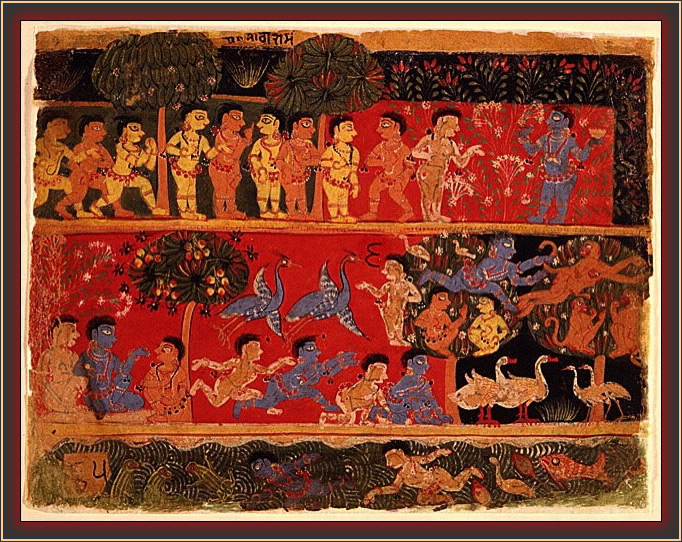
The painting
is titled: 'Krishna and Balarâma Play with Gopas, Folio
from a Bhagavata Purana.
India, Delhi region or Rajasthan, South Asia 1525-1550. Courtesy
LACMA.
Production: Filognostic
Association of The Order of Time.

Feed-back | Links | Downloads | Music | Pictures | What's New | Search | Donations




 Text 1