Canto 4
Chapter 14: The Story of King Vena
(1) Maitreya said: 'The sages headed by Bhrigu who always aspired the welfare of all the people, understood that the citizens with King Anga being absent were doomed to live on the level of animals. (2) The men of wisdom called for the mother of Vena Sunîthâ and then enthroned him [Vena] as the master over the world, even though the ministers did not agree. (3) Hearing that King Vena had ascended the throne the thieves, knowing that he was a most severe punisher, hid themselves immediately like they were rats afraid of a snake. (4) King Vena having ascended the royal seat was very proud of the eight kind of opulences [bhaga, see 3.24: 32] and considered himself to be the greatest. Impudently he began to insult the great personalities. (5) Thus blinded by power he, as proud as an uncontrolled elephant, mounted a chariot and traveled around, creating fear in heaven and on earth. (6) Not permitting the brahmins the performance of any sacrifice, that charities were given or that any butter was offered in the fire, he thus beating his kettledrums everywhere put an end to all religious rituals. (7) When the sages, who always had performed the sacrifices, saw what the great rogue Vena did, they considered it a threat to the common people and out of compassion talked about it. (8) 'Like a log burning from both sides, the common people alas from both the sides of the king and the thieves and rogues are in great danger. (9) Because we were afraid to be without a king Vena has been crowned although he was not qualified and now there is also the threat of danger from his side. How can the living beings be happy now? (10) Vena, born from the womb of Sunîthâ, has grown into a mischievous character, just like a snake that maintained with milk even attacks the one who feeds it. (11) With him appointed king there is no doubt that he desires to harm the citizens, but in order not to suffer the consequences of his sins we nevertheless should try to pacify him. (12) Despite knowing Vena's unrighteousness we have made him king. With him not responsive to our pacifying words, he, for his evildoing, will be condemned by the public and will have to burn, just as he will have to burn by our own fierce opposition.' (13) Thus having decided the sages approached Vena, while concealing their anger. They pacified him with kind words and then spoke with him.
(14) The sages said: 'Oh best of the royals! Please try to understand what we are about to tell you, oh King. It will increase your lifespan, strength and good repute, oh best one. (15) Persons who, in their words, mind, body and intelligence are free from attachment and acted according to the religious principles, will be granted the worlds that are free from misery; they will find liberation and lasting happiness. (16) May that not be lost by you, oh hero of the people, the king who misses that what is the root cause of prosperity, will lose his sway. (17) Oh King, the royal rule that protects the people against mischievous officials, thieves and rogues may for that reason collect taxes and enjoy this world as also the next. (18) It is in those kingdoms in the cities of which the Supreme Lord, the enjoyer of all sacrifices, is worshiped, that the people following the varnâs'rama system [of vocations and age groups] will act according to their nature. (19) The Fortunate One, the original cause of the cosmic manifestation, will be pleased with that king, oh noble one, who in his position of power is of the Soul that keeps the entire universe together. (20) With Him, the Controller of the Controllers, being satisfied, one can achieve the impossible and therefore the people are everywhere, with their preferred lead [their gods, kings and idols], by all means with the greatest pleasure, all performing sacrifices for Him. (21) It is He who with all the deities that are worshiped is the recipient. He is the sum total of the Vedas, the owner of all means of worship and the goal of all austerity. Therefore, oh King, you should, to your greater honor and self-interest, direct your countrymen to perform worship by means of the different kinds of sacrifices. (22) When the brahmins in the kingdom are of devotional service, all the enlightened souls who are part of the Lord, are properly respected and will, most satisfied, grant the desired result. Oh hero, you should not fail to respect them.'
(23) Vena replied: 'Oh how childish you all are in taking irreligious principles for religious ones. In fact you forsake the father who feeds you being unfaithful with another love. (24) They who out of ignorance failing in respect do not realize that the Lord is there in the form of the king, cannot find happiness in this world nor after they died! (25) What now is the name of that enjoyer of sacrifice unto whom you direct your great devotion? Just like a bad woman with her paramour you fail in your affection for [your king,] the husband! (26-27) The creator, the maintainer, the destroyer, the king of heaven, the god of the wind and the god of death; the god of the sun, the god of the rains, the god of the treasury and the god of the moon; the god of the earth, the god of the fire and the god of the waters; all these and also other powers capable of blessing and cursing abide in the body of the king, the king comprises all the gods. (28) For that reason, oh learned souls, you should worship me in your rituals and not be envious. Use those means for my sake, there is no one else to worship as the prime enjoyer of what is offered.'
(29) Maitreya said: 'With all respects offered not acceding to the request of the sages, he whose intelligence was perverted and who most sinfully had strayed from the path, thus was bereft of all good fortune. (30) All the brahmins as a consequence felt insulted by him who considered himself so very learned. Frustrated in their polite request, oh Vidura, they became very angry with him: (31) 'Put him to death, to death, this king, this sinner, this dreadful character who very soon will turn the whole world into a heap of ash if we let him live. (32) This man full of impiety, does not deserve the exalted throne as a god of man. He shamelessly insults Lord Vishnu, the master of all sacrifices! (33) Who else but that miserable Vena would be such a blasphemer of Him by whose mercy all opulence is received?' (34) Thus decided to put him to death they showed their anger and by the sound of their reproach [saying 'Hum'] ended the life of Vena, [the king] who was destroyed by blaspheming the Infallible One. (35) After the sages had returned to their hermitages, lamenting Sunîthâ preserved the body of her son by means of chanting mantras.
(36) Once, when the sages were bathing in the waters of the Sarasvatî and offered oblations in the fire, they sat down on the bank of the river and began to discuss the question of truth. (37) They then told each other that they had noticed that disturbances were developing that created fear among the people; would the citizens without a ruler not suffer the misfortune of having a world full of thieves and rogues? (38) And indeed, while the wise were considering this, wherever one looked dust clouds could be seen in the sky that were caused by the running of plundering criminals. (39-40) They then realized their fault: the disturbance of the common people whose riches were plundered, was due to the death of their protector. With the state full of thieves and murderers in chaos being bereft of a king, they, despite their knowledge, were not able to subdue the rogues. (41) An equipoised and peaceful brahmin with a disregard for afflicted souls, loses his strength of mind, just like a broken pot loses its water. (42) The family line of the saintly king Anga should not be broken, for the semen of the kings of this family was so productive that they enjoyed the shelter of Kes'ava ['He with the beautiful curls']. (43) The wise men thus decided to churn the thighs of the dead king with great force. Thereupon a person named Bâhuka [the dwarf] was born. (44) He was as black as a crow, very short in every way with very short legs and arms, had big jaws, a flat nose, reddish eyes and copper red hair. (45) Having appeared he meekly bowed before the sages inquiring: 'What can I do for you?' 'Please sit down', they replied and thus, oh best one, he became thereafter known as Nishâda. (46) His descendants were thereupon called the Naishâdas. They inhabited the hills and forests because they, being born from Vena, were feared because of all his sins.'


Third revised edition, loaded September 18, 2017.

Previous Aadhar edition and Vedabase links:
Maitreya said: 'The sages headed by Bhrigu who always aspired the welfare of all the people, understood that the citizens with King Anga being absent were doomed to live on the level of animals.Maitreya said: 'The sages headed by Bhrigu, always aspiring the welfare of all the people, having understood of the citizens that the king was absent, also knew that they for sure then would live on the level of animals.(Vedabase)
The men of wisdom called for the mother of Vena Sunîthâ and then enthroned him [Vena] as the master over the world, even though the ministers did not agree.
The men of wisdom, calling for the mother of Vena, Sunîthâ, enthroned him [Vena] as the master over the world, even though the ministers didn't agree. (Vedabase)
Hearing that King Vena had ascended the throne the thieves, knowing that he was a most severe punisher, hid themselves immediately like they were rats afraid of a snake.
Hearing that King Vena had ascended the throne hid the thieves, knowing that he was a most severe punisher, themselves immediately like rats afraid of a snake. (Vedabase)
King Vena having ascended the royal seat was very proud of the eight kind of opulences [bhaga, see 3.24: 32] and considered himself to be the greatest. Impudently he began to insult the great personalities.
King Vena having ascended the royal seat was very proud with the eight kind of opulences [as derived from the eight perfections of yoga, the siddhis] and began, inconsiderate, to insult the great personalities, considering himself to be the greatest. (Vedabase)
Thus blinded by power he, as proud as an uncontrolled elephant, mounted a chariot and traveled around, creating fear in heaven and on earth.
Thus, blinded by power, he, proud and uncontrolled as an elephant, mounted a chariot and traveled around creating fear on earth and in the heavens. (Vedabase)
Not permitting the brahmins the performance of any sacrifice, that charities were given or that any butter was offered in the fire, he thus beating his kettledrums everywhere put an end to all religious rituals.
Not permitting any sacrifices to be performed, charities to be given or any butter to be offered in the fire, o twice-borne one, he thus stopped, by beating the kettledrums everywhere, all the rituals of religion. (Vedabase)
When the sages, who always had performed the sacrifices, saw what the great rogue Vena did, they considered it a threat to the common people and out of compassion talked about it.
All the sages, after observing the activities of the great rogue that Vena was, considered it dangerous to the people in general and out of compassion came to speak about it as they had always been the performers of the sacrifices: (Vedabase)
'Like a log burning from both sides, the common people alas from both the sides of the king and the thieves and rogues are in great danger.
'Like a log burning from both sides, are the common people alas from both the sides of the king and the thieves and rogues in great danger. (Vedabase)
Because we were afraid to be without a king Vena has been crowned although he was not qualified and now there is also the threat of danger from his side. How can the living beings be happy now?
Afraid to be without a king has Vena, although not qualified, been crowned and now is there from him as well the danger; how can the common people now be happy? (Vedabase)
Vena, born from the womb of Sunîthâ, has grown into a mischievous character, just like a snake that maintained with milk even attacks the one who feeds it.
Like a snake that is maintained with milk even attacks its maintainer, has Vena, born from the womb of Sunîthâ, grown into a mischievous nature. (Vedabase)
With him appointed king there is no doubt that he desires to harm the citizens, but in order not to suffer the consequences of his sins we nevertheless should try to pacify him.
Appointed king there is no doubt that he desires to harm the citizens, but nevertheless should we, in order not to suffer the consequences of his sins, try to pacify him. (Vedabase)
Despite knowing Vena's unrighteousness we have made him king. With him not responsive to our pacifying words, he, for his evildoing, will be condemned by the public and will have to burn, just as he will have to burn by our own fierce opposition.'
Knowing of Vena's impiety have we nevertheless made him king; if he's not receptive to our pacifying words, will he, for his unrighteous acts, by the public be condemned to burn and will we have to use force to our own ability.' (Vedabase)
Thus having decided the sages approached Vena, while concealing their anger. They pacified him with kind words and then spoke with him.
Thus having decided approached the sages Vena concealing their anger and spoke to him in sweet words, after having pleased him with sweet words. (Vedabase)
The sages said: 'Oh best of the royals! Please try to understand what we are about to tell you, oh King. It will increase your lifespan, strength and good repute, oh best one.
The sages said: 'O best of the royals! Please try to understand that what we are about to tell you, o King, and which will increase your lifespan, strength and good repute, o best one. (Vedabase)
Persons who, in their words, mind, body and intelligence are free from attachment and acted according to the religious principles, will be granted the worlds that are free from misery; they will find liberation and lasting happiness.
To those persons, free from attachment, who in their words, mind, body and intelligence acted according the religious principles, will be given the worlds free from misery; they will find liberation and lasting happiness. (Vedabase)
May that not be lost by you, oh hero of the people, the king who misses that what is the root cause of prosperity, will lose his sway.
Let that spiritual life not be missed by you, o hero of the people; the king who misses that which is the cause of prosperity, will lose his sway. (Vedabase)
Oh King, the royal rule that protects the people against mischievous officials, thieves and rogues may for that reason collect taxes and enjoy this world as also the next.
O King, the royal rule protecting the people against mischievous officials, thieves and rogues may for that reason collect taxes and enjoy this world as well as the next. (Vedabase)
It is in those kingdoms in the cities of which the Supreme Lord, the enjoyer of all sacrifices, is worshiped, that the people following the varnâs'rama system [of vocations and age groups] will act according to their nature.
It is in those kingdoms in whose cities for sure the Supreme Lord, the enjoyer of all sacrifices, is worshiped, that the people will act according their own occupation in pursuance of the varnâs'rama system [of vocations and age groups]. (Vedabase)
Text 19
The Fortunate One, the original cause of the cosmic manifestation, will be pleased with that king, oh noble one, who in his position of power is of the Soul that keeps the entire universe together.
The Fortunate One, the original cause of the cosmic manifestation, will be pleased with that king, o noble one, who in his position of rule is of the soul that keeps the entire universe together. (Vedabase)
With Him, the Controller of the Controllers, being satisfied, one can achieve the impossible and therefore the people are everywhere, with their preferred lead [their gods, kings and idols], by all means with the greatest pleasure, all performing sacrifices for Him.
With Him, the Controller of the Controllers, satisfied, one can achieve the impossible; for this reason are the people everywhere with their preferred deities by all means with great pleasure all making offerings unto Him. (Vedabase)
It is He who with all the deities that are worshiped is the recipient. He is the sum total of the Vedas, the owner of all means of worship and the goal of all austerity. Therefore, oh King, you should, to your greater honor and self-interest, direct your countrymen to perform worship by means of the different kinds of sacrifices.
It is He who with all the deities in worship is the recipient. He is the sum total of the Vedas, the owner of all means of worship, the goal of all austerity; therefore should you, o King, to the greater honor of you yourself, direct your countrymen to perform worship by means of the various sacrifices. (Vedabase)
When the brahmins in the kingdom are of devotional service, all the enlightened souls who are part of the Lord, are properly respected and will, most satisfied, grant the desired result. Oh hero, you should not fail to respect them.'
When the brahmins in the kingdom engage in worship, are all the enlightened ones that are part of the Lord, properly respected and will they, very satisfied, grant the desired result; o hero, you mustn't disrespect them.' (Vedabase)
Vena replied: 'Oh how childish you all are in taking irreligious principles for religious ones. In fact you forsake the father who feeds you being unfaithful with another love.
Vena replied: 'Oh how childish are all of you indeed, taking irreligious principles for religious ones; in fact are all of you forsaking the father in worship of an obsolete one. (Vedabase)
They who out of ignorance failing in respect do not realize that the Lord is there in the form of the king, cannot find happiness in this world nor after they died!
They who ignorantly are of disrespect don't realize that the Lord is there in the form of the king; they can't find happiness in this world nor after death! (Vedabase)
What now is the name of that enjoyer of sacrifice unto whom you direct your great devotion? Just like a bad woman with her paramour you fail in your affection for [your king,] the husband!
What is the name of that enjoyer of sacrifice unto whom you direct your devotion so great? Like with an unchaste woman to her paramour you fall short in affection for the husband! (Vedabase)
The creator, the maintainer, the destroyer, the king of heaven, the god of the wind and the god of death; the god of the sun, the god of the rains, the god of the treasury and the god of the moon; the god of the earth, the god of the fire and the god of the waters; all these and also other powers capable of blessing and cursing abide in the body of the king, the king comprises all the gods.
The creator, the maintainer, the destroyer, the king of heaven, the god of the wind and the god of death; the god of the sun, the rains, the treasury and the moon; the god of the earth, the fire and the waters; all these and other powers as well capable of blessing and cursing, abide in the body of the king; the king comprises all the gods. (Vedabase)
For that reason, oh learned souls, you should worship me in your rituals and not be envious. Use those means for my sake, there is no one else to worship as the prime enjoyer of what is offered.'
For this reason o learned ones, you should worship me in your rituals and not be envious; use those means for my sake, there is no one else to be the prime enjoyer of what is offered.' (Vedabase)
Maitreya said: 'With all respects offered not acceding to the request of the sages, he whose intelligence was perverted and who most sinfully had strayed from the path, thus was bereft of all good fortune.
Maitreya said: 'With all respects offered not acceding to the request of the sages, was thus the one whose intelligence was perverted and who most sinful had strayed from the path, bereft of all good fortune. (Vedabase)
All the brahmins as a consequence felt insulted by him who considered himself so very learned. Frustrated in their polite request, oh Vidura, they became very angry with him:
Thus felt all the brahmins insulted by him, who thought himself to be so very learned; frustrated with their polite request, o Vidura, they became very angry with him: (Vedabase)
'Put him to death, to death, this king, this sinner, this dreadful character who very soon will turn the whole world into a heap of ash if we let him live.
'To death, to death, this king, this sinner, this dreadful nature who for sure very soon will turn the whole world into ashes if we let him live. (Vedabase)
This man full of impiety, does not deserve the exalted throne as a god of man. He shamelessly insults Lord Vishnu, the master of all sacrifices!
This man, full of impiety, never deserves the exalted throne to be the god of man; he shamelessly insults Lord Vishnu, the master of all sacrifices! (Vedabase)
Who else but that miserable Vena would be such a blasphemer of Him by whose mercy all opulence is received?'
Who else indeed but Vena, born under such a bad constellation, would be of such a blasphemy with Him, by whose mercy all opulence is received.' (Vedabase)
Thus decided to put him to death they showed their anger and by the sound of their reproach [saying 'Hum'] ended the life of Vena, [the king] who was destroyed by blaspheming the Infallible One
Thus decided to put him to death they, by the manifestation of their anger, with their angry tone alone, helped Vena, dead in his blasphemy against the Infallible One, out of the world. (Vedabase)
After the sages had returned to their hermitages, lamenting Sunîthâ preserved the body of her son by means of chanting mantras.
After the sages had returned to their own hermitages, preserved Sunîthâ, in her lamentation, the body of her son by means of chanting mantras. (Vedabase)
Once, when the sages were bathing in the waters of the Sarasvatî and offered oblations in the fire, they sat down on the bank of the river and began to discuss the question of truth.
Once, when the sages were bathing in the waters of the Sarasvatî, offering oblations in the fire, started they, sitting on the bank of the river, to discuss the matters of truth. (Vedabase)
They then told each other that they had noticed that disturbances were developing that created fear among the people; would the citizens without a ruler not suffer the misfortune of having a world full of thieves and rogues?
They told each other that they at the time had noticed that disturbances were developing that created fear among the people; wouldn't they, without a ruler, suffer the misfortune of having a world full of thieves and rogues? (Vedabase)
And indeed, while the wise were considering this, wherever one looked dust clouds could be seen in the sky that were caused by the running of plundering criminals.
Evidently, as the wise were considering this, could, wherever one looked, dust clouding the sky be seen caused by the running of criminals engaged in plundering. (Vedabase)
They then realized their fault: the disturbance of the common people whose riches were plundered, was due to the death of their protector. With the state full of thieves and murderers in chaos being bereft of a king, they, despite their knowledge, were not able to subdue the rogues.
They then realized that the disturbance with the common people who had their riches plundered, was due to the death of him who was their protector; and with the state full of thieves and murderers did they, bereft of a king, despite of having understood all the crime, not succeed to subdue the rogues. (Vedabase)
An equipoised and peaceful brahmin with a disregard for afflicted souls, loses his strength of mind, just like a broken pot loses its water.
A brahmin equipoised and peaceful, grossly neglecting the poor, is sure to see his spirit coming down, just like water will from a broken pot. (Vedabase)
The family line of the saintly King Anga should not be broken, for the semen of the kings of this family was so productive that they enjoyed the shelter of Kes'ava ['He with the beautiful curls'].
The family line of the saintly King Anga should not be broken, because being sinless their semen had the potency with which the kings of this family would enjoy the shelter of Kes'ava [He with the beautiful curls]. (Vedabase)
The wise men thus decided to churn the thighs of the dead king with great force. Thereupon a person named Bâhuka [the dwarf] was born.
Thus decided the wise men to churn by their special power the legs of the dead king, whereupon a person named Bâhuka [the dwarf] was born. (Vedabase)
He was as black as a crow, very short in every way with very short legs and arms, had big jaws, a flat nose, reddish eyes and copper red hair.
He was black as a crow, was very short in every way with very short legs and arms, had big jaws, a flat nose, reddish eyes and copper-red hair. (Vedabase)
Having appeared he meekly bowed before the sages inquiring: 'What can I do for you?' 'Please sit down', they replied and thus, oh best one, he became thereafter known as Nishâda.
Meek he then bowed before the sages inquiring: 'What can I do for you?'. 'Just sit down here' they replied, and thus, o best one, he became thereafter known as Nishâda. (Vedabase)
His descendants were thereupon called the Naishâdas. They inhabited the hills and forests because they, being born from Vena, were feared because of all his sins.'
His descendants were then called the Naishâdas, they inhabited the hills and forests, because, being born from Vena with Nishâda taking the burden of all the sins, they were feared. (Vedabase)


The text and audio are offered under the
conditions of the
Creative
Commons
Attribution-Noncommercial-Share Alike 3.0 Unported License.
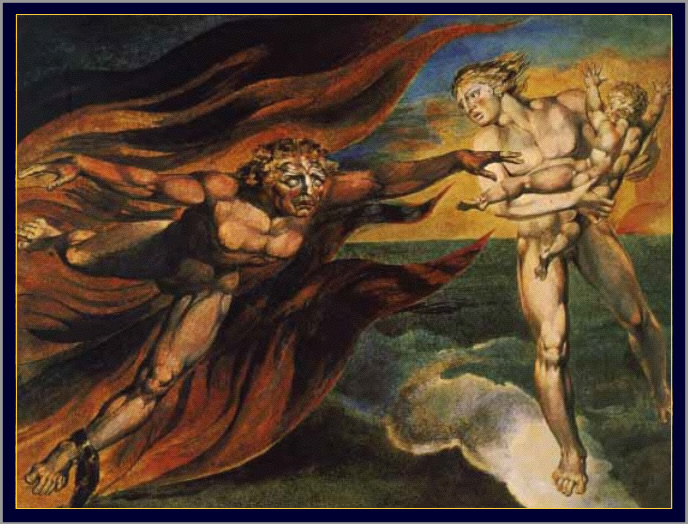
The picture
is titled: 'Good and Evil'
and was painted by William Blake. Source; William Blake Archive.
Production: Filognostic
Association of The Order of Time.

Feed-back | Links | Downloads | Music | Pictures | What's New | Search | Donations