Canto 4
Chapter 1: Genealogical Table of the Daughters of Manu
(1) S'rî Maitreya said: 'Svâyambhuva Manu begot in his wife S'atarûpâ [two sons, as] also three daughters named Âkûti, Devahûti and Prasûti, as you know [see 3.12: 56]. (2) Despite the fact that Âkûti had brothers* she was handed over to the great sage Ruci on the condition that the king would get the resultant son. This was settled with the support of religious rites and the consent of his wife. (3) Ruci, the most powerful great sage who was entrusted with the procreation, begot, in his supreme concentration, a pair of children with her who were of the greatest spiritual and brahminical strength. (4) The male child of the two, Yajña ['the One of Sacrifice'], was a direct personification of Vishnu while the other female child Dakshinâ was His inseparable plenary portion, the Goddess of Fortune [Lakshmî]. (5) The very powerful son the daughter gave birth to was taken to the home of the most happy Svâyambhuva Manu, while Dakshinâ was kept by Ruci. (6) The Lord and master of all sacrifice married her who always longed for Him. She most happy to have Him for her husband who Himself was also most pleased with her, thereupon gave birth to twelve sons. (7) The twelve were: Tosha, Pratosha, Santosha, Bhadra, Sânti, Idaspati, Idhma, Kavi, Vibhu, Svahna, Sudeva and Rocana. (8) In the period of Svâyambhuva Manu they were known as the Tushita demigods. Marîci headed the sages then and Yajña was the king of the demigods [Indra]. (9) The two sons of Manu, Priyavrata and Uttânapâda, were in that period the greatest of all kings and their sons, grandsons, great-grandsons and their offspring followed in his footsteps during that period of Manu. (10) Dear Vidura, about Svâyambhuva handing over his daughter to Kardama, you have heard me speak extensively [see 3.12: 57]. (11) The great personality Svâyambhuva gave Prasûti to Daksha, the son of Brahmâ, whose offspring spread enormously over the three worlds. (12) I told you already about the nine daughters of Kardama who became the wives of the nine great sages [see 3.24: 21-25]. Now hear from me my description of the generations stemming from them. (13) The daughter of Kardama, the wife of Marîci also named Kalâ, gave birth to Kas'yapa and to Pûrnimâ whose children spread all over the world. (14) Pûrnimâ got sons named Viraja, Vis'vaga, oh conqueror, and a daughter named Devakulyâ who became the water that washed from the Lord's lotus feet and later constituted the heavenly river the Ganges. (15) The wife of Atri Muni, named Anasûyâ, gave birth to three very famous sons: Dattâtreya, Durvâsâ and Soma [the moon god], who are [partial] incarnations of respectively the Supersoul [Vishnu], Lord S'iva and Lord Brahmâ.'
(16) Vidura said: 'Oh spiritual master, tell me how in the house of Atri the chief demigods responsible for maintenance, creation and destruction, could appear with a desire to do something.'
(17) Maitreya said: 'Being inspired by Lord Brahmâ to procreate, Atri, the chief of the scholars of spiritual knowledge, together with his wife went to the great mountain named Riksha to stay there for austerities. (18) In the forest there were many as'oka and palâs'a trees and flowers, with everywhere the sound of the flowing waters of the river the Nirvindhyâ. (19) Controlling the mind by regulating his breath the sage remained there for a hundred years subsisting on air while standing on the one leg of non-duality. (20) He thought: 'By taking shelter of Him I surrendered myself to Him, may He who is the master of the universe give me a son like Himself.' (21) Issuing from the head of the sage there was a fire being fueled by his breath control, that, while practicing his austerities, was noticed by the three principal gods of the three worlds. (22) [Together with] the Apsaras, the munis, the Gandharvas, the Siddhas, the Vidyâdharas and Nâgas [they] came to the hermitage of him who thus gained renown. (23) When he saw all these demigods and great personalities appear at the same moment, the mind of the sage, who had awakened on his one leg, lightened up. (24) Recognizing the symbols of their personal paraphernalia [drum, kus'a grass and discus] as also the bull, the swan and the bird Garuda they sat upon, he with folded hands fell down prostrating before them to offer his obeisances. (25) Dazzled by the glaring effulgence of their smiling faces and their merciful satisfied glances, the sage closed his eyes. (26-27) Absorbed by that vision he ecstatically expressed his prayers before those who are most appreciated in all the worlds. Atri said: 'Let me bow before You, oh Lord Brahmâ, Lord S'iva and Lord Vishnu, oh You who, as You always do in the different millennia, have accepted Your bodies according to the division of the modes of nature, for the sake of the creation, destruction and maintenance of the universe. Whom of You did I actually call for? (28) Be as merciful to please explain to me, so full of serious doubt, how it can be that You, despite being far elevated above the minds of the embodied souls, all have appeared here, with me having fixed my mind on the One Great Lord of all Fortune for the sake of begetting a child?'
(29) Maitreya said: ‘Oh mighty one, after thus having heard the words of the great sage, all the three chief demigods smiled at him and replied with gentle voices. (30) The gods said: 'It shall be done as you decided, and not otherwise. To you who never lost your resolve, dear brahmin, we are all the one and same [person] you were meditating on. (31) Therefore our plenary expansions - the sons to be born to you - will be very famous in the world, dear sage, and spread your glory to your great fortune.'
(32) The chief demigods, who perfectly being worshiped thus had offered the desired benediction, then, with the couple looking on, returned to their places. (33) Soma appeared as a partial expansion of Lord Brahmâ, Dattâtreya as a very powerful yogi of Lord Vishnu, and Durvâsâ as a partial expansion of S'ankara [S'iva]. Hear now about the generations that appeared from Angirâ. (34) S'raddhâ, the wife of Angirâ, gave birth to the four daughters Sinîvâlî, Kuhû, Râkâ and Anumati. (35) Next to them he begot two sons who were very famous in the millennium of Svârocisha Manu [the second Manu after Svâyambhuva]: they were the mighty Utathya and Brihaspati, the foremost knower of the Absolute Truth. (36) Pulastya begot in his wife Havirbhû, Agastya, who in his next birth would be Dahrâgni ['of the digestive fire'], and Vis'ravâ, who was great in austerity. (37) The demigod Kuvera, the king of the Yakshas [his supernatural attendants], appeared from Vis'ravâ. He was born from Idavidâ while the sons Râvana, Kumbhakarna and Vibhîshana were born from another wife [named Kes'inî]. (38) Gati, the wife of Pulaha, oh devoted one, gave birth to three chaste sons [Karmas'reshthha, Varîyân and Sahishnu] who knew all about karma and were very respectable and tolerant. (39) Kriyâ, the wife of sage Kratu, gave birth to sixty thousand sages who lived in accord with the Vâlakhilya [some Rig-Veda verses about retired life]. They most brilliantly excelled in the brahminical perspective. (40) From Ûrjâ [also called Arundhatî], Citraketu was begotten by the sage Vasishthha, oh great soul. He appeared as the first of seven sons who were all great and pure sages of Brahman, the Absolute Truth. (41) They were Citraketu, Suroci, Virajâ, Mitra, Ulbana, Vasubhridyâna and Dyumân. Born from another wife of his, there were also S'akti and othersons. (42) Also Citti [also known as Sânti], the wife of Atharvâ, gave fully dedicated to the Dadhyañca vow [the vow of meditation] birth to a son who was called As'vas'irâ. Now hear about the generation begotten by Bhrigu. (43) Bhrigu, most fortunately, begot in his wife Khyâti, the sons Dhâtâ and Vidhâtâ and a daughter named S'rî, who was very devoted to the Lord. (44) To these two sons were given in marriage Âyati and Niyati, two daughters of sage Meru, from whom appeared Mrikanda as also Prâna. (45) Mârkandeya Muni was born from the seed of Mrikanda and from Prâna the great sage Vedas'irâ appeared whose greatly powerful son named Kavi Bhârgava was also known as Us'anâ [or S'ukrâcârya]. (46-47) Oh Vidura, I have spoken to you about how, from the offspring of sage Kardama, all the great sages with their descendants populated the three worlds with the grandsons born to them. With faith hearing about this is the best way to drive away immediately all sins.
Prasûti, a daughter of Manu, married the son of Brahmâ called Daksha. (48) With her Daksha begot sixteen lotus-eyed daughters. Thirteen were given in marriage to Dharma and one was given to Agni. (49-52) One daughter he gave to the combined forefathers and one he gave to Lord S'iva, the deliverer of the sinners. S'raddhâ, Maitrî, Dayâ, Sânti, Tushthi, Pushthi, Kriyâ, Unnati, Buddhi, Medhâ, Titikshâ, Hrî and Mûrti are the names of the daughters of Daksha who were given to Dharma. S'raddhâ gave birth to S'ubha, Maitrî got Prasâda, Dayâ got Abhaya, Sânti got Sukha, Tushthi got Muda, Pushthi got Smaya, Kriyâ got Yoga, Unnati got Darpa, Buddhi got Artha, Medhâ got Smriti, Titikshâ got Kshema and Hrî got Pras'raya. Mûrti, a reservoir of all good qualities, gave birth to the two sages Nara and Nârâyana. (53) The appearance of the both of Them gladdened the universe and filled everyone's mind with peace. In all directions the rivers, mountains and the atmosphere became pleasant. (54-55) The demigods, Brahmâ and the others, all full of respect offered prayers. From the heavens musical instruments sounded, flowers were showered from the sky, the sages satisfied chanted Vedic hymns, the Gandharvas and Kinnaras began to sing, the heavenly damsels danced and thus all signs of good fortune were seen. (56) The gods said: 'Our obeisances unto the Supreme Original Personality who by His external energy created the variety of everything existing that resides in Him the way masses of clouds are found in the sky, in Him who today has appeared in the house of Dharma in the form of these sages. (57) May He, whom we know on the basis of the Vedas and who - in order to put an end to the misfortune of the created world - from the mode of goodness brought about the lives of us, the demigods, bestow upon us His merciful glance that supersedes the spotless lotus known as the home of the Goddess of Fortune.'
(58) Oh Vidura, after thus having been praised by the assembled demigods who found the mercy of His glance, the Supreme Lord left for Gandhamâdana Hill. (59) These two [Nara-Narâyana] partial [ams'a] incarnations of the Supreme Lord Hari have now, for mitigating the burden of the world, appeared here in the form of the two of Krishna [Krishna and Arjuna] who are the most eminent souls of the Kuru and Yadu dynasty. (60) Svâhâ [the daughter of Daksha and] the wife of the fire god Agni, produced three sons: Pâvaka, Pavamâna and S'uci who feed on the oblations of the sacrifice. (61) They in their turn produced forty-five fire gods, so that, taken together, there are forty-nine of them, including the fathers and the grandfather. (62) They constitute the names of the [49] fires in which the knowers of Brahman offer their oblations [ishthis] for Agni during Vedic ceremonies. (63) The forefathers are the Agnishvâttas, Barhishadas, Saumyas and Âjyapas; they are approached [with libations of water in combination] with or without fire and Svadhâ, Daksha's daughter is their wife. (64) They gave her two daughters, Vayunâ and Dhârinî, who both were expert in the knowledge and the [transcendental] wisdom of the impersonal path of Brahman. (65) The wife of Bhava [a name of S'iva] named Satî, served the demigod faithfully, but could not give birth to a child with her qualities and character. (66) That was because her father [Daksa] in anger had behaved unfavorably towards the faultless one [S'iva], so that she had to give up her body in the connectedness of yoga before she attained maturity. '


Third revised edition, loaded March 18, 2024.
Previous Aadhar edition and Vedabase links:
S'rî Maitreya said: 'Svâyambhuva Manu begot in his wife S'atarûpâ [two sons, as] also three daughters named Âkûti, Devahûti and Prasûti, as you know [see 3.12: 56].S'rî Maitreya said: 'Svâyambhuva Manu begot in his wife S'atarûpâ as well [as two sons] three daughters named Âkûti, Devahûti and Prasûti, as you know [see 3.12: 56]. (Vedabase)
Despite the fact that Âkûti had brothers* she was handed over to the great sage Ruci on the condition that the king would get the resultant son. This was settled with the support of religious rites and the consent of his wife.
Although Âkûti had brothers was she handed over to the great sage Ruci on the condition that the king, who had the support of religious rites and the consent of his wife, would get the resultant son. (Vedabase)
Ruci, the most powerful great sage who was entrusted with the procreation, begot, in his supreme concentration, a pair of children with her who were of the greatest spiritual and brahminical strength.
He, the most powerful great sage Ruci, was entrusted the procreation and begot in her a pair of children that were of the greatest spiritual and brahminical strength. (Vedabase)
The male child of the two, Yajña ['the One of Sacrifice'], was a direct personification of Vishnu while the other female child Dakshinâ was His inseparable plenary portion, the Goddess of Fortune [Lakshmî].
The male child of the two, Yajña ['the One of Sacrifice'], was a direct personification of Vishnu while the other female child Dakshinâ was His unseparable plenary portion, the Goddess of Fortune [Lakshmî]. (Vedabase)
The very powerful son the daughter gave birth to was taken to the home of the most happy Svâyambhuva Manu, while Dakshinâ was kept by Ruci.
The very powerful son born of the daughter was taken to the home of the very happy Svâyambhuva Manu, while Ruci kept Dakshinâ with himself. (Vedabase)
The Lord and master of all sacrifice married her who always longed for Him. She most happy to have Him for her husband who Himself was also most pleased with her, thereupon gave birth to twelve sons.
The Lord and master of all sacrifice who always longed for her, married and His wife, very pleased to have Him for her husband, gave birth to twelve sons. (Vedabase)
The twelve were: Tosha, Pratosha, Santosha, Bhadra, Sânti, Idaspati, Idhma, Kavi, Vibhu, Svahna, Sudeva and Rocana.
The twelve were: Tosha, Pratosha, Santosha, Bhadra, Sânti, Idaspati, Idhma, Kavi, Vibhu, Svahna, Sudeva and Rocana. (Vedabase)
In the period of Svâyambhuva Manu they were known as the Tushita demigods. Marîci headed the sages then and Yajña was the king of the demigods [Indra].
In the period of Svâyambhuva they were known as the Tushita demigods, with Marîci heading the sages and Yajña as the King of the Enlightened. (Vedabase)
The two sons of Manu, Priyavrata and Uttânapâda, were in that period the greatest of all kings and their sons, grandsons, great-grandsons and their offspring followed in his footsteps during that period of Manu.
The two sons of Manu, Priyavrata and Uttânapâda, were in that period of the greatest and their sons and grandsons spread all over. (Vedabase)
Dear Vidura, about Svâyambhuva handing over his daughter to Kardama, you heard me speak extensively [see 3.12: 57].
My dear, concerning Svâyambhuva handing over his daughter to Kardama, you have heard me speaking in full [see 3.12: 57]. (Vedabase)
The great personality Svâyambhuva gave Prasûti to Daksha, the son of Brahmâ, whose offspring spread enormously over the three worlds.
The great personality Svâyambhuva gave Prasûti to Daksha, the son of Brahmâ, who's offspring expanded greatly over the three worlds. (Vedabase)
I told you already about the nine daughters of Kardama who became the wives of the nine great sages [see 3.24: 21-25]. Now hear from me my description of the generations stemming from them.
I told you already about the nine daughters of Kardama who became the wives of nine great sages of spiritual knowledge [see 3.24: 21-25]. Now hear from me my description of the generations coming from them. (Vedabase)
The daughter of Kardama, the wife of Marîci also named Kalâ, gave birth to Kas'yapa and Pûrnimâ whose children spread all over the world.
The daughter of Kardama, the wife of Marîci also named Kalâ, gave birth to Kas'yapa and Pûrnimâ whose children spread all over the world. (Vedabase)
Pûrnimâ got sons named Viraja, Vis'vaga, oh conqueror, and a daughter named Devakulyâ who became the water that washed from the Lord's lotus feet and later constituted the heavenly river the Ganges.
Pûrnimâ got sons named Viraja, Vis'vaga, o conqueror, and a daughter named Devakulyâ. By the water which washed from the Lord His lotus feet she became the holy of the Ganges. (Vedabase)
The wife of Atri Muni, named Anasûyâ, gave birth to three very famous sons: Dattâtreya, Durvâsâ and Soma [the moon god], who are [partial] incarnations of respectively the Supersoul [Vishnu], Lord S'iva and Lord Brahmâ.'
The wife of Atri Muni, named Anasûyâ, bore three very famous sons: Dattâtreya, Durvâsâ and Soma [the moon-god], which are [partial] incarnations of respectively the Supersoul [Vishnu], Lord S'iva and Lord Brahmâ.' (Vedabase)
Vidura said: 'Oh spiritual master, tell me how in the house of Atri the chief demigods responsible for maintenance, creation and destruction, could appear with a desire to do something.'
Vidura said: 'O spiritual master, tell me how in the house of Atri the chief demigods to the causes of maintenance, creation and destruction, could appear desiring to do something.' (Vedabase)?
Text 17
Maitreya said: 'Being inspired by Lord Brahmâ to procreate, Atri, the chief of the scholars of spiritual knowledge, together with his wife went to the great mountain named Riksha to stay there for austerities.
Maitreya said: 'Being inspired by Lord Brahmâ to procreate went Atri, the chief of the learned in spiritual knowledge, together with his wife to the great mountain named Riksha to stay there for austerities. (Vedabase)
In the forest there were many as'oka and palâs'a trees and flowers, with everywhere the sound of the flowing waters of the river the Nirvindhyâ.
In that place in the garden of the forest there were many flowers, as'oka trees growing everywhere and the sound of the falling waters of the river the Nirvindhyâ. (Vedabase)
Controlling the mind by regulating his breath, the sage remained there for a hundred years subsisting on air while standing on the one leg of non-duality.
Controlling the mind by regulating his breath remained the sage there for a hundred years, eating the air standing on the one leg of non-duality. (Vedabase)
He thought: 'By taking shelter of Him I surrendered myself to Him, may He who is the master of the universe give me a son like Himself.'
He thought: 'Taking shelter I surrender myself to Him, may He who is for sure the master of the universe give me a son alike Himself.' (Vedabase)Issuing from the head of the sage there was a fire being fueled by his breath control, that, while practicing his austerities, was noticed by the three principal gods of the three worlds.
By the fire that, issuing from the top of the head of the sage, was fueled by his breath control, was he, practicing his austerities over the three worlds, noticed by the three principal gods. (Vedabase)
[Together with] the Apsaras, the munis, the Gandharvas, the Siddhas, the Vidyâdharas and Nâgas [they] came to the hermitage of him who thus gained renown.
With the fame of his honor spreading did the Apsaras, the munis, the Gandharvas the Siddhas, the Vidyâdharas and Nâgas, head for his place of meditation. (Vedabase)
When he saw all these demigods and great personalities appear at the same moment, the mind of the sage, who had awakened on his one leg, lightened up.
When he saw the simultaneous appearance of these demigods and great personalities, lightened up the mind of the sage who had awakened on his one leg. (Vedabase)
Recognizing the symbols of their personal paraphernalia [drum, kus'a grass and discus] as also the bull, the swan and the bird Garuda they sat upon, he with folded hands fell down prostrating before them to offer his obeisances.
Recognizing the symbols of their personal paraphernalia [drum, kus'a grass and discus] and the bull, the swan and Garuda on which they were seated, he with folded hands fell down prostrating before them, offering his obeisances. (Vedabase)
Dazzled by the glaring effulgence of their smiling faces and their merciful satisfied glances, the sage closed his eyes.
Dazzled by the glaring effulgence of their smiling faces and the apparent satisfaction from their merciful glances, the sage closed his eyes. (Vedabase)
Absorbed by that vision he ecstatically expressed his prayers before those who are most appreciated in all the worlds. Atri said: 'Let me bow before You, oh Lord Brahmâ, Lord S'iva and Lord Vishnu, oh You who, as You always do in the different millennia, have accepted Your bodies according to the division of the modes of nature, for the sake of the creation, destruction and maintenance of the universe. Whom of You did I actually call for?
Fixing his heart on them he whispered the ecstatic words of the prayers that he offered the honorable predominating demigods with folded hands. Atri said: 'I bow before you the Lord Brahmâ, Lord S'iva and Lord Vishnu, who, as always in the different millenniums, have accepted your bodies in the being divided to the modes of nature in the creation, destruction and maintenance of the universe. Whom of you have I really been calling for? (Vedabase)
Be as merciful to please explain to me, so full of serious doubt, how it can be that You, despite being far elevated above the minds of the embodied souls, all have appeared here, with me having fixed my mind on the One Great Lord of all Fortune for the sake of begetting a child?'
Being so merciful, please explain to me doubting so seriously, how it can be so that, although being far beyond the minds of the embodied, all of you appeared here while I, for begetting a child, fixed my mind on the One Great Lord of all Fortune? (Vedabase)
Maitreya said: ‘Oh mighty one, after thus having heard the words of the great sage, all the three chief demigods smiled at him and replied with gentle voices.
Maitreya said: 'O mighty one, after thus hearing of the great sage his words, replied in gentle voices all the three chief demigods smiling at him. (Vedabase)
The gods said: 'It shall be done as you decided, and not otherwise. To you who never lost your resolve, dear brahmin, we are all the one and same [person] you were meditating on.
The gods said: 'As you have decided to, so shall it be done and not otherwise; to you whose determination was never lost, o dear brahmin, we are all of the One you were so truly meditating upon. (Vedabase)
Therefore our plenary expansions - the sons to be born to you - will be very famous in the world, dear sage, and spread your glory to your great fortune.'
Therefore will our plenary expansions - your sons to be born - be very famous in the world, dear sage and to your great fortune they will also spread your good name.' (Vedabase)
The chief demigods, who perfectly being worshiped thus had offered the desired benediction, then, with the couple looking on, returned to their places.
As the husband and wife were looking on did the chief demigods, thus having offered the desired benediction being perfectly worshiped, return from there. (Vedabase)
Soma appeared as a partial expansion of Lord Brahmâ, Dattâtreya as a very powerful yogi of Lord Vishnu, and Durvâsâ as a partial expansion of S'ankara [S'iva]. Hear now about the generations that appeared from Angirâ.
Soma appeared as a partial expansion of Lord Brahmâ, Dattâtreya as a very powerful yogi of Lord Vishnu, and Durvâsâ as a partial expansion of S'ankara [S'iva]. Hear now about the generations that came from Angirâ. (Vedabase)
S'raddhâ, the wife of Angirâ, gave birth to the four daughters Sinîvâlî, Kuhû, Râkâ and Anumati.
S'raddhâ, the wife of Angirâ, gave birth to the daughters Sinîvâlî, Kuhû and Râkâ with Anumati as the fourth one. (Vedabase)
Next to them he begot two sons who were very famous in the millennium of Svârocisha Manu [the second Manu after Svâyambhuva]: they were the mighty Utathya and Brihaspati, the foremost knower of the Absolute Truth.
Besides them were the sons born from him very famous in the millennium of Svârocisha Manu [the second Manu after Svâyambhuva]: the mighty Utathya and Brihaspati, the full of the brahminical in person. (Vedabase)
Pulastya begot in his wife Havirbhû, Agastya, who in his next birth would be Dahrâgni ['of the digestive fire'], and Vis'ravâ, who was great in austerity.
Pulastya begot in his wife Havirbhû, Âgastya, who in his next birth would be Dahrâgni [the one of the digestive fire], and Vis'ravâ, the great one of austerity. (Vedabase)
The demigod Kuvera, the king of the Yakshas [his supernatural attendants], appeared from Vis'ravâ. He was born from Idavidâ while the sons Râvana, Kumbhakarna and Vibhîshana were born from another wife [named Kes'inî].
Of Vis'ravâ came the demigod Kuvera, the king of the Yakshas [his supernatural attendants], who was born from Idavidâ while the sons Râvana, Kumbhakarna and Vibhîshana were born from another wife [named Kes'inî]. (Vedabase)
Gati, the wife of Pulaha, oh devoted one, gave birth to three chaste sons [Karmas'reshthha, Varîyân and Sahishnu] who knew all about karma and were very respectable and tolerant.
Gati, the wife of Pulaha, o devoted one, gave birth to three chaste sons [Karmas'reshthha, Varîyân and Sahishnu] who knew all about karma and were also very respectable and tolerant. (Vedabase)
Kriyâ, the wife of sage Kratu, gave birth to sixty thousand sages who lived in accord with the Vâlakhilya [some Rig-Veda verses about retired life]. They most brilliantly excelled in the brahminical perspective.
Kriyâ, the wife of sage Kratu, from her side brought forth sixty thousand sages living to the Vâlakhilya [some Rig Veda verses about the retired position], who shone with the brilliance of the brahminical [they are also known as the small ones produced from Brahmâ, surrounding the chariot of the sun]. (Vedabase)From Ûrjâ [also called Arundhatî], Citraketu was begotten by the sage Vasishthha, oh great soul. He appeared as the first of seven sons who were all great and pure sages of Brahman, the Absolute Truth.
From Ûrjâ [also called Arundhatî], of the sage Vasishthha, o great one, came Citraketu as the principal of seven sons who were all great and pure sages of the Absolute Truth. (Vedabase)
They were Citraketu, Suroci, Virajâ, Mitra, Ulbana, Vasubhridyâna and Dyumân. Born from another wife of his, there were also S'akti and other sons.
They were Citraketu, Suroci, Virajâ, Mitra, Ulbana, Vasubhridyâna and Dyumân. Also were there S'akti and other sons born from his other wife. (Vedabase)
Also Citti [also known as Sânti], the wife of Atharvâ, gave fully dedicated to the Dadhyañca vow [the vow of meditation] birth to a son who was called As'vas'irâ. Now hear about the generation begotten by Bhrigu.
Also Citti [also known as Sânti], the wife of Atharvâ, got in complete dedication to the Dadhyañca vow [the vow of meditation] a son who was called As'vas'irâ. Now hear about the generation of Bhrigu. (Vedabase)
Bhrigu, most fortunately, begot in his wife Khyâti, the sons Dhâtâ and Vidhâtâ and a daughter named S'rî, who was very devoted to the Lord.
Bhrigu, greatly fortunate, begot in his wife Khyâti, the sons Dhâtâ and Vidhâtâ and a daughter named S'rî, who was of great devotion to the Lord. (Vedabase)
To these two sons were given in marriage Âyati and Niyati, two daughters of sage Meru, from whom appeared Mrikanda as also Prâna.
Âyati and Niyati, two daughters of the sage Meru, were given in marriage to the two of them from whom appeared Mrikanda and also Prâna. (Vedabase)
Mârkandeya Muni was born from the seed of Mrikanda and from Prâna the great sage Vedas'irâ appeared whose greatly powerful son named Kavi Bhârgava was also known as Us'anâ [or S'ukrâcârya].
Mârkandeya Muni was born from Mrikanda and from Prâna came the great sage Vedas'irâ whose greatly powerful son named Kavi Bhârgava was also known as Us'anâ [or S'ukrâcârya]. (Vedabase)Oh Vidura, I have spoken to you about how, from the offspring of sage Kardama, all the great sages with their descendants populated the three worlds with the grandsons born to them. With faith hearing about this is the best way to drive away immediately all sins.
Prasûti, a daughter of Manu, married the son of Brahmâ called Daksha.
O Vidura, I have spoken to you about how they, all the great sages, with their descendants populated the three worlds with grandsons born from the offspring of sage Kardama. With faith hearing about this will forthwith diminish the greater of all sinful reactions. Prasûti, a daughter of Manu, married the veritable son of Brahmâ, Daksha. (Vedabase)
With her Daksha begot sixteen lotus-eyed daughters. Thirteen were given in marriage to Dharma and one was given to Agni.
With her Daksha begot sixteen lotus-eyed daughters of which thirteen were given in marriage to Dharma and one was given to Agni. (Vedabase)
One daughter he gave to the combined forefathers and one he gave to Lord S'iva, the deliverer of the sinners. S'raddhâ, Maitrî, Dayâ, Sânti, Tushthi, Pushthi, Kriyâ, Unnati, Buddhi, Medhâ, Titikshâ, Hrî and Mûrti are the names of the daughters of Daksha who were given to Dharma. S'raddhâ gave birth to S'ubha, Maitrî got Prasâda, Dayâ got Abhaya, Sânti got Sukha, Tushthi got Muda, Pushthi got Smaya, Kriyâ got Yoga, Unnati got Darpa, Buddhi got Artha, Medhâ got Smriti, Titikshâ got Kshema and Hrî got Pras'raya. Mûrti, a reservoir of all good qualities, gave birth to the two sages Nara and Nârâyana.
One daughter he gave to the forefathers together and one he gave to Lord S'iva, the deliverer of the sinful. S'raddhâ, Maitrî, Dayâ, Sânti, Tushthi, Pushthi, Kriyâ, Unnati, Buddhi, Medhâ, Titikshâ, Hrî and Mûrti are the names of Daksha's daughters given to Dharma, of whom S'raddhâ got S'ubha, Maitrî got Prasâda, Dayâ got Abhaya, Sânti got Sukha, Tushthi got Muda, Pushthi got Smaya, Kriyâ got Yoga, Unnati got Darpa, Buddhi got Artha, Medhâ got Smriti, Titikshâ got Kshema and Hrî got Pras'raya. Mûrti, a reservoir of all good qualities, gave birth to the two sages Nara and Nârâyana. (Vedabase)
The appearance of the both of Them gladdened the universe and filled everyone's mind with peace. In all directions the rivers, mountains and the atmosphere became pleasant.
The appearance of the both of Them gladdened the universe and filled everyone's mind with joy; in all directions over the rivers and mountains the atmosphere became pleasant. (Vedabase)
The demigods, Brahmâ and the others, all full of respect offered prayers. From the heavens musical instruments sounded, flowers were showered from the sky, the sages satisfied chanted Vedic hymns, the Gandharvas and Kinnaras began to sing, the heavenly damsels danced and thus all signs of good fortune were seen.
From the heavens musical instruments vibrated and flowers were showered from the sky, the sages satisfied chanted vedic hymns and the Gandharvas and Kinnaras began to sing. The beautiful damsels of heaven danced as all signs of good fortune were seen and the demigods, Brahmâ and the others all offered prayers of respect. (Vedabase)
The gods said: 'Our obeisances unto the Supreme Original Personality who by His external energy created the variety of everything existing that resides in Him the way masses of clouds are found in the sky, in Him who today has appeared in the house of Dharma in the form of these sages.
The gods said: 'Our obeisances unto the Supreme Original Personality, who by His own external energy created the variety of all existing that resides in Him the way masses of clouds are found in the sky, and who today has appeared in the form of these sages in the house of Dharma. (Vedabase)
May He, whom we know on the basis of the Vedas and who - in order to put an end to the misfortune of the created world - from the mode of goodness brought about the lives of us, the demigods, bestow upon us His merciful glance that supersedes the spotless lotus known as the home of the Goddess of Fortune.'
May He, who is understood by the Vedas and who, in order to put an end to the misfortune of the created world, by the mode of goodness created us, the demigods, bestow His merciful glance, which supersedes the spotless lotus that is the home of the Goddess of Fortune'. (Vedabase)
Oh Vidura, after thus having been praised by the assembled demigods who found the mercy of His glance, the Supreme Lord left for Gandhamâdana Hill.
O Vidura, the Supreme Lord, thus being praised by the assembled demigods finding the mercy of His glance, departed after that worship for Gandhamâdana Hill. (Vedabase)
These two [Nara-Narāyana] partial [ams'a] incarnations of the Supreme Lord Hari have now, for mitigating the burden of the world, appeared here in the form of the two of Krishna [Krishna and Arjuna] who are the most eminent souls of the Kuru and Yadu dynasty.
These two partial [ams'a] incarnations of the Supreme Lord Hari, have now appeared here for mitigating the burden of the world as the two of Krishna who are the best that the Kuru and Yadu-dynasty brought forth. (Vedabase)
Svâhâ [the daughter of Daksha and] the wife of the fire god Agni, produced three sons: Pâvaka, Pavamâna and S'uci who feed on the oblations of the sacrifice.
Svâhâ [daughter of Daksha], the wife of the presiding deity of fire Agni, produced three sons: Pâvaka, Pavamâna and S'uci who feed on the oblations of the sacrifice. (Vedabase)
They in their turn produced forty-five fire gods, so that, taken together, there are forty-nine of them, including the fathers and the grandfather.
From them were forty-five fire gods produced, so that together there are in truth forty-nine of them, including the fathers and the grandfather. (Vedabase)
They constitute the names of the [49] fires in which the knowers of Brahman offer their oblations [ishthis] for Agni during Vedic ceremonies.
By the names of these forty-nine fire-gods do the knowers of Brahman direct themselves in their fire sacrifices. (Vedabase)
The forefathers are the Agnishvâttas, Barhishadas, Saumyas and Âjyapas; they are approached [with libations of water in combination] with or without fire and Svadhâ, Daksha's daughter is their wife.
Their forefathers are these Agnishvâttas, Barhishadas, Saumyas and Âjyapas; they either operate with or without fire and Svadhâ, Daksha's daughter is their actual wife. (Vedabase)
They gave her two daughters, Vayunâ and Dhârinî, who both were expert in the knowledge and the [transcendental] wisdom of the impersonal path of Brahman.
From them were two daughters, Vayunâ and Dhârinî, produced who were both expert in as well the knowledge as the transcendence with the impersonal way of Brahmân. (Vedabase)
The wife of Bhava [a name of S'iva] named Satî, served the demigod faithfully, but could not give birth to a child with her qualities and character.
The wife of Bhava [a name of S'iva], named Satî, faithfully engaged herself in the service of Bhava, the demigod, but was herself, despite of her qualities and character, not able to get a similar son. (Vedabase)
That was because her father [Daksa] in anger had behaved unfavorably towards the faultless one [S'iva], so that she had to give up her body in the connectedness of yoga before she attained maturity.'
Her own father namely had in anger been unfavorable to the faultless one [S'iva], so that she even before attaining maturity, in the connectedness of yoga had to give up her own body. (Vedabase)

The text and audio are offered under the
conditions of the
Creative Commons Attribution-Noncommercial-Share Alike 3.0
Unported License.
The first
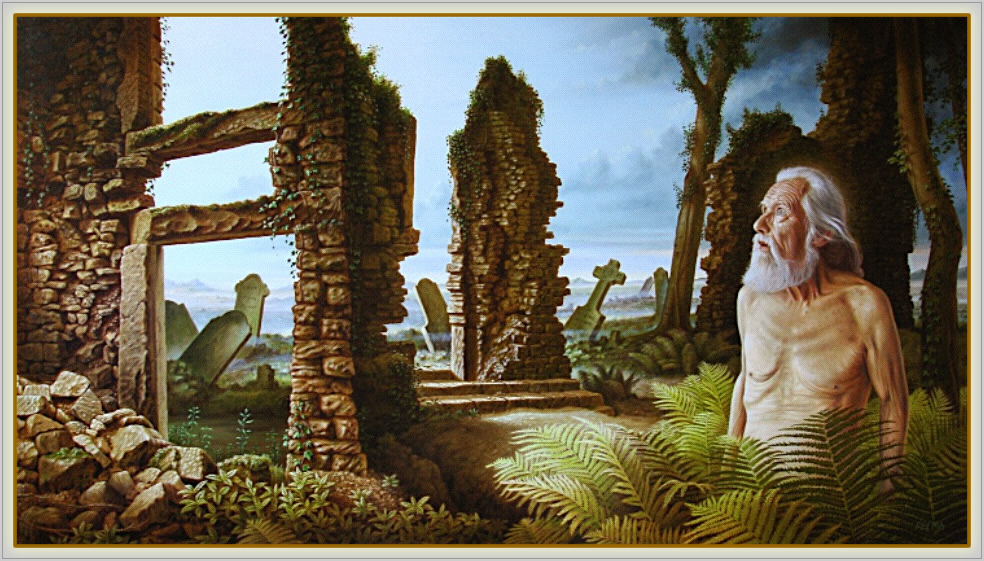
picture is a painting titled "Manu",
© by Wim Kuenen. Used with permission.
The second digitally adapted picture is a detail
of a painting in a Laotian Buddhist temple. Source.
Production: Filognostic
Association of The Order of Time.

Feed-back | Links | Downloads | Music | Pictures | What's New | Search | Donations