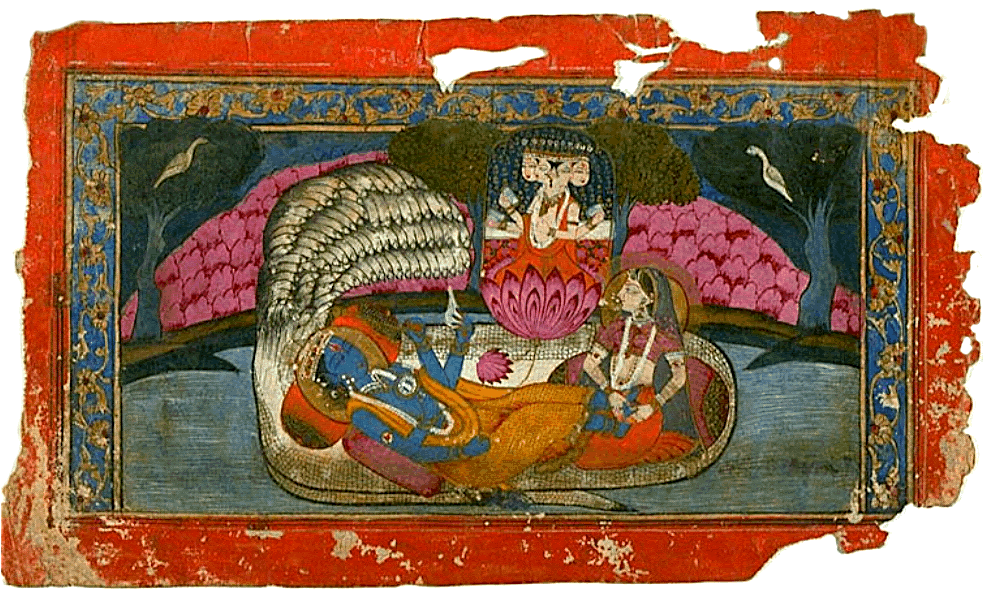
Canto 3
Chapter 20: The Beings Created by Brahmâ
(1) S'aunaka said: "After the position of the earth was restored [by Lord Varâha], oh son of Romaharshana [Sûta], what did Svâyambhuva Manu [see 2.7: 2, 3.12: 54, 3.13: 2] do to show the path to those who would be born? (2) Vidura, the great, unalloyed devotee and intimate friend of Lord Krishna, abandoned his elder brother [Dhritarâshthra] because he and his hundred sons went against Krishna. (3) Born of the body of Vyâsa and in no way inferior to him in greatness, he with all his heart took shelter of Lord Krishna and followed the souls devoted to Him. (4) What was it that this hero of purity, when he visited the holy places, asked Maitreya, the foremost knower of spiritual life whom he had met at Kus'âvarta [Hardwar] where he resided? (5) When the two had their conversation, oh Sûta, it resulted in the spotless narrations that, like the waters of the Ganges, vanquish all sins when one takes shelter of the lotus feet of the Lord. (6) All good fortune to you! Tell us the stories about His selfless deeds so worthy to be sung. What devotee, appreciative of the devotional mellows [rasas] one has with Him, would have enough of imbibing the nectar of the pastimes of the Lord?"
(7) Thus being questioned by the sages assembled in the Naimishâranya forest, Sûta, who had dedicated his mind to the Lord, then said to them: "Just listen to this."
(8) Sûta said: "Vidura, having heard how the Lord had assumed the body of a boar, He on His own power had uplifted the earth from the bottom of the ocean and as a good sport casually had killed Hiranyâksha, was overjoyed and addressed the sage. (9) Vidura said: 'Oh holy sage, knower of that which is beyond our scope, please tell me what Brahmâ began with after bringing forth the Prajâpatis who created mankind. (10) How did the scholars headed by Marîci observe the brahminical order of Svâyambhuva Manu and how have they developed this world? (11) Did they create it together with their wives, remained they independent or brought they all of this about in cooperation?'
(12) Maitreya said: 'Because of the Transcendental [Mahâ-Vishnu], the ever vigilant [Time] and difficult to fathom divine will, the equilibrium of the three basic qualities of nature got disturbed, because of which the complete of the material elements of the Fortunate One was produced. (13) From the [cosmic intelligence of the] mahat-tattva, by the threefold of the divine ordinance dominated by the quality of passion, the original gross body [the false ego of identification] was evolved in groups of five, beginning with the [group of the] ether and so on [the five gross elements with later on the five subtle elements, the working senses and the perceiving senses]. (14) Those elements, which separately could not bring about the coherence of the material universe, produced in combination with the union of the divine, a globe that shone like gold. (15) It was lying in the waters of the causal ocean as an egg, in an unconscious state, for [quite a bit] more than a thousand [celestial] years before the Lord [as Garbhodakas'âyî Vishnu] entered it. (16) From the Lord's navel the lotus sprouted of a thousand-and-more suns with a dazzling splendor [the galaxy, see 2.2: 24-25]. It is the abode of all conditioned souls where the self-born one [Lord Brahmâ, the Creator] found his existence as the first living entity. (17) When the Lord who sleeps in the causal waters entered Brahmâ's heart, he from his standard, his nature and rule, created the universe as he did before.
(18) First of all he from his shadow created the five types of ignorance called tâmisra [forgetfulness], andha-tâmisra [the illusion of death], tama [not knowing oneself], moha [the illusion of being matter] and mahâ-moha [mad after matter, craving; compare 3.12: 2]. (19) Dissatisfied Brahmâ threw off this body of ignorance that thereupon in the form of the darkness of night - which is the source of hunger and thirst - was seized by Yakshas [evil spirits] and Râkshasas [wild men, demons]. (20) Controlled by that hunger and thirst they ran after him in order to eat him and said in their affliction: 'Do not spare him!' (21) That disturbed the godhead and he told them: 'Do not eat me, but preserve me, for you Râkshasas and Yakshas are my sons!'
(22) The demigods who shine with the glory of enlightenment and were created first, took hold of the effulgent form of the daytime that was created as the vehicle of the divine. (23) The god, from his behind, next gave birth to the godless souls who, fond of sex, approached the Creator in lust for copulation. (24) At first the worshipable Lord had to laugh about being followed by the shameless ones of darkness, but he then, terrified and annoyed, hurried to get away. (25) He turned to Him whose feet are sought and bestows all boons, the Supreme Lord who dispels distress and who, in order to show His mercy to His devotees, manifests Himself in a suitable form. (26) 'Protect me, oh Supersoul, following Your order I created those sinful living beings who approach me for having sexual intercourse, oh Master. (27) Only You are capable of relieving the people who are afflicted by material miseries, only You can stop those who do not take shelter of Your feet.'
(28) He who unerringly knows the mind of each soul, upon seeing the distress of Lord Brahmâ said to him: 'Cast off your impure body'. Thus being commanded he cast it off. (29) That body [discarded assumed the form of a woman and] was intoxicating with tinkling ankle bells at its adorable feet, overwhelming eyes and a gold-ornamented shining girdle around the hips that were covered by fine cloth. (30) The breasts were tightly pressed together and raised high, the nose was well formed, the teeth beautiful, the smile lovely and the look defiant. (31) She hid herself out of shyness. Oh Vidura, all the godless souls fancying the braids of her dark hair were captivated by the woman: (32) 'Oh what a beauty, what a grace; oh what a budding youth! That she walks with us who are so desirous of her, as if she is free from passion!' (33) Indulging in all kinds of speculation about the evening twilight that had assumed the form of a young woman, the wicked-minded souls fond of her, full of respect asked her: (34) 'Who are you? To whom do you belong, oh pretty one? Why have you come here, oh fair lady? You are tantalizing us, unfortunate souls, with the priceless commodity of your beauty! (35) Whoever you may be, oh beautiful girl, by the fortune of seeing you playing with a ball, we onlookers have lost our head. (36) Moving your lotus feet about, oh beautiful woman, you bounce that ball with the palm of your hand. The weight of your full grown breasts must be tiresome for that waist of yours. You look as if you are tired, please loosen the tie of your hair!'
(37) The unenlightened souls, thus with their minds clouded, took the twilight of the evening for the wanton form of an alluring woman and seized her. (38) With a smile of deep significance the worshipful Lord then, by the self-awareness of His own sweetness, created the hosts of celestial musicians and dancing girls [the Gandharvas and Apsaras]. (39) The attractive form that factually was the shining moonlight He gave up and the Gandharvas headed by Vis'vâvasu gladly took possession of it. (40) After Lord Brahmâ from the sloth of the self had created the ghosts and evil spirits, he saw them naked and with disorderly hair, whereupon he closed his eyes. (41) They took possession of the body thrown off by the master of creation that is known as yawning. One sees the living beings with it drooling in their sleep, which is an unclean state that [with the ghosts and evil spirits belonging to it] constitutes the bewilderment of which one speaks as insanity. (42) Recognizing himself as being full of energy the worshipful Brahmâ, the master of all beings, from his invisible form created the hosts of Sâdhyas and Pitâs ['the ones to be propitiated' and the departed souls]. (43) They, the Pitâs, accepted that body, the source of their existence, and it is by that [unseen] body that those who are well versed in the rituals offer their oblations [called s'râddha] to these Sâdhyas and Pitâs. (44) The Siddhas [the ones of special powers] and the Vidyâdharas [the knowledgeable spirits] were created by his faculty of remaining hidden from vision. He gave them that wonderful form of himself known as Antardhâna [of being present but remaining unseen]. (45) From admiring himself seeing his reflection in the water, the master [Brahmâ] created the Kinnaras [the ones of power] and Kimpurushas [the monkey-like]. (46) They took possession of the form of the shadow he left behind, for reason of which they every daybreak [during the brâhma-muhûrta, one and a half hours before sunrise] gather with their spouses to glorify his exploits in song. (47) Once fully stretching his body as he lay down, he to his great concern saw that the creation lacked in progress. Thereupon he out of anger gave up that body also. (48) Oh Vidura, from the hairs falling from that crawling body the snakes came into being, the vicious cobras with big hoods on their necks.
(49) When he [once] felt as if he had accomplished his life's purpose, from his mind finally the Manus [the original fathers of mankind] appeared for promoting the welfare of the world. (50) He gave them the form of his own impassioned, personal body, seeing which those who were created earlier [the demigods] welcomed the Prajâpati [the founding father] with the following eulogy: (51) 'Oh Creator of the Universe, you created everything so very well: all the ritualistic customs you have settled so firmly for us to share in the sacrificial oblations! (52) By being of penance, through worship and by connectedness in yogic discipline being immersed in the finest absorption, you, the first seer, as the controller of the senses have evolved the sages, your beloved sons. (53) Each of them you, the unborn one, have given a part of your body characterized by deep meditation, yogic union, supernatural ability, penance, knowledge and renunciation.'


Third revised edition, loaded December 7, 2023.
Previous Aadhar edition and Vedabase links:
Saunaka said: "After the position of the earth was restored [by Lord Varâha], oh son of Romaharshana [Sûta], what did Svâyambhuva Manu [see 2.7: 2, 3.12: 54, 3.13: 2] do to show the path to those who would be born?S'aunaka said: "Having restored the position of the earth, o Sûta, what did Svâyambhuva Manu (see 2.7: 2, 3.12: 54, 3.13: 2) do to show those to be born the path? (Vedabase)
Vidura, the great, unalloyed devotee and intimate friend of Lord Krishna, abandoned his elder brother [Dhritarâshthra] because he and his hundred sons went against Krishna.
Vidura, the great unalloyed devotee and intimate friend of Lord Krishna, was abandoned by his elder brother [Dhritarâshthra] who was thus, along with his hundred sons, a great offender of Krishna. (Vedabase)
Born of the body of Vyâsa and in no way inferior to him in greatness, he with all his heart took shelter of Lord Krishna and followed the souls devoted to Him.
Born from the body of Vyâsa and in no way inferior to him in greatness, he with all his heart took shelter of Lord Krishna and followed those devoted to Him. (Vedabase)
What was it that this hero of purity, when he visited the holy places, asked Maitreya, the foremost knower of spiritual life whom he had met at Kus'âvarta [Hardwar] where he resided?
What did this hero of purity visiting the holy places ask Maitreya, the foremost knower of the spiritual life, whom he had met at Kus'âvarta [Hardwar] where he resided? (Vedabase)
When the two had their conversation, oh Sûta, it resulted in the spotless narrations that, like the waters of the Ganges, vanquish all sins when one takes shelter of the lotus feet of the Lord.
When the two had their conversation, o Sûta, did verily the spotless narrations arise that like the waters of the Ganges vanquish all sins once one has taken shelter of the Lord His lotus feet. (Vedabase)
All good fortune to you! Tell us the stories about His selfless deeds so worthy to be sung. What devotee, appreciative of the devotional mellows [rasas] one has with Him, would have enough of imbibing the nectar of the pastimes of the Lord?"
Tell us about those talks of greatness worth reciting and may all good befall you! Drinking the nectar of the Lord His pastimes a devotee who relates with Him would verily find satisfaction."(Vedabase)
Thus being questioned by the sages assembled in the Naimishâranya forest, Sûta, who had dedicated his mind to the Lord, then said to them: "Just listen to this."
Sûta, thus being questioned by the sages assembled in the Naimishâranya forest, with his mind dedicated to the Lord then said to them: "Just listen to this". (Vedabase)
Sûta said: "Vidura, having heard how the Lord had assumed the body of a boar, He on His own power had uplifted the earth from the bottom of the ocean and as a good sport casually had killed Hiranyâksha, was overjoyed and addressed the sage.
Sûta said: "Vidura, having heard about the Lord assuming the body of a boar, who through His own potency uplifted the earth from the bottom of the ocean and sportively killed the negligent Hiranyâksha, was overjoyed and addressed the sage. (Vedabase)
Vidura said: 'Oh holy sage, knower of that which is beyond our scope, please tell me what Brahmâ began with after bringing forth the Prajâpatis who created mankind.
Vidura said: 'O holy sage, knower of that which is beyond our scope, please tell me what Brahmâ began after bringing forth the Prajâpatis, the progenitors of mankind. (Vedabase)
How did the scholars headed by Marîci observe the brahminical order of Svâyambhuva Manu and how have they developed this world?
How did the learned ones headed by Marîci indeed live up to the brahminical order of Svâyambhuva Manu and how did they develop this world? (Vedabase)
Did they create it together with their wives, remained they independent or brought they all of this about in cooperation?'
Did they operate being married, did they remain independent or did all of them work together as they brought this all about?' (Vedabase)
Maitreya said: 'Because of the Transcendental [Mahâ-Vishnu], the ever vigilant [Time] and difficult to fathom divine will, the equilibrium of the three basic qualities of nature got disturbed, because of which the complete of the material elements of the Fortunate One was produced.
Maitreya said: 'From the elevated position of the Fortunate One [Mahâ-Vishnu] got - and this is difficult to explain - by the power of divine ordinance and the operation of eternal time, the equilibrium of the three modes in nature disturbed, so that the complete of the material elements was produced. (Vedabase)
From the [cosmic intelligence of the] mahat-tattva, by the threefold of the divine ordinance dominated by the quality of passion, the original gross body [the false ego of identification] was evolved in groups of five, beginning with the [group of the] ether and so on [the five gross elements with later on the five subtle elements, the working senses and the perceiving senses].
From the greatness of the cosmic intelligence [the mahat-tattva], took as ordained by the divine, in groups of five [five elements, five senses, five sense objects, five sense organs], beginning with the [spatial force field of the] ether the birth of the basic reality of the material elements place, in the threefold nature of which the element of passion [or quality of movement] predominates. (Vedabase)
Those elements, which separately could not bring about the coherence of the material universe, produced in combination with the union of the divine, a globe that shone like gold.
Those elements, which on themselves could not produce the material universe, having combined with the union of the divine produced a globe that shone like gold. (Vedabase)
It was lying in the waters of the causal ocean as an egg, in an unconscious state, for [quite a bit] more than a thousand [celestial] years before the Lord [as Garbhodakas'âyî Vishnu] entered it.
It lay in the waters of the causal Ocean as an egg in an unconscious state for a rainy season of in fact quite a bit longer than a thousand years before the Lord [as Garbhodakas'âyî Vishnu] entered it. (Vedabase)
From the Lord's navel the lotus sprouted of a thousand-and-more suns with a dazzling splendor [the galaxy, see 2.2: 24-25]. It is the abode of all conditioned souls where the self-born one [Lord Brahmâ, the Creator] found his existence as the first living entity.
Of the Lord His navel sprouted up the lotus of a thousand and more suns with a dazzling splendor [the galaxy, see 2.2: 24-25] which altogether was a resting place for the conditioned souls where he himself, the self-born one [Lord Brahmâ, the Creator] came about. (Vedabase)
When the Lord who sleeps in the causal waters entered Brahmâ's heart, he from his standard, his nature and rule, created the universe as he did before.
When the Lord, who was sleeping in the Causal Ocean, entered Brahmâ's heart, was by him according his own scheme the universe created as it was before. (Vedabase)
First of all he from his shadow created the five types of ignorance called tâmisra [forgetfulness], andha-tâmisra [the illusion of death], tama [not knowing oneself], moha [the illusion of being matter] and mahâ-moha [mad after matter, craving; compare 3.12: 2].
First of all was with his shadow ignorance created in five varieties called tâmisra [forgetfulness], andha tâmisra [the illusion of death], tama [not knowing oneself], moha [the illusion of being matter] and mahâmoha [mad after matter, craving; compare 3.12: 2]. (Vedabase)
Dissatisfied Brahmâ threw off this body of ignorance that thereupon in the form of the darkness of night - which is the source of hunger and thirst - was seized by Yakshas [evil spirits] and Râkshasas [wild men, demons].
Dissatisfied did Brahmâ throw off this body of ignorance which was then taken hold of by Yakshas [evil spirits] and Râkshasas [wild men, demons] to be the darkness, the source of hunger and thirst. (Vedabase)
Controlled by that hunger and thirst they ran after him in order to eat him and said in their affliction: 'Do not spare him!'
Overcome by that hunger and thirst they hunted to eat him crying out in their affliction: 'Do not spare him!' (Vedabase)
That disturbed the godhead and he told them: 'Do not eat me, but preserve me, for you Râkshasas and Yakshas are my sons!'
The godhead then anxiously told them: 'Do not eat me, but protect me, as you Râkshasas and Yakshas are my sons!' (Vedabase)
The demigods who shine with the glory of enlightenment and were created first, took hold of the effulgent form of the daytime that was created as the vehicle of the divine.
The demigods who, shining with the glory of the fear of God, first were created, took hold of the effulgent form of the daytime which as the vehicle of God was left behind. (Vedabase)
The god, from his behind, next gave birth to the godless souls who, fond of sex, approached the Creator in lust for copulation.
The god then from his backside gave birth to the godless who fond of sex approached the Creator in lust for copulation. (Vedabase)
At first the worshipable Lord had to laugh about being followed by the shameless ones of darkness, but he then, terrified and annoyed, hurried to get away.
It first made the worshipful Lord laugh to be followed by the shameless ones of darkness, but then terrified he, irritated, hurried to get away. (Vedabase)
Text 25
He turned to Him whose whose feet are sought and bestows all boons, the Supreme Lord who dispels distress and who, in order to show His mercy to His devotees, manifests Himself in a suitable form.
He turned to take shelter with Him who bestows all boons and whose feet are sought, the Lord who dispels distress and who, for showing His mercy to His devotees, manifests Himself in a suitable form: (Vedabase)
'Protect me, oh Supersoul, following Your order I created those sinful living beings who approach me for having sexual intercourse, oh Master.
'Protect me o Supersoul, by Your order I created those sinful living beings who approach me for having sex, o Master. (Vedabase)
Only You are capable of relieving the people who are afflicted by material miseries, only You can stop those who do not take shelter of Your feet.'
Only You can verily relieve the people afflicted with misery of their hindrances; only You can stop those who do not take shelter of Your feet.' (Vedabase)
He who unerringly knows the mind of each soul, upon seeing the distress of Lord Brahmâ said to him: 'Cast off your impure body'. Thus being commanded he cast it off.
He who without fail can see into each soul, seeing the distress of Lord Brahmâ, then told him: 'Cast off your impure body' and thus commanded he cast it off. (Vedabase)
That body [discarded assumed the form of a woman and] was intoxicating with tinkling ankle bells at its adorable feet, overwhelming eyes and a gold-ornamented shining girdle around the hips that were covered by fine cloth.
That body [in the form of a woman] was intoxicating with tinkling ankle bells, adorable feet, overwhelming eyes and a gold-ornamented shining girdle around hips covered by fine cloth. (Vedabase)
The breasts were tightly pressed together and raised high, the nose was well formed, the teeth beautiful, the smile lovely and the look defiant.
The breasts were, closely pressed together, highly raised, the nose was well formed, the teeth beautiful, the smile lovely and the glance sportive. (Vedabase)
She hid herself out of shyness. Oh Vidura, all the godless souls fancying the braids of her dark hair were captivated by the woman:
She hid herself out of shyness and, o Vidura, in fancying the tresses of her dark hair, were all the godless ones captivated by the woman: (Vedabase)
'Oh what a beauty, what a grace; oh what a budding youth! That she walks with us who are so desirous of her, as if she is free from passion!'
'O what a beauty, what a grace; o what a budding youth; that she walks with us, so desirous after her; as if she's free from passion!' (Vedabase)
Indulging in all kinds of speculation about the evening twilight that had assumed the form of a young woman, the wicked-minded souls fond of her, full of respect asked her:
Indulging in speculations of all kind on the evening twilight [of their passion] that had taken the form of a young woman, did the wicked-minded ones fond of her full of respect question her: (Vedabase)
'Who are you? To whom do you belong, oh pretty one? Why have you come here, oh fair lady? You are tantalizing us, unfortunate souls, with the priceless commodity of your beauty!
'Who are you? Whom do you belong to, o pretty one? Why have you come here, o passionate lady? You are tantalizing us, unfortunate ones, with the priceless commodity of your beauty! (Vedabase)
Whoever you may be oh beautiful girl, by the fortune of seeing you playing with a ball, we onlookers have lost our head.
Whosoever you may be, o beautiful girl, by the fortune of seeing you is the mind of us, the onlookers you agite, a ball to play with. (Vedabase)
Moving your lotus feet about, oh beautiful woman, you bounce that ball with the palm of your hand. The weight of your full grown breasts must be tiresome for that waist of yours. You look as if you are tired, please loosen the tie of your hair!'
By your moving your lotus feet about, o beautiful woman, you bounce that ball with the palm of your hand; the weight of your full grown breasts must be tiresome for that waist of yours; you look as if you're tired, loosen the binding of your hair!' (Vedabase)
The unenlightened souls, thus with their minds clouded, took the twilight of the evening for the wanton form of an alluring woman and seized her.
This way was the twilight of the evening by the godless seen in an alluring wanton form and bewildered thinking it to be a woman, they seized her. (Vedabase)
With a smile of deep significance the worshipful Lord then, by the self-awareness of His own sweetness, created the hosts of celestial musicians and dancing girls [the Gandharvas and Apsaras].
With a smile of deep significance, the worshipful Lord then, by the sweetness of Himself by Himself, created the hosts of celestial musicians and dancing girls [the Gandharvas and Apsaras]. (Vedabase)
The attractive form that factually was the shining moonlight He gave up and the Gandharvas headed by Vis'vâvasu gladly took possession of it.
That beloved form of in fact the shining moonlight he gave up and the Gandharvas headed by Vis'vâvasu gladly took possession of it. (Vedabase)
After Lord Brahmâ from the sloth of the self had created the ghosts and evil spirits, he saw them naked and with disorderly hair, whereupon he closed his eyes.
When Lord Brahmâ, from laziness having created the ghosts and evil spirits, saw them naked and with disorderly hair, he closed his two eyes. (Vedabase)
They took possession of the body thrown off by the master of creation that is known as yawning. One sees the living beings with it drooling in their sleep, which is an unclean state that [with the ghosts and evil spirits belonging to it] constitutes the bewilderment of which one speaks as insanity.
The body known as yawning that the master of creation threw off and of which one sees the living beings drooling in their sleep in an unclean state, is the bewilderment of which one speaks as insanity. (Vedabase)
Recognizing himself as being full of energy the worshipful Brahmâ, the master of all beings, from his invisible form created the hosts of Sâdhyas and Pitâs ['the ones to be propitiated' and the departed souls].
Recognizing himself as being full of energy did the worshipful Brahmâ, the master of all beings, from his invisible form create the hosts of Sâdhyas and Pitâs [the invisible demigods and departed souls]. (Vedabase)
They, the Pitâs, accepted that body, the source of their existence, and it is by that [unseen] body that those who are well versed in the rituals offer their oblations [called s'râddha] to these Sâdhyas and Pitâs.
They, the Pitâs, accepted that body, the source of their existence, and it is through that body that those well versed in the rituals do their oblations [called s'râddha] to these Sâdhyas and Pitâs. (Vedabase)
The Siddhas [the ones of special powers] and the Vidyâdharas [the knowledgeable spirits] were created by his faculty of remaining hidden from vision. He gave them that wonderful form of himself known as Antardhâna [of being present but remaining unseen].
The Siddhas [the ones of special powers] and also the Vidyâdharas [the knowledgeable spirits] were created by his faculty of remaining hidden from vision. To them he gave that wonderful form of himself known as Antardhâna [of being present but remaining unseen]. (Vedabase)
From admiring himself seeing his reflection in the water, the master [Brahmâ] created the Kinnaras [the ones of power] and Kimpurushas [the monkey-like].
From admiring himself seeing his reflection in the water the master created by himself the Kinnaras and Kimpurushas. (Vedabase)
They took possession of the form of the shadow he left behind, for reason of which they every daybreak [during the brâhma-muhûrta, one and a half hours before sunrise] gather with their spouses to glorify his exploits in song.
They took possession of the form of the shadow he left behind, for the reason of which they exactly at daybreak gathering with their spouses praise his exploits in song. (Vedabase)
Once fully stretching his body as he lay down, he to his great concern saw that the creation lacked in progress. Thereupon he out of anger gave up that body also.
Once fully stretching his body lying down he with great concern saw that the creation lacked in progress, whereupon he out of anger gave up that body also. (Vedabase)
Oh Vidura, from the hairs falling from that crawling body the snakes came into being, the vicious cobras with big hoods on their necks.
From the hairs dropping out from that body were they, the limbless, created, o Vidura, that took birth as snakes from whose crawling bodies the vicious cobra's big hoods of their necks are seen. (Vedabase)
When he [once] felt as if he had accomplished his life's purpose, from his mind finally the Manus [the original fathers of mankind] appeared for promoting the welfare of the world.
Contented with himself as if he had accomplished the object of his life, at last then from his mind came about the Manus for promoting the welfare of the world. (Vedabase)
He gave them the form of his own impassioned, personal body, seeing which those who were created earlier [the demigods] welcomed the Prajâpati [the founding father] with the following eulogy:
Them he gave the form of his own self-assured personal body, upon the sight of which those earlier created, celebrated the Prajâpati [the father of mankind] in welcome: (Vedabase)
'Oh Creator of the Universe, you created everything so very well: all the ritualistic customs you have settled so firmly for us to share in the sacrificial oblations!
'O Creator of the Universe, how well you did produce and, oh, how soundly did you establish all the ritualistic customs with which we shall share in the sacrificial oblations! (Vedabase)
By being of penance, through worship and by connectedness in yogic discipline being immersed in the finest absorption, you, the first seer, as the controller of the senses have evolved the sages, your beloved sons.
By penance, worship, connected in yogic discipline and in the finest absorption, did the first seer, the controller of the senses, evolve the sages, his beloved sons. (Vedabase)
Each of them you, the unborn one, have given a part of your body characterized by deep meditation, yogic union, supernatural ability, penance, knowledge and renunciation.'
To each of them did he, the unborn one, give a part of his own body that carried deep meditation, yogic union, supernatural ability, penance, knowledge and renunciation.' (Vedabase)

The text and audio are offered under the
conditions of the
Creative Commons Attribution-Noncommercial-Share Alike 3.0
Unported License.
The image is
titled: "Vishnu on Ananta". Date: around early 19th century.
Indian manuscript. See also: restored version. Source: The
University
of Michigan Museum of Art.
Production: Filognostic
Association of The Order of Time.

Feed-back | Links | Downloads | Music | Pictures | What's New | Search | Donations