
Canto 10
Canto 10
Chapter 62: Ûshâ in Love and Aniruddha Apprehended
(1) The honorable king said: 'Bâna's daughter named Ûshâ ['dawn'] married the best of the Yadus [Aniruddha]. Because of the marriage a great and terrible battle took place between the Lord and S'ankara [S'iva as 'the auspicious one']. Oh great yogi, it is up to you to explain all this.'
(2) S'rî S'uka said: 'Bâna ['arrow'], the eldest son of the one hundred sons born from the semen of Bali ['gift'] - the great soul who donated the earth to the Lord who had appeared in the form of Vâmana [see 8.19-22] -, was respectable, magnanimous, intelligent and truthful in his vows, and always fixed in his devotion for Lord S'iva. In the charming city known as S'onita ['resin'] he founded his kingdom, where the immortals served him like menial servants. They did that because S'ambhu ['the beneficent one' or S'iva] in the past had been pleased by him as he, endowed with a thousand arms, had played musical instruments while Mrida [S'iva as 'the gracious one'] was dancing. (3) He, the great lord and master of all created beings, the compassionate one offering shelter to his devotees, rewarded him with a benediction of his choice. Bâna then chose for him [S'iva] as the protector of his city. (4) Intoxicated by his strength, Bâna, one day being present at his side, said to Giris'a [S'iva as the lord of the mountain] while touching his lotus feet with a helmet as bright as the sun: (5) 'I bow down to you Mahâdeva ['great god'], oh controller and spiritual master of the worlds, who, like a tree from heaven, fulfills all the wishes of the people who feel unfulfilled. (6) The one thousand arms you gave me have become but a burden to me. Except for you I cannot find an equal opponent in the three worlds. (7) With my arms itching to pulverize mountains, I proceeded to fight the elephants of all directions, oh primeval one, but terrified of me they all ran away.'
(10) His virgin daughter named Ûshâ, in a dream had an amorous encounter with the son of Pradyumna, a lover she thus had found without ever having seen or heard of him before [see *]. (11) Not seeing him anymore in her dream, she - being among her girlfriends - rose up disturbed and was most embarrassed to hear herself say: 'Where are you my lover?' (12) The daughter Citralekhâ ['the fine sketch artist'] of a minister of Bâna named Kumbhânda, thereupon as a friend of hers most curiously questioned her companion Ûshâ. (13) 'Who is it you are looking for, oh beautiful eyebrows, and what do you expect from him, for we as yet have not seen anyone winning your hand, oh princess.'
(14) 'In my dream I saw a certain man with a dark complexion, lotuslike eyes, yellow garments and mighty arms - one of the kind that stirs a woman's heart. (15) He is the one I am seeking. That lover made me drink the honey of his lips, went elsewhere and left me hankering for him, being thrown in an ocean of distress.'
(16) Citralekhâ said: 'I will take your distress away! If he can be found anywhere in the three worlds, I will bring him to you, that [future] husband, that thief who stole your heart. Please point him out to me.'
(17) Thus having spoken she accurately drew for her the demigod and the heavenly singer, the perfected soul, the venerable soul and the lowlife serpent, the demon, the magician, the supernatural being and the human being. (18-19) Of the humans she drew Vrishnis like S'ûrasena, Vasudeva, Balarâma and Krishna, but seeing Pradyumna Ûshâ became bashful and with Aniruddha being drawn she bent down her head in embarrassment, oh great lord, and said smiling: 'That is Him, that One here!' (20) Citralekhâ, the yoginî, with Him, Krishna's grandson [Aniruddha], being recognized, oh King, then traveled by the higher spheres [the mystical way] to Dvârakâ, the city under the protection of Krishna. (21) Using her yogic power, she took Pradyumna's son who was sleeping on a fine bed, to S'onitapura and showed her girlfriend her Beloved. (22) Seeing Him, that most beautiful man, her face lit up. Together with the son of Pradyumna she then enjoyed in her private quarters that men were not allowed to see. (23-24) She worshiped Him in faithful service with priceless garments, garlands, fragrances, lamps, sitting places and such, with beverages, liquid and solid food and with words. Thus continuously keeping Him hidden in the maiden quarters He, who because of Ûshâ's greatly increasing affection was diverted in His senses, lost count of the days. (25-26) Thus enjoyed by the Yadu hero she, in breaking her vow [of chastity], could not conceal the symptoms of her extreme happiness. They were noticed by her governesses who reported [to Bâna, her father]: 'Oh King, we have noticed that your daughter is of a conduct not respectable for an unmarried girl, she besmirches the family. (27) She was well guarded by us within the palace and never left, oh master. We have no idea how she, hidden from the looks of men, could have been dishonored.'
(28) When Bâna heard that his daughter had been defiled, he most disturbed quickly headed for the maiden quarters. Arriving there he saw the most superior Yadu. (29-30) He stood perplexed to behold that son of Cupid sitting in front of her. That exclusive beauty of all the worlds, dark-skinned in yellow clothes, with His lotus eyes, mighty arms, earrings and locks, sat there with a face lit up by His glowing ornaments and smiling glances. He was playing dice with His all-auspicious sweetheart, the red kunkuma of whose breasts was found all over the, by her manufactured, springtime jasmine garland that hung between His arms. (31) Seeing him entering surrounded by many armed guards, the Sweet Lord raised His club made of muru [a type of iron] and stood firm ready to strike, like death personified holding the rod of punishment. (32) Closing in from all sides to apprehend Him, He attacked them like a dominant boar cornered by a pack of dogs, so that they all with their heads, arms and legs crushed, being hurt ran away to escape from the palace. (33) But even as He was striking down the guards, the son of Bali himself furiously captured Him with the [mystical] snake ropes [of Varuna, see also 8.21: 28]. Ûshâ, utterly defeated and discouraged, was overwhelmed by sorrow upon seeing the arrest and cried bitter tears.'


Third revised edition, loaded June 27, 2021.
Previous Aadhar edition and Vedabase links:
The honorable king said: 'Bâna's daughter named Ûshâ ['dawn'] married the best of the Yadus [Aniruddha]. Because of the marriage a great and terrible battle took place between the Lord and S'ankara [S'iva as 'the auspicious one']. Oh great yogi, it is up to you to explain all this.'The honorable king said: 'Bâna's daughter named Ûshâ ['dawn'] married the best of the Yadus [Aniruddha] and because of that took a great and terrible battle place between the Lord and S'ankara [S'iva as 'the auspicious']; o great yogi, I give it to you to explain all this.' (Vedabase)
S'rî S'uka said: 'Bâna ['arrow'], the eldest son of the one hundred sons born from the semen of Bali ['gift'] - the great soul who donated the earth to the Lord who had appeared in the form of Vâmana [see 8.19-22] -, was respectable, magnanimous, intelligent and truthful in his vows, and always fixed in his devotion for Lord S'iva. In the charming city known as S'onita ['resin'] he founded his kingdom, where the immortals served him like menial servants. They did that because S'ambhu ['the beneficent one' or S'iva] in the past had been pleased by him as he, endowed with a thousand of arms, had played musical instruments while Mrida [S'iva as 'the gracious one'] was dancing.
S'rî S'uka said: 'Bâna ['arrow'], the eldest son of the one hundred sons born from the semen of Bali ['gift'] - the great soul who donated the earth to the Lord who had appeared in the form of Vâmana [see 8.19-22] -, was, respectable and magnanimous, intelligent and truthful in his vows, always fixed in his devotion for Lord S'iva. In the charming city known as S'onita ['resin'] made he his kingdom, where the immortals served him as if they were menial servants. They did so because in the past S'ambhu ['the beneficent' or S'iva] had been pleased by him as he, having a thousands arms, had played musical instruments while Mrida [S'iva as 'the gracious'] was dancing. (Vedabase)
He, the great lord and master of all created beings, the compassionate one offering shelter to his devotees, rewarded him with a benediction of his choice. Bâna then chose for him [S'iva] as the protector of his city.
He, the great lord and master of all created beings, the compassionate giver of shelter to his devotees, rewarded him with a benediction to his choice and he chose for him [S'iva] as the guardian of his city. (Vedabase)
Intoxicated by his strength, Bâna, one day being present at his side, said to Giris'a [S'iva as the lord of the mountain] while touching his lotus feet with a helmet as bright as the sun:
He, intoxicated by his strength, with a helmet bright as the sun once present at his side said to Giris'a [S'iva as the lord of the mountain] touching his lotus feet: (Vedabase)
'I bow down to you Mahâdeva ['great god'], oh controller and spiritual master of the worlds, who, like a tree from heaven, fulfills all the wishes of the people who feel unfulfilled.
'I bow down to you Mahâdeva [great god], o controller and spiritual master of the worlds who like a tree from heaven fulfills all the wishes of the people who feel unfulfilled. (Vedabase)
The one thousand arms you gave me have become but a burden to me. Except for you I cannot find an equal opponent in the three worlds.
The one thousand arms you gave me have become but a burden to me and except for you do I in the three worlds not find an equal opponent. (Vedabase)
With my arms itching to pulverize mountains, I proceeded to fight the elephants of all directions, oh primeval one, but terrified of me they all ran away.'
With my arms itching to pulverize mountains I went to fight the elephants of all directions o primeval one, but terrified of me they all ran away.' (Vedabase)
Hearing that the great lord said infuriated: 'Your flag will be broken, oh fool, when your pride is vanquished in a battle you have with someone like me.'
Hearing that said the great lord incensed: 'Your flag will be broken when, o fool, your pride is vanquished in battle with someone equal to me.' (Vedabase)
Thus being addressed, the foolish character went home full of delight, oh king, unintelligently waiting there for the demise of his heroism as was predicted by the lord of the mountain [compare 2.1: 4].
Thus addressed went the poorminded one filled with delight home, o king, not so intelligent awaiting his heroism to be crushed as the lord of the mountain had predicted [compare 2.1: 4]. (Vedabase)
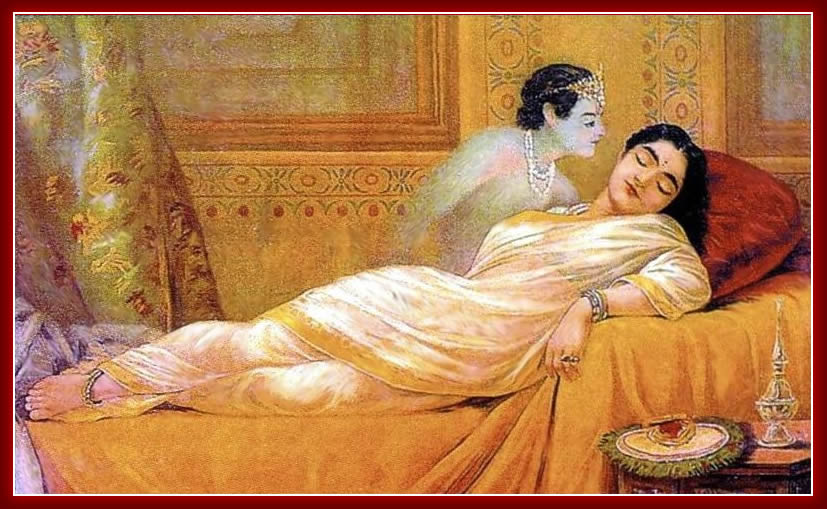
His virgin daughter named Ûshâ, in a dream had an amorous encounter with the son of Pradyumna, a lover she thus had found without ever having seen or heard of him before [see *].
His virgin daughter named Ûshâ in a dream had an amorous encounter with the son of Pradyumna while she never before had seen or heard of the lover she thus had found [see *]. (Vedabase)
Not seeing him anymore in her dream, she - being among her girlfriends - rose up disturbed and was most embarrassed to hear herself say: 'Where are you my lover?'
She, not seeing him [anymore] in her dream, disturbed rose to her feet while she was in the midst of her girlfriends and felt greaty embarrassed hearing herself say 'Where are you my lover?' (Vedabase)
The daughter Citralekhâ ['the fine sketch artist'] of a minister of Bâna named Kumbhânda, thereupon as a friend of hers most curiously questioned her companion Ûshâ.
The daughter Citralekhâ ['the fine sketch-artist'] of a minister of Bâna named Kumbhânda, thereupon as a friend of hers most curiously questioned her companion Ûshâ. (Vedabase)
'Who is it you are looking for, oh beautiful eyebrows, and what do you expect from him, for we as yet have not seen anyone winning your hand, oh princess.'
'Who is it you're looking for o beautiful eyebrows, and what is it that you expect from him, for we as yet haven't seen anyone winning your hand o princess.' (Vedabase)
'In my dream I saw a certain man with a dark complexion, lotuslike eyes, yellow garments and mighty arms - one of the kind that stirs a woman's heart.
'In my dream I saw a certain man with a dark complexion, lotuslike eyes, yellow garments and mighty arms - one of the kind stirring a woman's heart. (Vedabase)
He is the one I am seeking. That lover made me drink the honey of his lips, went elsewhere and left me hankering for him, being thrown in an ocean of distress.'
Him I am seeking, that lover who made me drink the honey of His lips and who, gone elsewhere, has left me, hankering for Him, in an ocean of distress.' (Vedabase)
Citralekhâ said: 'I will take your distress away! If he can be found anywhere in the three worlds, I will bring him to you, that [future] husband, that thief who stole your heart. Please point him out to me.'
Citralekhâ said: 'I'll take away your distress; if He's to be found anywhere in the three worlds, I'll bring Him to you, that husband-to-be, that thief who stole your heart - please point Him out to me.' (Vedabase)
Thus having spoken she accurately drew for her the demigod and the heavenly singer, the perfected soul, the venerable soul and the lowlife serpent, the demon, the magician, the supernatural being and the human being.
Thus having spoken she accurately drew for her the demigod and the heavenly singer, the one perfected, the venerable one and the lowlife serpent, the demon, the magician, the supernatural and the human being. (Vedabase)
Of the humans she drew Vrishnis like S'ûrasena, Vasudeva, Balarâma and Krishna, but seeing Pradyumna Ûshâ became bashful and with Aniruddha being drawn she bent down her head in embarrassment, oh great lord, and said smiling: 'That is Him, that One here!'
Of the humans she drew Vrishnis like S'ûrasena, Vasudeva, Balarâma and Krishna but seeing Pradyumna Ûshâ became bashful and with Aniruddha being drawn she bent down her head in embarrassment o great lord, and said smiling: 'That's Him, that one here!' (Vedabase)
Citralekhâ, the yoginî, with Him, Krishna's grandson [Aniruddha], being recognized, oh King, then traveled by the higher spheres [the mystical way] to Dvârakâ, the city under the protection of Krishna.
Citralekhâ, the yoginî, recognizing Him as Krishna's grandson [Aniruddha] then went, o King, by the higher spheres [the mystical way] to Dvârakâ, the city under the protection of Krishna. (Vedabase)
Using her yogic power, she took Pradyumna's son who was sleeping on a fine bed, to S'onitapura and showed her girlfriend her Beloved.
Pradyumna's son asleep on a fine bed did she, using her yogic power, take from there to S'onitapura in order to show her girlfriend her Beloved. (Vedabase)
Seeing Him, that most beautiful man, her face lit up. Together with the son of Pradyumna she then enjoyed in her private quarters that men were not allowed to see.
Upon seeing Him, that most beautiful man, lit her face up and had she a good time together with the son of Pradyumna in her private quarters, a place forbidden to the sight of men. (Vedabase)
She worshiped Him in faithful service with priceless garments, garlands, fragrances, lamps, sitting places and such, with beverages, liquid and solid food and with words. Thus continuously keeping Him hidden in the maiden quarters He, who because of Ûshâ's greatly increasing affection was diverted in His senses, lost count of the days.
With priceless garments, garlands, fragrances, lamps, sitting places and such; with beverages, liquid and solid food and with words she worshiped Him in faithful service. And thus continuously keeping Him hidden in the maiden quarters lost He, because of her greatly increasing affection, the count of days, the way He in His senses was diverted by Ûshâ. (Vedabase)
Thus enjoyed by the Yadu hero she, in breaking her vow [of chastity], could not conceal the symptoms of her extreme happiness. They were noticed by her governesses who reported [to Bâna, her father]: 'Oh King, we have noticed that your daughter is of a conduct not respectable for an unmarried girl, she besmirches the family.
She thus enjoyed by the Yadu-hero in breaking her vow [of chastity] could not conceal the symptoms of her extreme happiness that were noticed by her governesses who reported [to Bâna, her father]: 'O King, we've noticed that your daughter is of the for an unmarried girl faulty conduct that besmirches the family. (Vedabase)
She was well guarded by us within the palace and never left, oh master. We have no idea how she, hidden from the looks of men, could have been dishonored.'
Well guarded by us within the palace and never having left, o master, have we no idea how she, hidden from the looks of men, could have been deflowered.' (Vedabase)
When Bâna heard that his daughter had been defiled, he most disturbed quickly headed for the maiden quarters. Arriving there he saw the most superior Yadu.
Bâna upon hearing of the defilement of his daughter most disturbed quickly headed for the maiden quarters where he upon his arrival saw the most eminent of the Yadus. (Vedabase)
He stood perplexed to behold that son of Cupid sitting in front of her. That exclusive beauty of all the worlds, dark-skinned in yellow clothes, with His lotus eyes, mighty arms, earrings and locks, sat there with a face lit up by His glowing ornaments and smiling glances. He was playing dice with His all-auspicious sweetheart, the red kunkuma of whose breasts was found all over the, by her manufactured, springtime jasmine garland that hung between His arms.
He stood perplexed to behold sitting in front of her that son of Cupid, the exclusive beauty of all the worlds, dark-skinned in yellow clothes, with His lotuseyes, mighty arms, earrings and locks, smiling with the glow and glances from His adorned face, as He played dice with His all-auspicious sweetheart, of whom the red of the kunkuma of her breasts was smeared all over the by her manufactured springtime jasmine garland that hung between His arms. (Vedabase)
Seeing him entering surrounded by many armed guards, the Sweet Lord raised His club made of muru [a type of iron] and stood firm ready to strike, like death personified holding the rod of punishment.
Seeing him entering surrounded by many an armed guard raised the Sweet Lord His club made of muru [a type of iron] to stand firm, ready to strike like death personified with the rod of punishment. (Vedabase)
Closing in from all sides to apprehend Him, He attacked them like a dominant boar cornered by a pack of dogs, so that they all with their heads, arms and legs crushed, being hurt ran away to escape from the palace.
They, closing in from all sides to apprehend Him, were by Him struck like a dominant boar faced with a pack of dogs so that they all being hit ran to escape from the palace with their heads, arms and legs crushed. (Vedabase)
But even as He was striking down the guards, the son of Bali himself furiously captured Him with the [mystical] snake ropes [of Varuna, see also 8.21: 28]. Ûshâ, utterly defeated and discouraged, was overwhelmed by sorrow upon seeing the arrest and cried bitter tears.'
But as He was striking down the guards, did the son of Bali furiously himself capture Him with the [mystical] snake-ropes [of Varuna, see also 8.21: 28]. Ûshâ then was utterly defeated and discouraged, overwhelmed by sorrow crying bitter tears when she heard of the arrest.' (Vedabase)
*: Here S'rîla Vis'vanâtha Cakravartî Thhâkura quotes the following verses from the Vishnu Purâna (V.32), which explain Ûshâ's dream: 'Oh brâhmana, when Ûshâ, the daughter of Bâna, happened to see Pârvatî playing with her husband, Lord S'ambhu, Ûshâ intensely desired to experience the same feelings. At that time Goddess Gaurî [Pârvatî], who knows everyone's heart, told the sensitive young girl: 'Don't be so disturbed! You will have a chance to enjoy with your own husband.' Hearing this, Ûshâ thought to herself: 'But when? And who will my husband be?' In response, Pârvatî addressed her once more: 'The man who approaches you in your dream on the twelfth lunar day of the bright fortnight of the month Vais'âkha will become your husband, oh princess.'


Feed-back | Links | Downloads | Music | Pictures | What's New | Search | Donations



 Text 1