|
Srîmad Bhâgavatam
&
Bhagavad Gîtâ Time Quotes:
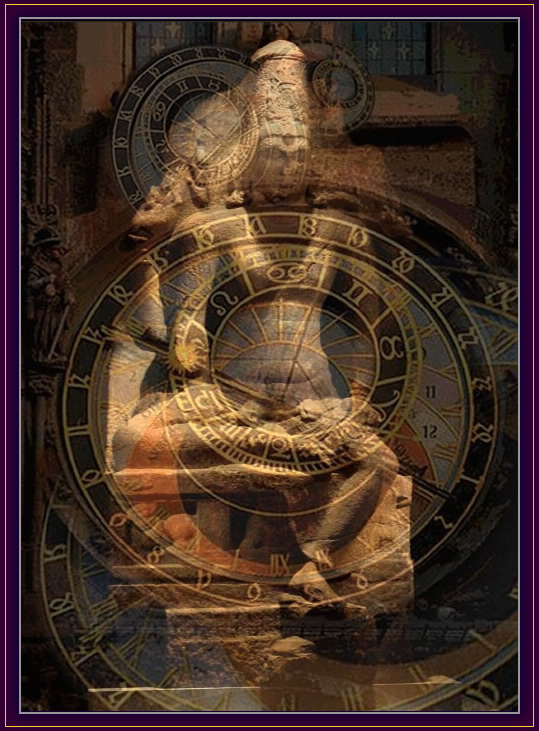
In the meditations of the
different forms of yoga it is all about
transcending the duality and developing
stability in that consciousness above
matter. One of the most primary dualities is
the one of the personal, the completeness,
the integrity as opposed to the impersonal,
the numerical, the temporary and distinct.
In the Bhâgavatam both are dealt with. For
when we meditate, with or without a mantra,
we become aware of the different dualities
and attain equilibrium with them. Then we
see matters the way they are and are freed
from illusion. That constitutes the basis of
all religiosity and science. Striving for
freedom from illusion is the essence of and
condition for that what we call
civilization. Thus constitutes meditating on
time, with calendars and clocks, and thus
learning to observe, respect and experience
time, the course of time and the changing
moment of the eternal Now the way we have it
naturally (see tempometer), the perfect
counterpart of the religious or not
religious meditation upon the person (of
God), the transcendence towards the
complete, the acquiring of an overview and
reaching of an integrity of beatitude. When
one respects one half, one automatically
achieves respect and motivation for the
proper order of the reality of the other
half of this duality. Thus to meditate upon
and have respect for the natural order of
time leads to meditation on and respect for
the original nature and order of the person.
When one is soberly aware of the time the
way it has its course in nature, one is
consequently also aware of the counterpart
constituted by the person as the ideal
integrity, the coherence and the
completeness and unification of the forces
of nature as a form of conscious control, as
a conscious counterplay of those further
impersonal forces of nature. The person thus
cannot be separated from his natural
counterpart that is the impersonal. One
belongs to the other, the one exists because
of the other, the way light and darkness and
heat and cold do. In order to offer a clear
notion of how this impersonal aspect is
described in the Bhâgavatam, I offer here an
overview of all that in this book is stated
about time.
Anand Aadhar Prabhu
Canto
1
S.B. 1.5: 18
The
philosophically inclined should for
that reason endeavor only for this
[spiritual fulfillment] that is not
so much found by searching from high
to low, because material fulfillment
- countered by miseries - is in the
course of the time that operates so
subtly, found anyhow as a result of
one's actions.
S.B. 1.6: 8-9
Being
only five years old, I attended the school
of the brahmins and lived, depending on her,
without having a clue about time, place and
direction.
When she once went out at night to milk a
cow, she was bitten in the leg by a snake on
the path and thus my poor mother fell victim
of the supreme time.
S.B. 1.8: 4
Krishna
together with the munis pacified the
shocked and affected family who had lost
their friends and members, by showing how
each is subjected to the Time that cannot
be avoided.
S.B. 1.8: 28
I consider
You the personification of Eternal
Time, the Lord without a beginning or
an end, the All-pervasive One who
distributes His mercy everywhere,
equally, among the beings who live in
mutual dissent.
S.B. 1.9:
14-15
All the
unpleasant that transpired, I think, is
the inescapable effect of Time; you, just
like the rest of the world with its ruling
demigods, fall under that control the way
clouds are carried by the wind.
Why else
would there be such misfortune with
Yudhishthhira, the son of the ruler of
religion, being present, as also Bhîma
with his mighty club, Arjuna carrying his
Gândîva and our well-wisher Krishna?
S.B. 1.11: 6
They said: 'We have
always bowed down to Your lotus
feet, oh Lord, like one does in the
worship of Brahmâ and his sons and
the king of heaven. You after all
are for the ones who desire the
supreme welfare in this life, the
Master of Transcendence upon whom
the inevitable time has no grip.
S.B. 1.13:
17-20
But the insurmountable and
imperceptible
Time surpasses inimitably those who are inattentive
and engrossed in the mind of attachment to
family affairs.
Vidura, well aware of this, said to
Dhritarâshthra: 'Oh
King, [dear brother], please withdraw
yourself without delay, just see how fear
is ruling your life.
In this material world, oh master, there is
no help from anyone or anything to escape
this fear, because that fear concerns the
Supreme Lord who approaches us all in the
form of eternal Time.
Inevitably overtaken by the pull of time a
person must, just like that, give up this
life, as dear as it is to everyone, not to
mention the wealth and such he has acquired.
S.B. 1.13: 46
How is
this body, which is made out of the five
elements [fire, water, air, earth and
ether] and is controlled by time, by
materially motivated action and by the
modes of nature [kâla, karma and the
gunas], capable of protecting others when
it is just as well bitten by that snake?
S.B. 1.13: 49
He, the Father
of all creation, the Supreme Lord, has
now, oh great King, descended in this
world in the form of [death, the
all-devouring] Time, in order to
eliminate everyone inimical to the
enlightened souls.
S.B. 1.14: 3
The time had
taken an inauspicious turn: he observed
seasonal irregularities and saw that
human beings sinfully turned to anger,
greed and falsehood in heartening their
civil means of livelihood.
S.B. 1.14: 5
The people
gradually were acquiring godless habits
like wantonness and such. The king facing
these serious matters and bad omens, spoke
with his younger brother about it.
S.B. 1.14: 8
Might it be so
that, as Nârada told us, the Supreme
Personality has decided it is time to
leave this physical manifestation of
Himself?
S.B. 1.15: 27
Bearing in
mind the words spoken by Govinda, I
remember how attractive they are, and how
they, imbued with importance and
appropriate to time and circumstance, put
an end to the pain in the heart.' "
S.B. 1.16: 24
Please
inform me, oh reservoir of all riches, about
the reason of your sadness that reduced you
to such a weak state. Or has, oh mother,
powerful Time that even subdues the most
powerful soul, stolen away your good fortune
extolled by the demigods?'
S.B. 1.18: 37
'Verily,
seven days from now
the wretched soul of the dynasty who
offended my father will,
because of breaking with the
etiquette, be bitten by a snake-bird.'
S.B. 1.19: 4
Thus pondering, the
message reached him of the curse of
death pronounced by the sage's son.
That curse in the form of the fire of
a snake bird, he accepted as
auspicious because that impending
happening would be the consequence of
his indifference about worldly affairs.
Canto 2
S.B. 2.1: 14
Oh member of
the Kuru family, therefore also your
life's duration that is limited to
seven days, should inspire you to
perform everything that traditionally
belongs to the rituals for a next life.
S.B. 2.1: 24
His
personal body is this gross material
world in which we experience all that
belongs to the past, the present and
the future of the existence of this
universe.
S.B. 2.1:
33-34
His
veins are the rivers and the plants and
trees are the hairs on the body of the
Universal Form, oh King. The air is His
omnipotent breathing, the passing of the
ages, Time, is His movement and the
constant operation of the modes of
material nature is His activity.
Let me tell you that the hairs on the head
of the Supreme One are the clouds, oh best
of the Kurus, and that the intelligence of
the Almighty One is the prime cause of the
material creation, so one says. His mind,
the reservoir of all changes, is known as
the moon.
S.B. 2.2: 15
Whenever
one desires to give up one's body, oh
King, one should as a sage, without
being disturbed, comfortably seated and
with one's thinking unperturbed by
matters of time and place, in control of the life air restrain the senses with the
help of the mind.
S.B. 2.2:
17-18
Therein
one will not find the supremacy of
time that for sure controls the godly
who direct the worldly creatures with
their demigods, nor will one find
there mundane goodness, passion or
ignorance or any material change or
causality of nature at large.
Knowing
what and what not relates to the
divine of the transcendental position,
they who wish to avoid what is
godless, completely give up the perplexities [of
arguing to time and place], and place
thereto in
purely at Him directed good-will every moment His worshipable lotus feet in
their heart.
S.B. 2.2:
24-25
In the
control of the divinity of fire [Vais'vânara, or with regular
sacrifice and meditation] one attains by following the
path of [the
sushumnâ, the channel of balancing] the breath,
the illuminating pure Spirit of the Absolute,
whereupon being freed from impurities
going upwards one [in respect of the
cyclic order of the luminaries] reaches
the [galactic cakra
order of the] Lord,
oh King, called S'is'umâra
[meaning: dolphin, to the form of the
Milky Way, galactic
time].
Passing beyond that navel of the universe,
the pivot, the center of spin of the
Maintainer [Vishnu], only the individual living being
who got purified by the realization of his
smallness [the yogi], reaches the place
worshiped by those who know the Absolute
Spirit. The
self-realized souls enjoy their stay there
for the time of a kalpa [a day of Brahmâ].
S.B. 2.5: 11
All of
the world that I created was created
from the effulgence [the brahmajyoti] of His existence, just like it is with the
fire, the sun, the moon, the planets
and the stars
[that radiate from His effulgence].
S.B. 2.5:
21-22
The Lord of
Control by the potency of His material
energy thus, from the independent will of
His divine self, arrived at many
appearances, taking upon Himself their
karma, [being subjected to] time and their
particular natures.
Because of the superintendence of the
Original Person the creation of the
mahat-tattva [the 'greater reality'] took
place, from eternal time there was the
transformation of the modes and from the
modification of the original nature the
different activities found their
existence.
S.B. 2.5:
26-29
By
transformation of the ether the air
found its existence which is
characterized by the quality of touch.
Along with it sound also appeared as a
characteristic that was remembered
from the ether.
Air thus acquired also a life of
diversity with
energy and force. Air in its turn again
transformed under the influence of
time and generated from its nature the element of fire in response to what
preceded. With its form there was
likewise touch and sound [as the
hereditary burden or the karma of the
previous elements]. Fire transformed
[or condensed from oxygen and
hydrogen] into
water. Thus the
element of taste came about which
consequently was accompanied by touch,
sound and form. But because of the
variegatedness of that transformation
of water next
the smell of the juice followed that assumed form [as the earth element] together with the qualities
of touch and sound.
S.B. 2.5: 34
The universe after countless
millennia having been submerged in the
[causal] waters,
was by the personal soul [the Lord] who
animates the inanimate awakened to its
own time of living.
S.B. 2.6:
11
The
unseen mover [viz. Time] of the seas and
oceans of the living beings that are
involved with evolution and extinction
is, as seen from His belly [the middle
worlds, S'iva], by the intelligent souls
known as the [beating] heart that is
located in the subtle body.
S.B. 2.6: 24
For the
performance of sacrifices, the
sacrificed such as flowers and leaves
and burning material [such as straw] is needed
together with an altar as also a
framework of time [a calendar e.g.] in
order to follow the modes of nature.
S.B. 2.6: 42
The first
avatâra of the Lord is the
Original Person: [Mahâvishnu or
Kâranodakas'âyî Vishnu. He forms the basis
of] spacetime [kâla
svabhavah, the original nature of
time], cause, effect, the elements,
the modes, as also the ego, the senses
and the mind. These together
constitute the diversity of the
complete whole of all that moves and
does not move of the universal being
[also called Garbhodakas'âyî Vishnu].
S.B.
2.8: 12-13
And
what about a day of Brahmâ [a kalpa] and
the periods between them [vikalpas]? What
can you say about the time we refer to
with the words past, future and present?
And how about the lifespan allotted to
embodied beings?
Oh purest of the twice-born souls, when did
time begin and what can you say about the
indication of time as being short or long as
like passing with a certain activity?
S.B. Text
2.9: 3
The very moment
he [the witness, the soul], in his glory
of transcending the time of the material
energy, enjoys it to be free from
illusion, he in that fulness will forsake
these two [of 'I' and 'mine'].
Canto 3
S.B. 3.2:
7
Uddhava
said: 'What can I say about our
wellbeing now the sun of Krishna has set
and the house of my family has been
swallowed by the great serpent of
the past?
S.B.
3.4: 16-17
Even though
You have no desires You engage in
all kinds of activities, even though
You are unborn You still take birth,
being the controller of eternal Time
You nevertheless take shelter of
the fortress out of fear for Your
enemies and despite enjoying within
Yourself, You lead a household life
in the association of women; this
bewilders the intelligence of the
scholars in this world.
You
are never divided and ever fresh, yet
You, in Your eternal intelligence, oh
Master, call upon me for consultation,
as if You would be bewildered. But
that is never the case. That boggles
my mind, oh Lord.
S.B. 3.5: 14
I pity
all those ignorant poor people
who, in decay with the divinity of
Time, in the sinfulness of their
pitiable state of ignorance have
turned away from the stories about
the Lord and waste the
length of their lives with useless
philosophical exercises, imaginary
purposes and a diversity of
rituals.
3.5: 26-28
With the effect
of Eternal Time [kâla] upon
the three modes of this illusory energy,
the Supreme being, He who essentially is
spiritual,
generated the
virility [the valor, the manliness, the
power] by
[entering the universe as] the person
[as the Purusha].
From the unmanifested then by the
interaction of time came about the
Mahat-tattva [the
complete of the Supreme, the cosmic
intelligence]. This self of
discernment seated in the physical self,
dispels the ignorance and makes the
universe clearly visible.
That [cosmic
intelligence] thus being a part of [or
subjected to] guna, kāla and
[jîv-]âtmâ [the
material qualities, time and the
individual self], transformed itself,
within the range of sight of the
Personality of Godhead, into the
individuality of all the different life
forms of this universe with their desire
to [pro]create [to continue their
identification and karma].
S.B. 3.5: 33-36
Material
energy is a partial mixture of time [the
time of expanding and contracting]. The
Supreme Lord glancing this over from the
ether, thus being contacted created the
transformation of that touch in the form
of air.
The air, also transformed by the
extremely powerful ether, gave rise to
the form of light and [the
bio-electricity] of sense perception by
which the world is seen.
From the interaction of
the air and its bio-electricity with the glance
of the Lord [of the ether] there was by the mixture
of time a
transformation of the material
energy that created the taste [for
life] in water.
The electrified water thus created due
to the transformation of the Supreme
Spirit [of the ether] glancing over the
earth, led to the creation of the
quality of smell with the partly uniting
of the external energy with eternal
time.
S.B. 3.5: 49
Oh Unborn
One, direct us in making our offerings
at the right time whereby we can share
our meals and also all other living
beings can have their sustenance so that
we with our
offerings of food can eat without
disturbance.
S.B. 3.6:
15
Eyes appeared in the
gigantic body that offered a position
to Tvashthâ, the director of light and
the power of sight by which forms can
be seen.
S.B. 3.6:
24
Next the heart of the
Universal Being manifested in which
Candra, the god of the moon took his
position with the function of mental
activity because of which one is lost
in thoughts.
S.B. 3.7: 33
Oh
brahmin, how are the
periodical offerings [of S'râddha]
regulated to honor the deceased and to
respect what the forefathers have
created and how are the times settled
in respect of the positions of the
luminaries like the planets and the
stars?
S.B.
3.8: 11-12
The way the
power of fire is hidden in wood, He
resided there in His place in the water,
keeping all living beings in their
subtlety within His transcendental body
from where He gives life in the form of
Time [kâla].
For the duration of thousand times four
yugas [4.32 billion years] He with His
internal potency lay dormant for the sake of
the further development - by means of
His force called kâla [time] - of the
worlds of the living beings who depend
on fruitive activities. That role gave
His body a bluish look [the blue of the
refuge of the vivifying water].
S.B. 3.8: 14
With the
Time that roused the karma
to activity, soon from the original
self [of Vishnu] with that
[agitation] a lotus bud appeared
that, just like a sun, illumined the
vast waters with its effulgence.
S.B.
3.8: 20
Groping
in the dark, oh Vidura, with his
contemplating this way it thus came to
pass that the enormity of the
three-dimensional reality of time [tri-kâlika] was
generated that, as a
weapon [a cakra], inspires fear in the
embodied unborn soul by limiting his
span of life to a hundred years [compare 2.2:
24-25].
S.B.
3.9: 17
As long as
the people of the world are engaged
in unwanted activities and in the
activities of their self-interest
despise the by You as beneficial
pronounced devotional activities,
the struggle for existence of these
people will be very tough and with [the
defiance of] Your Vigilant Rule
[of Time] lead straight to a
shambles. Let there be my obeisances
unto You.
S.B. 3.10: 5
He who
was born on the lotus, then saw how
the lotus upon which he was situated
and the water surrounding it trembled
because of the wind that was propelled
by the power of eternal Time.
S.B.
3.10: 12-13
It is by
means of time [kâla], the hidden,
impersonal feature, that the Lord
separated from the Supreme Absolute [God
or brahma] the material phenomenon that
was established as the bewildering
material potency of Vishnu.
The way it [Eternal Time] is there in
the present, it was there in the
beginning and will also be there
hereafter.
S.B. 3.11: 2-4
The
supreme oneness of that particle being
present within material bodies, keeps
its original form till the end of time,
it is of a continual, unrivaled
uniformity.
Time, my best one, besides being known as the
supreme, non-manifest Almighty Lord who
controls all physical action, can
therefore also be measured by the motion
of the minutest and largest forms of
combinations of particles.
The time of that infinitesimal particle
is the time it takes to occupy [or
vibrate in] a certain atomic space. The greatest
of time is the time taken by the
existence of the complete of all atoms.
S.B. 3.11:
11-15
The
aggregate of such a 'day' and
'night' is called an ancestral
[traditional or solar] month with
two of them forming a season. There
are six of them [respectively 'cold'
or hemanta, 'dew' or s'is'ira,
'spring' or vasanta, 'warm'
or grîshma, 'rainy' or varshâs
and 'autumn' or s'arad,
counting from December 22]
corresponding to the movement of the
sun going through the southern and
northern sky.
This movement of the sun is said to
form one day of the demigods and is
called a vatsara [a tropical
year] of twelve months. The duration
of life of the human being is
estimated to be of a great number [a
hundred] of those years [see also the
'full calendar of order'].
The
infinitesimal particles and their
combinations, the
planets, the heavenly bodies [like
the moon] and the stars, all rotate
in the universe, to complete their
orbit in a year of the Almighty
[cyclic order, the command] of
eternal time.
We speak
about an orbit of the sun, about an
orbit of the other planets, the
orbit of the stars [in our galaxy
around Sagittarius A in the sky],
the orbit of the moon, oh Vidura,
and the orbit of the earth as being
a single [but differently named]
year [respectively a celestial year,
a planetary year, a galactic
year, a lunation and a
tropical year].
With attention for all His five
different types of years, one should be of respect
for the One [Lord
of Time] who,
differing from all that was created,
moves under the name of Eternal Time
and who with His energy in different
ways invigorates the seeds of
creation while during the day dissipating the
darkness of the living entities. By
thus performing sacrifices one
develops quality in one's material
existence.'
S.B.
3.11: 38-39
The time
measured by the two halves of
Brahmâ's life takes but a second for
the beginningless, unchanging and
unlimited Soul of the universe.
This
eternal time, beginning from the
atom up to the final duration of two
parârdhas, is never
capable of controlling the Supreme
Lord, it is the
controller of those
souls who are identified with their
body.
S.B.
3.15: 3
The demigods said:
'You, oh mighty one, must be
knowing about this darkness we are so
very afraid of. Your supreme divinity
is not affected by time and thus
nothing is hidden for you.
edited
until here
S.B. 3.21:
16
Oh original father of all, the conditioned souls in the grip of desire are all bound by the rope of
the words of You, the Lord of the
living beings. I, following their example,
also offer my
oblations to You, oh
light of eternal time.
S.B.
3.21: 18
The
wheel of the universe that with a
tremendous speed spins around the axle
of Your imperishable [nature, Brahman]
with the three naves [of the sun, the
moon and the stars], the [twelve to]
thirteen spokes [of the lunar months],
the three hundred and sixty joints [of
the days in a demigod year], the six
rims [of the seasons], and the
innumerable leaves [that are the
moments], may be cutting short the
life-span of the universe but not the
lives of the devotees.
S.B.
3.24: 33
I surrender myself to
You Lord Kapila, who are the supreme,
transcendental personality, the origin of
the world, the full awareness of time
and the three basic qualities of
nature, the Maintainer of All the
Worlds and the sovereign power who by
His own potency absorbs the
manifestations after their
dissolution.
S.B. 3.25:
38
Oh mother, My devotees will never, not by time nor by a
weapon of destruction, lose Me [and My
opulence], who was chosen by them as
their dearest self, son, friend,
preceptor, benefactor and deity.
S.B.
3.26: 15-18
Thus, with the
classification I provided, the
material qualities of the Absolute
Truth of Brahman are summed up [called
saguna brahman]. One speaks thereto of
time as the twenty-fifth element.
Some
say that the time
factor constitutes the power of the
Original Person that is feared by the doer,
the individual soul, who is deluded
by the false ego of being in touch
with material nature.
The
[expanding, accelerating] movement of
material nature without the
interaction of her modes and their
specific qualities, oh daughter of
Manu, is the [space]time [the fourth
dimension] from which we in our world
know Him, the Supreme Lord.
He,
the Lord of All Entities, abides, as a
consequence of His potencies, within in the form
of the original person [purusha] and
without in the form of time [the twenty-fifth element].
S.B.
3.26: 22
The characteristic
traits of one's [reason in this state of Krishna
or natural time] consciousness thus are similar to those of the
natural state of pure water: clarity, invariability
and serenity.
S.B. 3.26:
35
From the ether evolved, from
the subtlety of sound, the subtle element of touch under the transforming
impulse of time. Thus the air is found
as also the sense organ for it and the
active perception with
that sense of touch.
S.B.
3.26: 50
When [in the
beginning of creation] the seven
primary elements [the five material
elements, ego and cosmic intelligence
- the mahat-tattva] were not yet
mixed, [the Lord,] the origin
of creation endowed with kâla,
karma and guna [time, workload and the
modes] entered the universe.
S.B.
3.28: 12
one's thinking is
purified and controlled by the practice of yoga, one should, while looking at the tip of
one's nose, meditate
on the goal of the Supreme Lord [kâshthhâ, His form and measure of time,
e.g. represented by a mechanical clock or water
clock fixed on the sun's summit with the
division of time according to the
Bhâgavatam].
S.B. 3.29: 4
And
what about the nature of Eternal Time,
[the drive of nature,] the form of the
Supreme Lord, of You as the ruler over
all the other rulers, under the
influence of whom the common people
act piously?
S.B.
3.29: 37
[Natural] time, known
as the divine cause of the different
manifestations of the living entities,
constitutes the reason why all living
beings who consider themselves
as existing in separation, from the
greatest on, live in fear.
S.B.
3.29: 38
He who
from within enters all the living
entities, constitutes the support of
everyone and annihilates [them again]
by means of other living
beings, is named Vishnu, the
enjoyer of all sacrifices who is that
time factor, the master of all masters.
S.B.
3.29: 40-45
He for whom the wind out of fear blows and
this sun is shining, for whom out of
fear Indra sends his rains and the
heavenly bodies are shining; He
because of whom out of fear the trees,
creepers and herbs each in their own
time bear flowers and produce their
fruits; He afraid of whom the rivers
flow and the oceans do not overflow,
because of whom fire burns and the
earth with her mountains does not
submerge; He because of whom the sky
provides air to those who breathe and
under the control of whom the universe
expands its body of the complete
reality [mahat-tattva] with its seven
layers [**], He for whom out of fear
the gods of creation and more, in
charge of the basic qualities of
nature, within this world carry out
their functions according to the yugas
[see 3.11], He of whom
afraid all the animate and inanimate beings find their
control; that infinite, final operator
of beginningless Time is the
unchangeable Creator who creates
people out of people and by means of
death puts an end to the rule
of death.'
S.B.
3.30: 1
Kapila said: 'Just like a
mass of clouds has no knowledge of the
powerful wind, a person has no
knowledge of this time factor, even
though he is being conditioned by it.
S.B.
3.31: 16
What else but Your
divinity, that as a partial aspect
[the Paramâtmâ] dwells in both the
animate and the inanimate, would give
us the knowledge of the threefold of
Time, of past, present and future? In order to be freed
from the threefold misery [as caused
by oneself, nature and others] we, as individual souls
engaged on the
path of fruitive activities, have to surrender to
that divinity.
S.B. 3.32:
12-15
[But remember that] even
Brahmâ, the Creator of the mobile and
immobile manifestations who is the
source of Vedic wisdom, as also the sages and
the masters of yoga, the
Kumâras and the other perfected souls
and original thinkers of yoga who
attained the original Person of the
Absolute Truth, the first among all the
souls, by dint of their detached,
egoless actions, despite their
independent vision and all their
spiritual qualities, again take birth to
assume their positions when this
manifestation of the Lord is recreated
through the operation of time and the
three modes. And that is also true for
all others who enjoyed the divine
opulence that resulted from their pious
deeds, they also return when the
interaction of the modes again takes
place.
S.B. 3.32:
37
I
explained to you the four divisions of identity
[svarûpa] in devotional service [three according to
the modes and one for their transcendence*], as also the
imperceptible action of time [the
conditioning] that drives the living
entities.
Canto 4
S.B. 4.11: 15
Man and woman evolved
[by the impelling force of Time] from the five elements of matter
and by their sexual
behavior even more men and women came
about in this world.
S.B.
4.11: 18-20
Under the influence of
the, no doubt hard to fathom, potency of
the Almighty One in the form of the force
of Time, the
interaction [or disturbance of the
equilibrium] of the modes of nature resulted in this diversity of
energies. The Supreme Personality exerts
His influence upon this diversity, even
though He is not the one acting, and in
this diversity He leads to death, even
though He is not the one who kills.
He to whom there is no end puts in
the form of Time everything to an end, He
who knows no beginning constitutes the
beginning of everything, He who is inexhaustible gives
life to one living being by means of
another one and He as death puts an end to
everything that kills.
As
death entering everyone's life no one is
His ally or enemy. All the combinations of
the elements [organic and inorganic]
helplessly follow His movement like dust
particles moved by the wind.
S.B.
4.11: 22
Some, oh king, explain
this karma [the work load of fruitive
activities] as arising from one's
particular nature or as brought about by
others, oh protector of men. Some say it
is due to time, others refer to fate,
while still others ascribe it to the
desire of the living entity.
S.B.
4.12:
4
One's
intelligence
is of ignorance with the
misconceptions of 'I' and 'you'. To a person
following the bodily concept life appears to be just
like in a dream; it [the
physical approach] constitutes the cause
of bondage and misfortune.
S.B.
4.12:
16
He considered everything
created comprising his body, his wives,
children, friends, his influence, riches,
the pleasure grounds, the facilities for his
women and the complete of the beauty of the
earth with its oceans, as something bound to
time and for that reason he left for
Badarikâs'rama [the Himalayan forest].
S.B.
4.12: 36
Radiating by
its effulgence that place illumines from within all the three
worlds everywhere and also makes them radiate.
It can
only be reached by those who constantly
engage in welfare activities and not by those
who are not merciful with other living
beings.
S.B.
4.24:
56
The
invincible time, by which You in Your
prowess and majesty with simply raising
Your eyebrows vanquish the entire
universe, constitutes no threat to a soul of
complete surrender.
S.B.
4.24: 65
One may
guess about [the authority and order of]
Your reality [of Time]. [All] we see is
how You, just like the wind scattering the
clouds, with Your so very great force [of
Time] in the long run destroy all the
planetary systems and how all living
beings equally find their end because of
external causes.
S.B.
4.27: 3
Intimately making fun, she embraced him as he
held her in his arms. Thus being
captivated by the woman he lost his
keenness and was not quite aware of
how, day and night, the insurmountable
time was passing.
S.B.
4.27: 12 &
13
Thus wantonly
involved with a heart enslaved by
kith and kin, one day the time [of old
age] arrived that is not very loved
by those who are fond of women. (13) Oh King,
there is a king belonging to
the heavenly kingdom [Gandharvaloka]
who is called Candavega ['the
impetuously streaming time']. He is at
the head of three hundred and sixty very
powerful other Gandharvas [the days in
a year].
S.B.
4.27: 19
[All of this happened
during the time that] the daughter of
the Almighty Time [called Kâlakanyâ] traveled
the three worlds desiring someone for
a husband, oh King Prâcînabarhi, but
there was never anyone who accepted
her proposal.
S.B.
4.27: 27
When
the king of the Yavanas heard the
daughter of Time express herself in
these words, he, wishing to serve
the Lord, was
willing to do
his duty in the private sphere and
addressed her with a smile:
S.B. 4.29: 21-22
The year
called Candavega stands for the [passage
of] time to which the three hundred and
sixty men and women from heaven are to be
understood as being the days and nights
that by their moving around reduce the
lifespan that one has on this earth [see
4.27: 13].
(22) The daughter of Time who
was welcomed by no one and as the sister-in-law
was accepted by the king of
the Yavanas in favor of death and
destruction, stands for
jarâ, old age [see 4.27:
19-30].
S.B. 4.29: 54
The flowers work just like a
woman who with her sweet scent of flowers
suggests the safety of a household existence
as being the result of an innocent desire
for sensual pleasures such as plucking
flowers. Thus one fulfills
one's desires [like the
deer] in always being absorbed in thoughts
of sex with the wife and pleasures to the
tongue. The sound of the different
bumblebees, that is so very attractive to
the ears, compares to the most attractive
talks of the wife in the first place and
also to those of the children that occupy
one's mind completely. The tigers in front
of him are together alike
all the moments of the days and nights that,
in enjoying one's household,
unnoticed take away one's
life span. And from behind there is the
hunter taking care not to be seen while
crouching upon him like the superintendent
of death by whose arrow one's heart is
pierced in this world.
You should see yourself in this as the one
whose heart is pierced, oh King.
S.B. 4.29: 69
With the Fortunate One
constantly at one's side, abiding by a
spirit of pure goodness [free from
passion and ignorance], the world around
oneself [the so-called 'here and now' that with all
those impressions can be] like with the
dark appearance of the [new] moon [also
called Rahu with an eclipse], thus being
connected will manifest itself [crystal
clear].
S.B. 4.29: 79
footnote**
According to Vijayadhvaja
Tîrtha, who belongs to the
Madhvâcârya-sampradâya the two following
verses appear after verse 79. "Being of
devotion unto Krishna, of mercy towards
others and of perfect knowledge of the
True Self, liberation from being bound
to a material life will be the
consequence. The great secret of it all
is that the material existence of what
we [will] see and do not see [anymore]
all dissolves, just like when one
sleeps; in other words, everything that
happened in the past, happens in the
present and is going to happen in the
future, is but a dream."
S.B. 4.30: 28
You who in Your
compassion by Your expansions [and
teachers] are visible to the humble
devotees, are by
one's devotional service -
with [the necessary respect of] time -
always remembered as such
[ - by Your
beautiful embodiment and not so much by
thousands of mantras -],
oh destroyer of all inauspiciousness.
S.B. 4.31: 18
All of you united in His quality, be therefore engaged in the
devotional service of directly the
Supreme Lord who is the actual cause
[pradhâna] of Time, who is the
original Person and the One Supreme
Soul of the unlimited number of
individual souls*, He who, by His spiritual
power, is aloof from all emanations of
the self.
Canto 5
S.B. 5.4: 17
Being
of worship [unto Vishnu] He,
also in respect of the different
gods and purposes and, in line
with the instructions, providing
in
abundance for everything
that was needed, performed
according to time
and circumstance a
hundred times over all kinds of
ceremonial sacrifices with
priests of the proper age and
faith.
S.B. 5.8: 9
'Alas! [he
thought to himself], by the Controller
turning the wheel of time this creature
was deprived of its family, friends and
relatives. Finding me for its shelter, it
has only me as its father, mother, brother
and member of the herd. Surely having no
one else it puts great faith in me as the
support to rely upon and thus fully
depends on me for its learning,
sustenance, love and protection. I have
got to admit that it is wrong to neglect
someone who has taken shelter and must
accordingly act without regrets.
S.B. 5.9: 6
Supposing
that
his son, despite not feeling for it,
had to be fully instructed by him in all the
cleanliness, Vedic literature, vows,
principles, sacrifice and service to
the guru that belongs to the celibate
state [the brahmacarya-âs'rama], the
brahmin, who considered his son his
life breath, in reality acted out of
household
attachment. Therefore he died, when he was
seized by death not as forgetful [as
he was], as a man full of frustration
about the unfit obstinacy of his son.
S.B. 5.9: 20
Oh,
Vishnudatta ['protected by Vishnu';
Parîkchit], to those who are not
perplexed, this is not such a great
miracle. They who without animosity are of
goodness to all, are by the Supreme Lord
of the invincible Time who carries the
best of all weapons [the Sudars'ana disc],
personally fully liberated from the very
strong and tight knot in the heart [that
is the consequence] of a false physical
concept of life. Even when threatened by
decapitation [or by other attacks on their
lives], those liberated souls and
devotees, who full of surrender are
protected at His lotus feet, are never upset by these
kinds of emotional conditions, they have nothing to
fear.'
S.B. 5.10: 6
Thus he
sarcastically criticized him severely.
But there was no protest of a false
belief of 'I' and 'mine' from him, who
in silence kept carrying the palanquin. As someone
on the spiritual platform, he happened to be of
such a particular disposition concerning
the physical matters of having a,
from ignorance resulting, finite
vehicle of time, a physical body that
consists of a mixture of the natural
modes, the workload and material
intentions.
S.B.
5.11: 13-14
The
knower of the field is [originally]
the all-pervading, omnipresent,
authentic person, the Oldest One who
is seen and heard of as existing by
His own light. He is never born, He is
the transcendental Nârâyana, the
Supreme Lord Vâsudeva. He is the one
who, just like the air present within
the body, by His own potency, exists
in the soul as the controller of the
moving and unmoving living entities.
He is the Supersoul of expansion who
has entered [and initiated the
creation] and thus is of control as
the Fortunate One in the beyond. He is
the shelter and knower of everyone in
every field. He is the vital force
[the Mover of Time] that appeared in
this material world [see also
B.G. 9: 10 & 15: 15].
S.B.
5.12: 10
Please
understand that being meager, fat, tiny
or big, existing as an individual
entity, inanimate matter or whatever
other natural phenomenon of disposition,
all concerns impermanence in the name of
a certain place, time and activity; a
temporary state [inherent] to the
operation of nature's duality.
S.B.
5.14: 9
Sometimes,
in
the
dark
of
night
driven
by
a
momentary
whirlwind
of
passion,
he
copulates like mad, in a total neglect
of the rules. Blinded by the strength
of that passion he, notwithstanding
the divinities [of the sun and the
moon, of regularity and order], then
loses all notion being overcome by a
mind full of lust.
S.B.
5.14: 29
Thus
it may happen that, because of the
cakra of the Controller, the Supreme
Lord Vishnu's disc of Time, the
influence of which stretches from the
first expansion of atoms to the
duration of the complete life of
Brahmâ, one has to suffer the symptoms
of its rotating. With that
rotation in the course of time,
swiftly before one's eyes [in terms of
eternity], in a moment, all lives of
the living entities are spent, from Brahmâ
to the simplest blade of grass.
Directly of Him, the Controller whose
personal weapon is the disc of Time,
one is afraid at heart. As a
consequence not caring about the
Supreme Lord, the Original Person of
Sacrifice, one then accepts as
worshipable what lacks foundation,
with self-invented gods who, operating
like buzzards, vultures, herons and
crows, are denied by the
scriptures of one's civilization.
S.B. 5.18:
15
The
Supreme Lord resides
in Ketumâla in the
form of Kâmadeva [or also
Pradyumna, see 4.24:
35],
according to His wish to satisfy
the Goddess of Fortune as also
the sons [the days] and the
daughters [the nights] of the
founding father [Samvatsara, the
deity of the year], who rule the
land and of whom there are as
many as there are days and
nights in a human lifetime. The
fetuses of these daughters,
whose minds are upset by the
radiation of the mighty weapon
[the cakra] of the Supreme
Personality, are ruined and
after one year expelled dead
[from the womb] as miscarriages.
5.18: 33
From
You, with Your countless different
names, forms and features, the
scholars derive their notion of
numerical proportions, enumerations
and compositions, the truth of which
they verify by observation. Unto Him
who thus discloses Himself in
analysis, You, I offer my obeisances [see also
Kapila 3.28-33].'
S.B.
5.19:
13-14
Having forsaken one's
identification with the body, one
must, at the end of one's time [of
living], with a
devotional attitude concentrate
one's mind on You who are
transcendental to the material
qualities. This forsaking
constitutes the perfection of the
practice of yoga as explained by the
almighty Lord Brahmâ. (14) A person
driven by desire thinks in fear about the
present and future of his children,
wife and wealth, but anyone who knows
about the hopelessness of this
deficient vehicle of time, considers such
endeavors only a waste of
time because the body is
lost in the end.
S.B. 5.20:
12
'With
his effulgence he divides the time in
the light and dark period of the month
[s'ukla and krishna]. May he, that
divinity of the moon and the grain to
be distributed to the forefathers and
the demigods, may that king of all
people, remain favorably disposed unto
us.'
S.B.
5-20: 30
That dvîpa has
one mountain [range] named Mânasottara
that separates the varshas on the
inner and the outer side. Measuring a
10.000 yojanas high and wide, it
harbors in its four directions the
cities of the four demigods ruling
there [Indra, Yama, Varuna
and Soma]. The chariot of
the sun god Sûrya,
circumambulating mount Meru on its
highest point, moves around in an orbit
that, calculated in terms of the days
and nights of the demigods [**], consists of
one complete year.
S.B.
5.21: 7
Thus encircling with an
orbit before the Mânasottara mountains
[thereabout] of ninety-five million
one hundred thousand yojanas long, so
the scholars teach us, one, on the east of
Meru, finds Devadhânî, the city of
King Indra, south of it the city named
Samyamanî of Yamarâja, in the west the
city named Nimlocanî of Varuna and in the
north the city of the moon named
Vibhâvarî. At all the four sides of
Meru [as the energetic pivot] thus
creating sunrise, sunset, noontime and
midnight, it brings about the
particular times of the living beings
to be active or to cease their
activity [*].
S.B.
5.21: 13
This vehicle has only one
wheel with twelve spokes [the months],
six segments [the seasons] and three
pieces to its hub [four month
periods], that in its entirety is
known as a solar year [a samvatsara].
Its axle is fixed on the top of Meru
with Mânasottara at the other end. The
wheel of the chariot of the sun being
fixed there rotates to the mountain
range of Mânasottara like a wheel of
an oil press machine.
S.B.
5.22: 2
To that he
[S'uka] clearly stated: 'Just as what
one sees with the movements of small
ants spinning around on a potter's
wheel, that because of their changing
positions experience a different
orientation, such a difference can also be observed
with the movement [of the sun and the
planets] in relation to Meru and
Dhruvaloka [the central heap of
stars and the galaxy center]. With the
stars moving around [that center], the two are
located at their right side, but because
of the individual movements of the
planets led by the sun upon that
rotating wheel of time, the sun and
planets that are observed in different
mansions and constellations are
evidently of another progress.
S.B.
5.22: 3
He [that solar lead of
time], this supremely powerful
Original Person who is Nârâyana
Himself, the Supersoul of the three
Vedic principles who is there for the
benefit and karmic purification of all
the worlds, is the cause sought by all
saintly and Vedic knowing. He divides
the year, as He
thinks fit, in its
twelve parts and arranges the six seasons
beginning with spring with their different
qualities.
S.B.
5.22: 5&6
He
now, the Soul of all the worlds, who
[in the form of the sun] has entered
the wheel of time in a position
between heaven and earth, passes
through the twelve divisions of the
year consisting of the months
that are named after the signs of the
zodiac. The scholars teach that they
[according to the moon] are divided in
bright and dark halves or [fifteen
day] fortnights and that,
following their instruction, the six
portions of its orbit, called ritu or
season, calculated to
the stars, each cover two and a
quarter constellations [thus one speaks of
twelve or more constellations]. (6) They also say that the
period of time the sun moves through
[the visible] half of outer space is
called an ayana.
S.B.
5.22: 11
[More than] two hundred
thousand yojanas behind [the moon],
there are [spinning] with Meru to the
right, to the many stars that by the
Supreme Controller were attached to
the wheel of time, the twenty-eight
lunar mansions including Abhijit.
S.B.
5.23: 1-3
S'rî S'uka then
said: '1.3 Million yojanas
above them [the stars of the sages]
one finds that supreme abode of Lord
Vishnu where the great devotee Dhruva,
the son of Uttânapâda, resides
whose glory of obedient devotion I
described already [see 4.9]. It is the
source of life of all living entities
from
now until the end of the kalpa, about which
Agni, the fire god, Indra the king of
heaven, the founding father who is the
Prajâpati,
Kas'yapa as also Dharmarâja, in unison
full of respect move clockwise. (2) For all
the restless luminaries, the planets,
the stars and the rest, that place
constitutes the incandescent
radiating pivot that is
established by the Lord. The
inconceivable, all-powerful force of
Time is considered the cause of their
revolving. (3) The luminaries keep their positions, just like three bulls
that for threshing rice are yoked to a
central pole. Moving in their orbits
they have a fixed
position relative to the inner and
outer rims of the wheel of time, the
same way the planets keep their
positions around the sun. Holding on
to Dhruvaloka till the end of
creation, they revolve in the sky as if they are driven
by the wind, just
like heavy clouds and big birds do,
that controlled by the air, move their
bodies around according to their
respective positions. Thus the
luminaries behave consequently, by the
combined effort of material nature and
the Original Person, the way they
always have and never collide with the
earth.
S.B.
5.23: 4
Some imagine this great army
of luminaries to be a s'is'umâra [a
dolphin] and describe it, concentrated
in yoga, as [that what can be seen of]
the Supreme Lord Vâsudeva [see also a picture
of the celestial sky as factually seen in a
telescope].
S.B.
5.23: 8&9
This
[form of S'is'umâra] certainly is the
form of the Supreme Lord, of Lord
Vishnu who consists of all the
demigods. With that form before one's
eyes one should each morning, noon and
evening in all modesty meditate on the
following words: 'Our
obeisances unto this resting place of
all the luminous worlds, unto the
master of the demigods, the Supreme
Personality in the form of Time upon
whom we meditate' [namo jyotih-lokâya
kâlâyanâya animishâm pataye
mahâ-purushâya abhidhîmahîti, see also
2.2: 24]. (9) Those who in
respect of that leader of the demigods
consisting of all the planets and
stars, that destroyer of sin, practice
the mantra as mentioned above by three
times a day offering their respects
this way or by three times a day
meditating as such [in silence], will
by that respect [for our sweet Lord in
the form of] time
very soon find all their sins
annihilated.'
5.24: 3
The Supreme Lord who is
there for the protection of both [these
divinities] operates by the supreme
presence of the wheel of Time [the
Sudars'ana Cakra]. This disc is deemed
the most dear, most devoted and favorite
weapon that by its power and unbearable
heat makes Râhu flee, with a mind full
of fear and a bewildered heart, far away
from that position wherein he resides
for almost an hour and that by the
people is called an eclipse.
5.24:
11
There one
assuredly is of no concern about
divisions of time relative to the
changes of day and night [as observed
with sundials and lunar phases].
5.24: 14
No
other cause of death than the almighty
wheel of Time in the form of His disc
weapon, is capable of influencing them
in any way.
5.24: 15
It is
practically always out of fear for the
Lord's cakra order [the
compelling natural order of time] that
the wives of the godless souls lose
their fetuses in miscarriages.
5.24: 28
Below Sutala in the
world of Talâtala the dânava [demon]
king rules named Maya. His cities were
burned by the almighty Tripurâri
[S'iva], the lord of the three cities,
who desired the welfare of the three
worlds. But he, Maya, the master and
teacher of all sorcery, regained his kingdom by his grace.
Being protected by Mahâdeva [the great
god who is S'iva] he thinks he has
nothing to fear from the Sudars'ana
Cakra [the presence of the Lord in the
form of Time] that [in all
worlds] is worshiped [with clocks
and calendars].
5.26: 8
Someone who takes away
the money, the wife or children of
someone else is sure to be bound with
the fetters of time by the most
frightening men of Yamarâja and by
force to be thrown into the hell of
Tâmisra ['the darkness']. Having
landed in that darkest of all
conditions being deprived of food and
water, beaten with sticks and scolded,
he sometimes, in his
desperation, loses his consciousness
because of the
severe punishments received.
Canto 6
6.1: 42
The
sun, the fire, the sky, the air, the
gods, the moon, the evening, the day and
the night, the directions, the water and
the land are all evidence of the
personal dharma [the very nature] of the
embodied living entity [see also B.G. 8:
4].
6.1: 47
Just as
the present time carries the
characteristics of what was and what will
become, someone's present birth likewise
is indicative of the dharma and adharma of
what one did and will be doing.
6.3: 27
They,
the devotees, who with an equal vision
are of surrender to the Supreme Lord and
whose sacred histories are proclaimed by
the demigods and perfected souls, you
should never approach, for they are
fully protected by the mace of the Lord.
It is not to us to punish them, just as
it is not given to time itself [to tell
right from wrong].
6.5: 11
The earth[ly
affair, the body,] was the field of
action, the eternal cause engrossing the
individual soul that constitutes the basis
of his bondage. What would the use of
time-bound labor be when one fails to see
the finality of it all?
6.5: 19
kāla-cakraṁ bhrami
tīkṣṇaṁ
sarvaṁ niṣkarṣayaj jagat
svatantram abudhasyeha
kim asat-karmabhir bhavet
The so
very sharp, revolving wheel of Time
governs all the world according to its own
rule and measure; of what use is it to
endeavor in desire for results in
this world when one does not know about
this [this order of time]?
6.5: 20
How can one,
entangled in the modes of nature
[see B.G. 18: 19-29], undertake
anything [like begetting children],
if one does not understand the
instructions of the scriptures of
the Father, that tell one how to put
an end to the material way of life?'
6.8: 20-23
(20) May Kes'ava
protect me with His club during
the hours after sunrise, may
Govinda holding His flute protect
me early in the morning, may
Nârâyana, the Lord of all
potencies, protect me late in the
morning and may Lord Vishnu, the
ruler with the disc in His hand,
protect me during the hours at
noon [see also 5.21: 10].
(21) May Lord Madhusûdana with the
fearful bow S'ârnga protect me
early in the afternoon. May
Mâdhava, the Lord of Brahmâ,
Vishnu and S'iva, protect me in
the late afternoon and may Lord
Hrishîkes'a protect me during the
hours at dusk. May Lord Padmanâbha
[the Lord from whose navel the
universe sprang] be the one
protector during the entire
evening early and late.
(22) May the Lord with the
S'rîvatsa mark protect me during
the hours after midnight, may
Janârdana, the Lord with the sword
in His hand, protect me late at
night and may Lord Dâmodara
protect me during the hours before
dawn [during which there is the
brâhmamuhûrta **]. May the
Controller of the Universe, the
Supreme Lord in the form of time,
protect me [as the kâla-mûrti,
also the clock].
(23) Please let the sharp rimmed
[Sudars'ana] disc [His order of
time, the cyclic of natural time]
that, wielded by the
Lord,destructively moves in all
directions alike the fire at the
end of time, burn to ashes the
enemy forces, the same way a
blazing fire with its friend the
wind would burn dry grass in an
instant.
6.8: 31
We
pray that whatever is disturbing
us [and our devotion], will find
its end as a logical consequence
of the fact that it is You, the
Lord [of time] alone, who decides
what the ultimate reality would be
of that what is and that what is
not [like happiness and grief
coming and going, see B.G. 2: 14].
6.9: 31
The godly
souls said: 'You, oh Lord awarding the
results of sacrifice, we offer our
obeisances. You, using the cakra [the
disc, the cyclic order of time] as a
weapon, are the one to set the limits. All
our respect for You who are known by so
many transcendental names.
6.9: 35
Therefore
we do not really know whether Your
Lordship is there like an ordinary human
being bound to actions in the material
world, like someone who under the
influence of the modes thus depends on
time, space, activities and nature - and
thereby is forced to accept the good and
bad results of his own actions, or whether
You are there as a completely
self-satisfied [âtmârâma] and
self-controlled person who never fails in
his spiritual potency and is always a
neutral witness.
6.9: 38
You, on closer
scrutiny, are the essence of authenticity,
the controller of all and everything
spiritual and material. You are there as
the cause of all causes of the entire
universe who with all qualities are
present within all, up to the minutest
atom. You are [with the temporality] of
all manifestations the only one who
remains.
6.9: 42
Therefore,
oh Supreme Lord, what can we, as sparks of
the original fire [the 'golden seed' that
You are], tell You, You who personally are
amused to be engaged in creation,
destruction and maintenance with Your
divine energy, You, who as the Supersoul
and spirit of the absolute Brahman resides
in the hearts of all the different living
beings and externally are present
according to time, place and the physical
constitution, You, whom one realizes as
the cause of that what constitutes the
[existence and consciousness of the]
living being, You, as the witness of all
that is going on, as the witnessing itself
and the embodiment of the eternal memory
of the entire universe [the âkâs'a
record]?
6.12: 8-10
(8) Like birds caught in a
net, all worlds and their rulers sigh
powerlessly under the time factor that is
the cause out here. (9) People not
aware of that [time factor, Him, the Lord
of Time, the] strength of our senses,
mind, body, life force, death ànd
immortality, consider their indifferent
body the cause. (10) Oh sir [dear Indra],
please understand that all things thus, oh
generous one, just like a wooden doll [a
'woman made of wood'] or a cuddly animal
[of 'straw and leaves'], depend on Îs'a
[the Power, the Lord and master of Time
constituting their life and coherence].
6.12: 12 & 13
(12) Not
knowing [the Lord, the time factor] one
considers oneself - despite being fully
dependent - to be the one in control, but
it is He who creates beings by other
living beings and it is He who devours
them through others. (13) The blessings of
longevity, opulence, fame and power arise
when the time is ripe [His time], just as
the opposite is found without having
chosen for it.
6.15: 3
The
way grains of sand wash ashore and drift
apart by the force of the waves, the
embodied souls are brought together and
separated by time [compare B.G. 2: 13].
6.16: 5
In the course of time
eventually all people become each other's
friends, family members, enemies, neuters,
well-wishers, indifferent or envious ones
[compare B.G. 3: 27].
6.16: 41
Engaged a
different way [as in demigod worship] one
lacks in consciousness and arrives in
human society thus at the 'I' and 'mine'
and the 'me' and 'you' [of the false ego].
In approaches other than Yours one is, as
a result of the deviating vision, impure
in one's conduct, time bound and full of
adharma [compare B.G. 18: 66].
6.17: 21
He, the
One Supreme Lord, by His potencies gives
shape to the conditioned existence of all
living beings as also to their liberation
[in devotional service]. He constitutes
the reason for their happiness and
distress as also for the position of being
elevated [with Him] above time.
6.18: 66-67
When a person
worships the Original Person, he
immediately gets a grip on his life [as
for time and measure]. And so it happened
with Diti who for almost a year had
worshiped the Lord [see 5.18: 12]. In
order to compensate for the faults made by
the mother, the Lord changed the
forty-nine parts that Indra had created,
the Maruts, into [the fifty] demigods
[together with Indra] who became
soma-drinkers [priests].
Canto 7
7.1: 8
According to
the time of their prevalence one with
the mode of sattva [goodness] finds
the devas and the rishis [the gods and
sages], with the mode of rajas
[passion] one encounters Asuras [the
unenlightened ones] and with the mode
of tamas [inertia] one is faced with
Yakshas and Râkshasas [ghosts and
demons, see also B.G.
14: 11-13].
7.1:
11-12
Oh
ruler of man, the true cause that is the male
principle, the original
unmanifest foundation of matter
[pradhâna], is the [primal, expanding]
movement of time [as the fourth
dimension] which forms the shelter of
the Lord [to meditate upon, see also
B.G. 11: 32]. (12) Oh King, also
being this [authentic notion of] Time,
the Supreme Lord of name and fame
increases, in the mode of
goodness, the numbers of
enlightened souls and is consequently, as the
friend of the demigods, inimical to
and destructive with the unenlightened
souls [the materialists] who are ruled
by passion and ignorance.
7.2: 43
The fire
in wood can be observed separately, just
as the air within the body and the
[time-effect of the] all pervading ether
that does not mix with anything. The same
way the living entity can be separately
considered as transcendental to its
material encasement of involvement with
the modes.
7.3: 9-11
[This is what he
considers:] 'Lord Brahmâ, who, by his
austerity absorbed in yoga, created the
moving and unmoving living beings [see 3.8], has his throne
in all the worlds high and low. I, by dint
of an even more severe penance [than his]
being absorbed in yoga, will, from the
eternality of time and the soul, achieve
the same for myself. (11) By my strength I
will turn this world upside down and
handle everything that is not right
different from before. What is the use
of all other practices? At the end of a
day of creation, time will vanquish all the worlds of
Vishnu anyway!'
7.3: 26-27
S'rî
Hiranyakas'ipu said: 'At the end of a day
of creation, when he [Lord Brahmâ] under the
influence of time is covered by the dense
darkness of ignorance, this
cosmic creation manifests [again] by the light of the rays
emanating from his body. This world,
endowed with the three basic qualities
of rajas, sattva and tamas [passion,
goodness and ignorance], is by him created, maintained and
annihilated. That
transcendental and supreme Lord I offer my respectful
obeisances.
7.3: 31
Not affected by
anything, you are [the personification
of] the ever vigilant Time that, by each of its
segments in the form of days, hours and
minutes and such, reduces the duration of
life of all beings. You are the cause of life of this material
world,
the
Great Self and Supreme Controller who was
never born.
7.8: 8
He, the Supreme Controller
of Time, Urukrama, the Lord of the Great
Strides [Vâmana], is the one strength of
one's mind and life, the steadiness of
one's physical power and senses. He, the
True Self, is the Supreme Master of the
three basic qualities, who by His
different natural forces creates,
maintains and withdraws again the entire
universe.
7.8: 42
S'rî Indra said:
'Our share of the sacrifices was secured
by Your Lordship protecting us, oh
Supreme One. We have no words to
describe the degree our lotus-like
hearts were afflicted by the Daitya, our
hearts that are really Your residence.
Alas, oh Lord, how insignificant is our
world in the grip of Time, but for the
sake of the devoted souls in Your
service, You have shed Your light so
that they may find liberation from their
bondage. What else but considering the
visible world as unimportant, would
constitute their way, oh Nrisimhadeva?'
7.8: 52
The
keepers of the wealth [the Yakshas] said:
'We, serving You to Your pleasure, belong
to Your best followers. This son of Diti
forced us to carry his palanquin, but
caused the sorrow [the poverty] of each
and everyone. Thus we acknowledge You, oh Lord Nrisimha,
for
You are
the one who put him to death, oh
twenty-fifth principle [that is the Time,
see
3.26:
10-15].'
7.9: 5
The
godhead was by him, such a
little boy fallen at His lotus feet, greatly moved and
filled with mercy He raised His lotus
hand, placed it on his head and dispelled
the fear for the snake of time from all minds
[present there].
7.9: 20-24
(20)
Whatever situation it may concern,
whatever seems to be the reason, whatever
time it might be, by whatever agent and
relating to whatever agent, caused by
whatever agent or for the sake of whatever
agent, whatever the way of something or of
whatever nature something might be, is
certainly all nothing but another form of
the Supreme Reality. Stated differently:
in nature one finds, because of all kinds
of changes, a specific form of
separateness, but whatever form it may
concern, it is always a manifestation of
Your Lordship's energy. (21) The illusory
nature of matter creates a mind that
constitutes the source of fruitful actions
[or karma] that are difficult to
control. These actions are
conditioned by the Time, that agitates the
modes of nature and is respected [in a
certain way] by the person. Thus being
defeated by the alluring - but deluding -
material energy, one is tied to the
sixteen spokes [of the senses of action
and perception, the elements and the mind]
of the wheel of rebirth, oh Unborn One.
Who can escape from this without taking to
Your way [see also B.G. 9: 25]? (22) You are that
one element of Time to the tender mercy of
which the soul eternally is left, being
defeated by the modes of Your rule. I
present here, who as a form of material
energy in all his forsaking and appearing
is subjected to Your cyclic control, am
powerless, oh Lord and Master. I am
crushed under the wheel with the sixteen
spokes. Please help me, this soul of
surrender, to get out of this, oh Almighty
One.
(23)
Oh Almighty One, I have seen that people
in general desire the longevity,
opulence and glory of the pious leaders
of heaven. But our father wishing this
all [for himself], was simply by the
laughter he provoked of Your expansion
[as Nṛsiṁha],
pulled down by You in the blink of an
eye and destroyed. (24) Therefore I
do not want to live as long as Lord Brahmâ
does, or be rich and mighty. I know where
all these foolish blessings of the senses
of the embodied being lead to. I have no
desire to be finished by You, so powerful
as the Master of Time. Please lead me to
the association of Your servants.
7.9: 33
Having
awakened from Your slumber on the bed of
Ananta in the causal ocean, the great
lotus of all the worlds appeared from Your
navel, like a banana tree does from its
seed. That cosmic body of Yours, this
universe agitated by the Time factor,
constitutes Your way [in the form of the
modes and their divinities] of dealing
with the material affair [with prakriti].
7.10: 13
By relishing your
merit being happy, by acting piously
defeating sin, by the rapid progress of
time
forsaking your body and by spreading
your reputation throughout even the worlds
of the gods, you will, freed from all
attachment, turn back to Me.
7.10: 43-44
This
history describes the character of
the devotion, spiritual knowledge and
renunciation of that most exalted
devotee Prahlâda. Try to understand each of
these stories and thus discover what
belongs to the Lord, the Master of
maintenance, creation and destruction,
what His qualities and activities are, the wisdom
handed down [in disciplic succession] and
how He, by the time factor, stands for the
finality of all the higher and lower
living beings and their cultures, however
great they might be.
7.10: 67
Oh ruler
of man, with the arrows joined on his bow
Lord S'iva thus, being the Master and
Controller, at noon set the so difficult
to pierce three cities afire.
7.12: 11
The above [in verse 6]
described directions of the guru for the
householder apply equally to the
renunciate soul, be it
that the householder can have sexual
intercourse for a certain period of time
[see also B.G. 7: 11].
7.13: 6
He
should not rejoice in the certainty of
the death of the
body, nor in the
uncertainty of its life, he instead
should observe the supreme [command] of Time that rules the
manifestation and disappearance of all
living beings.
7.13: 33
He who
lives for the money is always afraid of
the government, of thieves, of enemies,
relatives, animals and birds, of beggars,
of Time and of himself.
7.14: 3-4
When
one
at the appropriate time, in good
association being surrounded by
persons of peace, repeatedly listens
to the nectar of the narrations
about the Lord's avatâras, one will
gradually see the bonds slackened of the association with
one's wife and children, like one
awakens from a dream [see also 5.5: 1 and B.G. 18:
54].
7.14: 10
On
the threefold path [of dharma, artha
and kâma] not being too zealous [not
engaging in ugra-karma or harmful
actions], a person, according to time and
circumstance, should aspire for only as much as the
grace of God would provide [see also 4.8: 54].
7.14: 13
What
is
[the value of] the attachment
to this
insignificant
vehicle
of
time
that
is
doomed
to
be
eaten
by
the insects, to turn into stool or
into ashes? What is the value of
being attracted to the body of one's
wife, compared to [the
value of one's attraction for] the
soul that is as all-pervading as the
ether?
7.14: 24-26
It is by these
auspicious times [of being regular to
natural occurrences] that the fate of
human beings is improved. For the human
being during all seasons to have auspiciousness,
success and longevity, one therefore on those days
must perform all kinds of ceremonies [*]. (25) At all these
natural times taking a holy bath, doing
japa [the Vedic rosary], performing fire
sacrifices and keeping to vows,
constitutes a permanent benefit, with whatever
that is given in respect of the Supreme
Lord, the twice-born souls managing the
deities, the forefathers, the godly souls,
the human beings in general and all other
living beings. (26) Oh
King, the purification rituals, which
serve the interest of [having days with]
the wife, the children and oneself as
also serve the interest of having
funerals, memorial days and days for
doing fruitful labor, must be performed
at the [natural] times [relative to sun
and moon] meant for them.
7.15: 4
In exceeding this number
of invitees or relatives [with the
s'raddha ceremony], things will not work
out perfectly as for the most suitable
time and place, the paraphernalia, the
person to receive the honor and the
method applied.
7.15: 26
The guru, who is
the light on the path, must be considered
the Supreme Lord in person and he who
considers him and what he heard from him
as being mortal and time-bound, is like an
elephant that has bathed [and thereafter
takes a dust bath].
7.15: 28
One has
wasted one's time when all the prescribed
activities and observances, designed for
the definite subjugation of the six
departments [of the five senses and the
mind], have not led to the ultimate goal:
the connectedness in yoga [of one's
individual consciousness with Him].
7.15: 50-51
The fine
substances [of the sacrifice] result in the
smoke [that is associated with] the
divinity of the night, the dark half of
the month, the sun going through the south
and the new moon [compare B.G. 8: 25]. By that
divinity [one finds] the food grains that
are the seeds of the vegetation on the
earth's surface, oh ruler of the earth.
Thus called into existence by the father
[of Time] they [by feeding us through the
sacrifices] lead to one after the other
birth,
to the time and again regular assuming of
a physical form to be present in this
world
[see also B.G. 9: 21].
7.15: 60
The body
consisting of the five elements cannot
exist without the sense-objects
belonging to it. The untrue is found in the
total form of that body which, just like
that what belongs to it, in the end, turns
out to be a temporary appearance.
7.15: 66
Oh king, a
person should perform his duties according to his
[varnâs'rama] position in society, engaging with the
means, the place and the time that are not
[scripturally] forbidden and he should not
follow any other course of action, unless
there is an emergency [see also 7.11:
17 and B.G. 3: 35].
Canto 8
8.2: 33
He,
the Lord, protects anyone who is of surrender.
He protects those who are afraid of death
against the so
very strong serpent of time that chases
someone endlessly with its terrifying
force [see B.G. 11: 32]. I surrender to
Him, who is the refuge and for whom even
death flees away.'
8.3: 25
I do not want to
live like this in the world. What is the
use of this captivation from within and
from without in being born as an
elephant? I do not want the misery
and destruction because of the time
factor. I want to be liberated from that
covering of my spiritual existence [see also 1.2: 3, 6.15: 16]!
8.5: 28
Let us offer our
obeisances to the truth of Him, whom one
considers the axle of Lord Brahmâ's
lightning fast revolving sacred wheel of Time with its fifteen spokes
[the knowing and working senses and the
five airs], three naves [the modes] and
eight segments [the five elements, mind,
false ego and intelligence] that feed
one's thought process [compare 3.21:
18, 7.9: 21, 5.21: 13 and B.G. 18: 61].
8.5:
42-43
Greed is
there from His lower lip and affection
from His upper lip, from His nose
there is the bodily luster and from
His touch animalistic love manifested.
From His brows there is the Lord of Death
[Yamarâja] but from His eyelashes there is
eternal Time. May He, the One of all
Prowess, be favorably disposed towards us. (43) The material
elements, their weaver [kâla, time],
fruitive labor [karma], the modes of
nature [the gunas] and the diversity brought about by
His creative potency [yoga-mâyâ],
constitute a difficult to fathom
completeness from which the great sages
turn away [in their aversion against the
delusional quality of the material world].
May He, the Controller of All and
Everything, be contented with us.
8.5: 48
Not even
the slightest activity properly performed
[for Your sake] is in vain, because being
dedicated to the Controller [who is the
Time], You are realized as the Original
Soul friendly and beneficial to all
persons.
8.6: 25
Do not
fear the kâlakûtha ['false time'] poison
that will appear from the ocean of milk,
and take care not to be led by greed,
lust or anger with the result of the
churning.'
8.7: 25-26
You are
the source of the [spiritual, Vedic]
sound, the origin of the universe, the
soul, the life breath, the senses and the
elements. You are the basic qualities of
nature and the natural disposition, the
eternal time, the sacrifice and the dharma
of truth [satya] as also truthfulness
[rita]. It is unto you that one utters the
original syllable consisting of the three
letters [A-U-M]. (26) Oh soul of
all godly souls, fire constitutes your
mouth, oh Lord of all the worlds, the
surface of the globe is known as your
lotus feet, oh self of the gods, time
constitutes your movement, the directions
are your ears and the controller of the
waters [Varuna] is your taste.
8.7: 32
In this
world, which has originated from you and
at the time of her destruction is burned
to ashes by you with the sparks of the
fire emanating from your eyes, you have,
out of your mercy for the living beings,
annihilated Tripura [7.10: 53] as also put an
end to the sacrifices out of desire [see
e.g. 4.5], the poison of [false]
time [in this story] and many other forms
of misery. But these matters are not part
of
the praises offered to you, since you ban
this world from your mind.
8.8: 21-22
Someone
might be of dharma but is he friendly
towards other living beings? Someone can
be of renunciation but he might miss the
cause of liberation. A person may have
power over people, but still not be
liberated from the great force of material
nature [from the power of time]. Someone
may be free from the influence of the
modes of nature but never be a second one [another Lord of
Control and Yoga, see also 1.2: 8]. (22) Someone may live
a long time but still not know how to
behave and be happy, someone may master
the art of living but still not know how
to get old. And when someone knows the
both of them, such a person still might be
unlucky in another respect. Nor is of
someone excelling in all walks of life
said that he wishes Me [in my position of
devotion unto Vishnu]!'
8.11: 7-8
Bali retorted: 'All present
here on this battlefield are subjected to
the rule of time and successively
acquire with what they do a
reputation, achieve a victory, suffer
defeat and then find their death. (8) Because the
entire world is moved by time, an
enlightened soul who sees this will not
rejoice or complain. In that sense you all
pretty much lost your way [compare B.G. 2: 11]!
8.12: 40
The moment
one, [living] with the time and all its
different elements, is joined with Me in the
form of Eternal Time [or the pure Time
Spirit], that illusory energy of the modes
of nature [the goddess Durgâ in sum
**] will no longer be able
to bewilder you.'
8.14: 9
In the form of
the founding fathers [the Prajâpatis] He
creates offspring, to annihilate the
miscreants He assumes the form of kings
and in the form of time He is there to put an
end to everything that became different in
following the basic qualities of nature.
8.17: 27
You as the
original cause, the dissolution and the
maintenance of the universe, are the
reservoir of endless potencies whom one
calls the Original Person. You are the
Lordship, the Controller who is the Time
that holds the entire universe in its grip, the way waves drag
someone along who fell in them.
8.19: 8-9
Seeing him with
the trident in his hand coming
towards Him like death personified, the
Chief of the Mystics, the
Knower of Time, Lord Vishnu, thought the
following: (9) 'Wherever I go, this
one here - like the death of each - will also go. I will therefore enter his heart,
he only looks outside himself.'
8.21: 21-22
Formerly
time worked in our favor and brought us
the victory over the gods, but today time,
which indeed is the Greatest Power [the
Supreme Authority] in our existence, works
against us. (22) No man is able to
surpass the time factor by any power,
counsel, cleverness, fortifications,
spells, herbs, diplomacy or by whatever
other means.
8.22: 34
None of
the controllers of the worlds will be able
to overrule your command there, not to speak of
the common man, for I, with my cakra, will
personally take care of all the Daityas
who defy your rule.
8.23: 16
As for the
time and place, the person, the
paraphernalia, [the practice of] the
mantras and following the principles,
faults can be made, but these are all
nullified by regularly chanting Your
glories in congregation [*].
Canto 9
9.1: 38-39
S'iva, being pleased with
him, oh servant of the state, in order to
keep his promise [to Umâ] and to show the
sage his love, said: 'This disciple of
your line will one month be a female and
the next month be a male. Sudyumna may
with this arrangement [then] rule the
world as he likes.'
9.4: 3
The so
highly intelligent descendants of Angirâ
[see 6.6: 19] are today performing a
sacrifice, but on every sixth day that
they do this, oh learned one, they will
fall in illusion with their
self-interested actions.
9.4: 28
Pleased
with his unalloyed devotional service, the
Lord gave him His cakra [disc weapon] that
protects the devotees but is so fearful to
the ones opposing Him [see also 7.9: 43
and B.G. 9: 31].
9.4: 53-59
(53-54)
Lord Brahmâ
said: 'At the end of my lifetime [a
dvi-parârdha, see 3.11: 33] when His
pastimes have ended, the Lord of the End
Time [Vishnu], the Self of Time, with a
single movement of His eyebrows will
destroy this universe including my
heavenly abode. I, Lord S'iva, Daksha,
Bhrigu and the other sages, as also the
rulers of man, the rulers of the living
beings and the rulers of the demigods,
all carry out His orders and together
bow, for the salvation of all living
beings, our heads in surrender to the
principle regulating our lives.'
(55)
Durvâsâ who, scorched by Vishnu's cakra,
was turned down by Lord Brahmâ, [next]
for his shelter went to the one who
always resides on Kailâsa [Lord S'iva].
(56) S'rî S'ankara [S'iva] said: 'My
dear one, we have no power over the
Supreme One, the Transcendence in Person
with whom I, the other living beings and
even Lord Brahmâ wander around within
the countless universes that, together
with us, at times arise and then are
destroyed again. (57-59) I, Sanat and
the other Kumâras, Nârada, the great
Unborn Lord, Kapila, Vyâsadeva, Devala
[the great sage], Yamarâja, Âsuri [the
saint], Marîci and other masters of
perfect knowledge headed by him, have
learned to know the limits of all there
is to know, but none of us can fully
comprehend His illusory energy [of mâyâ]
and that what is covered by it. The
weapon of the Controller of the Universe
[the cakra] is even for us difficult to
handle, and you should therefore seek
your refuge with the Lord who will
certainly bestow upon you His happiness
and fortune.'
(from the
Cakra-prayers: ) 9.5: 6
All my
respects for you, the auspicious center of
spin, the measure for the complete of
nature who are like a fire of destruction
to the unenlightened souls who lack in
pious conduct. You, the keeper of the
three worlds with a wonderful effulgence,
are of a supreme goodness and act as fast
as the mind I try to voice.
9.6: 35-36
He also in
full awareness of the [Super]soul
worshiped Yajña, the Lord of Sacrifices,
the God and Supersoul of everyone elevated
above the sensual plane. This happened in
sacrificial ceremonies that were attended
by all the godly people whom he rewarded
with large donations. The ingredients, the
mantras and the regulative principles, the
worship and the worshiper as also the
priests in their dharma of proceeding
according to the time and place, all
together contributed to assure that the
interest of the true self was done
justice.
9.7: 15
With his mind thus
controlled by the affection for his
son, he cheated the god with words
about the time [that it would take]
and made him wait.
9.9: 2
His son Dilîpa
did, just like his father, not
succeed and was also defeated by
time. Thereafter Dilîpa's son
Bhagîratha performed severe
austerities.
9.10: 22
Râma
said to him: 'You scum of the earth,
since you, oh criminal, like a dog have
kidnapped My helpless wife, I, as Time
itself, as someone not failing in His
heroism, will personally punish you
today for that shameless act, you
abominable evildoer [see also B.G. 16:
6-18]!'
9.19: 27-28
She understood that
living with friends and relatives, who are all
subjected to the control of the rigid laws of
nature [Time], is like associating with
travelers at a water place. It is a creation
[according to one's karma] of the Lord's
illusory potency. The daughter of S'ukrâcârya
gave up all her attachments in this dreamlike
world, fixed her mind fully on Lord Krishna and
shook off the worries about her self [about both
her gross and subtle nature, the linga].
9.20: 16
The
king, well aware of what would befit the
time and place, said yes and then married,
according to the rules of dharma, with
S'akuntalâ the gandharva way [of mutual
consent].
9.22: 8
Brihadratha
begot with a second wife he had a son in two
halves who, because the mother rejected
them, by Jarâ [the daughter of Time, see
also 4.27: 19] playfully were united while
she said: 'Come alive, come alive'. Thus a
son called Jarâsandha ['Jarâ's
hermaphrodite'] was born [who later became a
vital enemy of Lord Krishna].
Canto 10
10.1: 5-7
When
in the past, on the battlefield, my
grandfathers [the Pândavas] were fighting
with imperishable warriors, like Devavrata
[Bhîshma] and other great commanders who
were like timingilas [shark-eaters], they
crossed the so very difficult to overcome
ocean of Kaurava soldiers in the boat that
He is, as easily as one steps over a calf's
hoof print. This body of mine, the only seed
left of the Kurus and Pândavas, was scorched
by As'vatthâmâ's weapon when I resided in
the womb of my mother, but it was by Him,
[Krishna,] holding the cakra in His hand,
protected because my mother sought His
protection [1.8: 11 and 1.12: 7]. Oh man of
learning, please describe the glories of the
Lord who, by His own potency, appeared as a
normal human being, of Him, the Giver of
Death and Eternal Life, as one calls Him, of
Him who manifests Himself in physical forms
bound to time, of Him, the Original Person
who is present both inside and outside of
all the embodied beings.
10.1: 22
Before
we came here, the Personality of Godhead knew
already about the distress of mother earth.
Together with your good selves as His parts,
He wants to manifest Himself by taking birth
in the family of the Yadus. He wants you to be
there with Him [for the fulfillment of His
mission] for as long as He, the Lord of Lords,
with His potency of Time, moves around on this
earth to diminish the burden of the planet.
10.3: 25-26
When, after
millions and millions of years, the cosmos
runs at its end, the primary elements merge
with their primal forms, and everything that
manifested, by the force of Time, turns into
the unmanifest, You, oh Lord with the Many
Names, are the only one to remain. (26) This
so powerful Time factor, by which, from the
smallest measure of time up to the measure
of a year, this entire creation works, is
said to be Your action, the movement of You,
the secure abode, the Supreme Controller,
whom I offer my surrender.
10.5: 4
Material things are purified by
time, by washing and bathing them, by rituals,
by penance, by worship, by charity and by
contentment, but the soul is purified by
self-realization.
10.10: 30-31
You are the
One for all living beings, You are the
master of the life force, of the body, of
the soul and the senses. You are the Time,
the Supreme Lord Vishnu, the
Imperishable Controller. You, as the
Greatest One, who are both the cosmic
creation and the subtle reality, You,
consisting of passion, goodness and
slowness, are the Original Personality,
Overseer and the Knower of the restless
mind in all fields of action.
10.11: 22
Upananda [Nanda's
elder brother], the oldest and
wisest one with the greatest
experience, said in that meeting
what, according to the time and
circumstances, to the interest of
Râma and Krishna would be the best
thing to do:
10.13: 39
[Balarâma
said to Krishna:] 'These boys are
no [incarnated] masters of
enlightenment, nor are these
calves great sages. You, oh
Supreme Controller, only You, are
the One who manifests Himself in
all the diversity of existence.
How can You be
everything that exists at
the same time? Tell Me, what
exactly is Your word to this?' By
saying these words Baladeva then
with His Lordship arrived at
an understanding of the situation
[**].
10.13: 53
They
were worshiped by the time factor
[kâla], the individual nature
[svabhâva], the reform by
purification [samskâra], desire
[kâma], fruitive action [karma],
the modes [guna] and other powers
the glory of whose appearances was
defeated by His greatness [see
also B.G. 13: 22].
10.16: 41
We
pray for You as the Time, for You as the
Certainty with the Time and for You as the
Witness of all Time measures. Our prayers
are there for You in the Form of the
Universe, for You as the One Supervising
it All, for You as its Supreme Creator,
and for You who are the Original Cause of
the Universe.
10.16: 49
You are the Almighty
Lord of the Creation, Maintenance and
Destruction of this universe who,
beginningless and without acting with
the modes, with the potency of Time
endeavors [to promote the balance] in
relation to the modes. While
impeccably playing Your game, You by
Your glance awaken the distinctive
dormant characteristics of each of
these [modes].
10.16: 57
Oh Creator, oh Lord of the
Time and the Seasons, You are the one who
generated this universe filled with the
appearances of the natural modes that are
endowed with different personal
propensities in varieties of talents and
physical capabilities, wombs and seeds,
and different mentalities and forms.
10.17: 24
Please
protect us, Your people, Your friends,
against this insurmountable [deadly] fire
of Time. Oh Master, we at Your benevolent,
blessed feet which drive away all fear,
are incapable [to escape from here]!'
10.20: 16
The roads,
no longer used, faded away being overgrown
by grass, just like written texts do that,
not being studied by the brahmins, wither
away under the influence of time.
10.23: 10-11
Even
though the place and time, the items used, the
hymns, the rituals, the priests and the fire,
the officiating God-conscious souls, the
performer of the sacrifice, that what was
sacrificed and the dharmic result, are all
part of the directly visible reality of His
Absolute Truth, of Him, the Supreme Lord
Beyond the Senses, they with their borrowed
intelligence considered Him arrogantly just an
ordinary person.
10.23:
48-49
He constitutes the place and
time, the items used, the hymns, the
rituals, the priests and the fire, the
officiating God-conscious souls, the
performer of the sacrifice, the performance
and its dharmic result [see verse 10-11].
He, the Supreme Lord Vishnu, the Master of
all Yoga Masters, has directly visible taken
birth among the Yadus, but despite having
heard about this we foolishly failed to
understand that.
10.24: 31
S'rî S'uka said: 'When
Nanda and the elders heard these words
being spoken by the Supreme Lord, by the
Time in person, in order to break the
pride of Indra, they accepted them as
excellent.
10.26: 4
As a new-born child with
hardly His eyes open, He sucked [the
poisoned milk] from the breast of the
greatly powerful Pûtanâ, in the process also
sucking away her life air, just like the
force of time sucks away the youth from a
body [see 10.6].
10.27: 6
You are the
father and the guru of the entire universe,
the Original Lord and the insurmountable
Time who, when You by Your own decision
assume Your transcendental forms, strives to
be the authority to eradicate the
self-conceit of those who think they are the
Lord of the Universe.
10.34: 29
When
he saw the two approaching like Time
and Death personified, he became
afraid. In his confusion he left the
women behind and ran for his life.
10 36: 32
When you
have brought Them here I will have Them
killed by the elephant, that is as mighty
as time itself. And if They manage to
escape that, my wrestlers, who are as
strong as lightning, will put an end to
Them.
10.37: 21
Then I will see You, as the
charioteer of Arjuna, assume the form of
Time in bringing about the destruction of
the armed forces of this world.
10.38: 5
But
enough of that, even for a fallen soul
like me there is a chance to acquire the
audience of Acyuta. Some time someone,
pulled along by the river of time, may
reach the other shore!
10.38: 16
And when I have fallen at
the base of His feet, the Almighty One
will place upon my head His lotus hand
that dispels the fear for the serpent of
time, the snake because of whose swift
force the people terrified seek shelter.
10.43: 5
Thus
being threatened the elephant keeper
got angry and goaded the furious
elephant, that was like Yama, time
and death, in the direction of
Krishna.
10.43: 36
When Krishna heard
this He, welcoming the fight and [thus]
considering it desirable, spoke words
befitting the time and place [see also
4.8: 54]:
10.50: 5-6
When
Krishna, the Supreme Lord Hari, saw how
his army, like an ocean that overflowed
its boundaries, besieged His city and
filled His subjects with fear, He as the
Ultimate Cause in a Human Form, considered
what, to the purpose of His descent into
this world, would be the best course of
action considering the time and place:
10.51: 18 & 19
(18) Your
children, your queens and your other
relatives, ministers, advisors and
subjects, do not live anymore. Time has
swept them away. (19) The Supreme,
Inexhaustible Lord of Control is the
Time itself, more powerful than the most
powerful, who, playing a game of
herdsman and flock, sets the mortal
beings in motion.
10.51: 38
Not even the
greatest sages enumerating My births and
activities, which take place in respect of
the three aspects of time [past, present,
future], oh King, can reach the end
[compare 8.5: 6 and 8.23: 29].
10.54:
14
Nevertheless
I never lament or rejoice, for I know that
the world is driven by Time and fate
combined.
10.54:
16
Our enemies,
with the time in their favor, have won
now, but then again, when our time has
come, we will win.'
10.59:
29
Desiring
to create, oh Master, You stand out as
being the Unborn One [as Brahmâ], for the
purpose of annihilation You adopt the mode
of ignorance [as S'iva], and for the sake
of maintenance You are [manifested as]
the goodness [as the Vishnu
avatâras] of the Universe. [Yet You are]
not covered [by these basic qualities], oh
Lord of Jagat [the Living Being that is
the Universe]. Being Kâla [time], Pradhâna
[the unmanifested state of matter, the
primal ether] and the Purusha [the
Original Person], You nevertheless exist
independently thereof.
10.60:
39
You are the Supreme Soul of
all the Worlds who gives Himself away and
about whose prowess the sages speak who
gave up their staff [for wandering around,
becoming Paramahamsas, see 5.1*]. You were
for that reason chosen by me in rejection
of those masters of heaven - the one born
on the lotus [Brahmâ] and the one ruling
existence [S'iva]. What would my interest
be in others whose aspirations are
destroyed by the force of Time generated
by Your eyebrows?
10.63:
26
I
approach You for being the negation of
this mâyâ, this material bewilderment of
time, fate, karma, the individual
propensities, the subtle elements, the
field [that is the body], the life force
[prâna], the self, the transformations
[the eleven senses] and the aggregate of
all of this [in the form of the subtle
body called the linga]. That illusory
reality constitutes a never ending flow
[like that] of seeds and sprouts.
10.64:
11
What would
be unknown to You, oh Master, oh Witness
of the Mind of all Beings whose vision is
not impeded by time? Nevertheless I shall
speak as You wish.
10.68:
24
'Look how
wondrously inescapable Time moves on. That
what is a shoe now wants to step on a head
that is ornamented with a crown!
10.69:
32
[He saw Him]
arranging opulent weddings for daughters
and sons in accordance with the vidhi, at
the right time, with wives and husbands
compatible to them.
10.70:
3-5
(3) But
Vaidarbhî [Rukminî] did not like that most
auspicious time of the day, because she
then would have to miss the embrace of her
beloved [Krishna]. (4-5) Mâdhava rose
during the brâhma-muhûrta [the hour before
sunrise], touched water and cleared His
mind to meditate on the unequaled,
exclusive, self-luminous Self beyond all
dullness of matter. This True Self
dispels, infallible as it is, by its [His]
own nature, perpetually the impurity and
gives the joy of existence. It is known as
the Brahman that, with its [His] energies,
constitutes the cause of the creation and
the destruction of this universe [see also
3.29: 31 & 36-37, B.G. 7: 5 & 6
and *].
10.70:
26
The whole
world delighting in misconduct, is
bewildered about the duties out here to be
of one's own worship for You according to
Your [varnâs'rama] command. May there be
the obeisances unto You, the Ever Vigilant
['unblinking eye of Time'], who all of a
sudden [at the time of one's death] cuts
off that headstrong hope for longevity in
this life.
10.71:
8
Hiranyagarbha
['the one of the golden light' or
Brahmâ] and S'arva ['he who kills by the
arrow', S'iva, see 7.10: 67] are but the
instruments, in universal creation and
annihilation, of the Supreme Lord of the
Universe, of You in the form of formless
Time.
10.73:
12-13
We who in the
past, in our lusting about the wealth,
were blinded and quarreled with each other
about ruling this earth, have very
mercilessly harassed our citizens, oh
Master, and have with [You in the form of]
death standing before us, arrogantly
disregarded You. We, oh Krishna, have been
forced to part with our opulence and were
hurt in our pride by Your mercy in the
form of the irresistible power of the Time
that moves so mysteriously. We beg You to
allow us to live in the remembrance of
Your feet.
10.74:
6
S'rî S'uka said:
'The son of Prithâ thus having spoken,
with the permission of Krishna chose, at a
proper time for the sacrifice, the priests
who were suitable, brahmins who were Vedic
experts:
10.74:
19
'Acyuta deserves the
supreme position, He is the Supreme
Lord, the leader of the Sâtvatas. He
stands for all the demigods as also for
the place, the time and the
paraphernalia, and such.
10.74:
31
'The Vedic word
of truth that Time is the unavoidable
controller, has by this been proven, for
even the intelligence of the elders could
be led astray by the words of a boy!
10.77:
35
As he ran
toward Him carrying his club, Krishna
severed his arm with a bhalla cutting
arrow. In order to kill S'alva, He next
raised His wonderful disc weapon.
Looking like a mountain beneath a rising
sun, He shone with a radiation
resembling the light at the end of time.
10.82:
29-30
His fame as
praised in the Vedas, the water washing
from His feet and the words of the
revealed scriptures thoroughly purify
this universe [see also B.G. 15: 15].
Even though her wealth had been ravaged
by Time, the earth's vitality has been
awakened by the touch of His lotus feet
with her fulfilling all our desires like
an abundance of rain. By seeing Him in
person, by touching Him and walking with
Him, conversing, lying down, sitting,
eating, being bound through marriage
with Him and having Him as a
blood-relative, you [normally] following
the hellish path of family life have now
found Vishnu, liberation and heaven [in
person] who constitutes the cessation
[of one's searching in life. See also
5.14 and 7.14 and B.G. 11: 41-42].'
10.83:
4
By the
light of Your personal form we are
released from the bonds of the three
[states] of material consciousness
[wakefulness, dreaming and sleeping].
Being totally immersed therein, we are of
spiritual happiness having bowed down to
You, the goal of the perfected saints [the
paramahamsas], who by the power of Your
illusion have assumed this form for the
protection of the unlimited and ever fresh
Vedic knowledge, which is threatened by
time.'
10.84:
12
Neither
the fire, the sun, the moon nor the
firmament, neither the earth, the water,
the ether, the breath, the speech nor the
mind, take away, when they are worshiped,
the sins of someone entangled in material
opposites. But they are wiped away by just
a few moments of service to men of
[brahminical] learning.
10.84:
23
None of these kings who
enjoy Your company, nor the Vrishnis, know
You, hiding behind the curtain of mâyâ, as
the Supreme Soul, the Time and the Lord
[B.G. 6: 26].
10.84:
32-33
The quality
of [the Lord] His awareness is never
disturbed by time-dependent matters
like the creation, destruction and so
on of this universe, not by its own
activity nor by another agency [see
B.G. 4: 14 and 10: 30]. The
consciousness of Him, the One
Controller without a Second, is not
affected by hindrances, material
actions and their consequences, and
the basic qualities of nature with
their flow of changes [kles'a, karma
and guna]. Others [though] may
consider Him as being covered by His
own expansions of prâna and other
elements of nature, just like the sun
is hidden by clouds, snow or
eclipses.'
10.84:
38
An
intelligent person should renounce the
desire for wealth by means of sacrifices
and charity. He should give up the desire
for a wife and kids by engaging in temple
affairs. With the help of [the cakra order
of] Time [the Time that is also the
destroyer of all worlds, see also 9.5 and
B.G. 3: 16] he should forget the desire
for a world for himself, oh Vasudeva. All
sages renounced their [three types of]
desires for [the wealth, the family and
one's own command of] a household life and
went into the forest for doing penances
[see also B.G. 2: 13].
10.85:
30
Having
taken birth from me, You have now
descended because of the kings who,
living in defiance of the scriptures and
with their good qualities destroyed by
the time [of Kali-yuga], became a burden
to the earth.
10.86:
48
May there be my
obeisances unto You, who are the
Supersoul for the knowers of the
Supreme Spirit, unto You, who [in the
form of Time **] brings death to the
conditioned soul, unto You, the One
who assumes the forms of effect as
also the forms of cause, unto You
whose vision is not covered by Your
deluding potency but who are covered
to our vision.
10.87: 24
Ah, who out here, who but
recently was born and soon will die, has
an inkling of the One Who Came First,
from whom the [leading] seer [Brahmâ]
arose who was followed by the two groups
of demigods [controlling the senses and
the principles. See B.G. 7: 26]? When He
lies down to withdraw, at that time
nothing remains of the gross and the
subtle, nor of that what comprises them
both [the bodies], while also the flow
of Time and the S'âstras are no longer
there [B.G. 9: 7].
10.87: 30
If the
countless embodiments of the living
beings would be eternal, the
omnipresent [Time] as a consequence
would not be such a sovereign rule, oh
Unchanging One. But it is not
otherwise. Because the substance
cannot be independent from that from
which it was generated [- pradhâna,
the primeval ether -] [You] the
regulator [who are the Time, B.G. 10:
30] must be known as being equally
present everywhere [as the 'fourth
dimension']. When one supposes that
one knows [You materially], one is
mistaken in the falsehood of an
opinion [on the local order, see 6.5:
19].
10.87: 31
Material
nature [prakriti] and the person
[purusha] do not find their existence
at a particular point in time. Not
originating as such [from one or the
other], it is from the combination of
these two [primordial elements] that
living bodies find their existence in
You, just as bubbles find their
existence as a combination of water
and air. And just as rivers merge into
the ocean and all flavors [of flower
nectar] merge into the honey, these
living beings with all their different
names and qualities [in de end] merge
[again] in [You,] the Supreme [see
also B.G. 9: 7].
10.87: 32
Those who
are wise understand the extend to
which Your mâyâ bewilders human
beings, and frequently render
traditional service unto You, the
source of liberation. How could
there, for the souls who faithfully
follow You, be any kind of fear
about a material existence, a fear
that by the three rimmed [wheel of
Time - of past, present and future]
- by Your furrowing eyebrows -
repeatedly is raised in those who do
not take shelter of You [see also
B.G. 4: 10, 7: 14 & 14: 26]?
10.87:
41
Neither the masters of
heaven nor even You, can reach the
end of Your glories, oh Unlimited
One, oh You within whom the many
universes by the drive of Time, each
in their own shell, are blown about
in the sky like particles of dust.
The s'rutis bearing fruit by [neti
neti] eliminating that what is not
the Absolute Truth, find in You
their ultimate conclusion [see
siddhânta].'
10.90: 47
Oh
King, when Krishna took His birth among
the Yadus, He outshone the pilgrimage
site of the heavenly river [the Ganges]
that washes from His feet. Because of
His embodiment friends and foes attained
their goal [7.1: 46-47]. The undefeated
and supremely perfect goddess S'rî
belongs to Him, she for whom others are
struggling. His name, being heard or
chanted, is what destroys the
inauspiciousness. He settled the dharma
for the lines of [disciplic] succession
[the schools of the sages]. With Lord
Krishna holding the weapon that is the
wheel of Time [His cakra], it is no
wonder that the burden of the earth was
removed [see also 3.2: 7-12].
Canto 11
11.1:
11-12
After in the house of the
lord of the Yadus [Vasudeva] having performed most
favorable rituals to bestow piety
and take away the impurities of
Kali-yuga, the sages Vis'vâmitra,
Asita, Kanva, Durvâsâ, Bhrigu,
Angirâ, Kas'yapa, Vâmadeva, Atri,
Vasishthha, Nârada and others, were
by The Soul of Time [Lord Krishna]
sent away to go to Pindâraka [a
pilgrimage site].
11.1:
24
Even though the Supreme
Lord very well knew what it all meant, He
did not want to reverse the curse of the scholars and
so He, in His form of Time, accepted it.'
11.3:
08
When the dissolution of
the material elements is at hand, [the
Lord in the form of] Time, which has
no beginning or an end, withdraws the manifest universe,
consisting of the gross objects and
subtle modes, back into the not
manifest [see also
3.29: 40-45, 3.26: 51].
11.3:
14
Fire, by
darkness deprived of its [quality, its]
form, turns into air and the air, losing
its [quality of] touch, dissolves into the
ether. When the sky [the ether], by the
Supreme Soul of Time is deprived of its
quality [of sound], it merges into the ego
[of not-knowing].
11.6:
14-16
(14) Brahmâ and all the other
embodied beings have their existence like
oxen bound by a rope through their nose. Being controlled by Time
they trouble each other. May the lotus
feet of You, the Supreme Personality
transcendental to both material nature and
the individual person, bring us
transcendental happiness [compare
1.13: 42, 6.3: 12].
(15) You are
the cause of the creation, maintenance
and annihilation of this [universe].
You are the cause of the unseen, of
the individual soul and of the
complete whole of the manifest
reality. They say that You, this very
same personality, are the time factor
controlling all, who appears as a
wheel divided in three [summer, winter
and spring/autumn]. One says that You
are the Supreme Personality who, in
the form of Time, uninterrupted in
Your flow effects the decay of
everything [*].
(16) The living
being [beginning with Mahâ-Vishnu]
acquires its power [potency] from that
[time aspect] of Yours. You establish
the vastness of matter with it
[mahat-tattva]. United with that same
nature You therefrom generate - the
way an ordinary fetus is produced -
the golden primeval egg of the
universe endowed with its [seven]
outer layers [see kos'a].
11.7:
43
(43)
Just
as the
realm of the ether is not touched by
the winds that blow the clouds, a
person [in his real self] is not
affected by his physical bodies
consisting of fire, water and earth,
that are moved by the
basic qualities of nature created by
Time
.
11.7:
48-50
(48) The state of
the body [one undergoes] from one's
birth until one's death, changes by
the course of Time that itself cannot
be seen; it is the body that
changes, not the soul, just as the
phases of the moon [change, but not
the moon itself, B.G. 2: 13, 2: 20].
(49) Just as with
flames [which one cannot see
apart] from a fire individual
souls cannot be seen separately from
the bodies that constantly die and are
born again, also the [absolute
of] Time itself cannot be seen,
despite [the relativity of] its
speeding, compelling stream [*].
(50) A yogi with his
senses accepts and forsakes sense
objects depending the moment
[according to the cakra order]
and does not attach to them, just
as the sun, with its rays engaged
in [evaporating and returning]
bodies of water, is not ruled by
them.
11.8:
36
(36) How little happiness did
the sensual pleasure give
me and
the men who pleased my senses! The
enjoyment of having a man or [even the
grace of] the gods has, being spread in
time, all its beginning and its end
.
11.8:
41-42
(41) When
one has fallen in the well of a material
existence, by sensual pleasures has been
robbed of one's insight and is caught in
the grip of the snake of Time, who else
but the Original Lord, would deliver one's
soul [see also 10.34]?
(42) The moment a soul
attentively sees the universe as being
seized by the snake of Time, he, being
sober, will detach from everything
material and be fit to serve as his own
protector.'
11.9:
16-19
(16) The one Self, the
One Lord without a second who became
the Foundation and Reservoir of All,
is Nârâyana, the Godhead who by His
own potency created the universe in
the beginning and by His potency of
Time withdraws His creation within Hi
mself at the end of the kalpa.
(17-18) When the material powers of
sattva and so on, are balanced by the
time factor that is the potency of the
True Self [the Soul, the Lord], the
Original Personality, the purusha is
found as the Supreme Controller, the
Lord of both the primary nature
[pradhâna] and the person. He, the
worshipable object of all conditioned
and transcendental souls, has His
existence in the purest experience
that one describes as kaivalya [or
beatitude], the fulness of the
blissful state without [guna]
attributes [see also B.G. 7: 5 and *].
(19) By means of the pure potency of
His Self, His own bewildering energy
composed of the three basic qualities,
He, oh subduer of the enemies, at the
onset of creation agitating [in the
form of Time], manifests the plan of
matter [the sûtra, the thread, the
rule or direction of the mahat-tattva,
see also 3.26: 19].
11.10:
14-16
(14-16)
For the controllers and enjoyers
of karma, fruitful labor, there
is of course the eternal duality
of happiness and grief, time and
place, to have and to be. When
you take all that is matter for
eternal and complete, your
intelligence is ruled by all the
different forms and changes
belonging to it. All living
beings thinking thus, oh
Uddhava, time and again will
find themselves being born
[falling ill and dying] and so
on [see 3.11]; after all, being
united with a form one is bound
to the [conditioning] limbs of
time [of sun and moon, day and
night etc.].
11.10:
26
After for
long having enjoyed the heavens until
his pious credits were used up, having
exhausted his merits he against his will
falls down from heaven, [not properly
fixed] being forced from his course by
time [compare B.G].
11.10:
30
In all the worlds among
all their leaders there
exists fear of
Me [in the form of Time]; the individual souls living
as long as a kalpa fear
Me, and even the one supreme, Brahmâ, who
lives for two parârdhas,
fears Me [see also
1.13: 17-20, 3.8: 20, 3.11: 33, 3.25: 42, 3.26: 16, 3.29: 37, 3.29:
40-45, 5.24: 15, 5.24: 28].
11.10:
33-34
(33) As long as one is
not free from this dependence there will
be fear for the Lord and Controller [who
is the Time]. They [then] who enjoy this
[karmic bond] will become bewildered and
always be full of sorrow.
(34) With the given reciprocal action
[or the operation] of the basic
qualities of nature, one calls Me
variously the Time, the Soul, the Vedic
Knowledge, the World, [the original
nature or] Nature [at large], as also
the Dharma.'
11.13:
4
(4) The doctrine [followed], [the way
one deals with] water, the people [one
associates with], one's surroundings and
[the way one behaves with] time, one's
[occupational] activities, one's birth
[or social background], as also [the
type of] meditation, mantras and
purificatory rites [one respects], are
the ten [factors] determining the
[prominence of a particular] mode.
11.13:
13
(13)
When one
has conquered the breathing process [prânâyâma] and has
mastered the sitting postures [âsana], one
should attentively, step by step, without
slackening gather one's mind by
concentrating on Me at appointed times [to
the positions of the sun and the moon, see B.G. 7: 8 and 5: 26-28].
11.15:
12
(12)
The yogi may obtain laghimâ
[lightness] by attaching to Me as the
supreme element of the smallest elements
[the atoms], the subtle property of Time
[see also cakra].
11.15:
15
(15) When one
focusses one's consciousness on
Vishnu, the Original Controller of
the Three [gunas, see also B.G. 7: 13] who is the mover in
the form of Time, one will obtain
the siddhi of îs'itvâ [the
supremacy] by means of which the
conditioned body [the field] and its
knower can be controlled
[*].
11.15:
28
(28) A yogi, pure of
character, who by dint of his devotion
unto Me knows how to focus his mind
[dhâranâ], acquires insight in the
three phases of time [past, present
and future] including knowledge of
birth and death [see tri-kâlika].
11.15:
33
(33)
One says [though] that they [these
siddhis], for the one who practices
the highest form of yoga - the
[bhakti] yoga by means of which one
obtains everything thinkable from Me
- are a hindrance and a waste of
time.
11.16:
10
(10) I am the goal of those
who seek progress, the Time of those who
exert control, I
am the equilibrium of the basic qualities of
nature, as also the virtue of those
endowed with good qualities
.
11.16:
27-28
(27) Of that
what constitutes a stable vision I am
the solar year, of the seasons I am
spring, among the months I am
Mârgas'îrsha [November-December] and of
the lunar mansions [the twenty-seven
nakshatras] I am Abhijit.
(28) Among the yugas I am Satya-yuga,
among the steady I am Devala and Asita,
of the Vedic editors I am Dvaipâyana
[Vyâsadeva] and among the scholars
learned in spirituality I am
S'ukrâcârya.
11.18: 3
(3) [In the forest] one
should allow the hair
on one's head and body, one's facial hair
and nails [to grow], as also the filth of
one's body, not [extensively] clean one's
teeth, [but] bathe three times a day and [at
night] sleep on the ground
.
11.18: 5-6
(5) One
eats what is either prepared on a fire,
what has ripened by time or what was
pulverized with a mortar, with a stone or
ground with one's teeth.
(6) One
should personally collect whatever that is
needed for one's sustenance depending the
place, the time and one's energy, and
understand that [living in the forest] one
must not store anything for another time
[see also 7.12: 19].
11.19:
10
(10) Please
uplift this person who so
badly craving for some
insignificant happiness, bitten
by the snake of time, hopelessly fell down
in this dark pit [of material existence].
Oh Greatest Authority, pour out Your words
of mercy that lead to liberation!'
11.20:
2
(2) They also
discuss the differences within the
varnâs'rama system wherein the father
may be of a higher [anuloma] or a
lower [pratiloma] class than the
mother, they are about heaven and hell
and expound on the subjects of having
possessions, one's age, place and time
[see also 4.8: 54 and *].
11.21:
7
(7) What
would be the right and wrong
considerations concerning the time,
place, the things and so on, is
established by Me with the purpose
of restricting materially motivated
activities
.
11.21:
9-10
(9) The time
that by its nature [solar position,
lunar phase] or by its objects
[appointment by calendar and sundial] is
suitable for performing one's prescribed
duties is considered good and the time
that impedes the performance of one's
duties or is unsuitable [night time e.g.
or times of different obligations] is
considered bad [see also B.G. 7: 8,
11.20: 26, kâla and kâlakûtha **].
(10) The purity or impurity of a thing
[or of a substance] is determined
[validated] with the help of another
thing, in respect of what one says about
it, by means of a ritual performance [of
purification], in respect of time or
according to its relative magnitude
[***].
11.21:
12
(12)
By a combination of time, air,
fire, earth and water, or by each of them
separately, [matters are purified, like] grains,
things made of wood, clay and bone, thread,
skins, liquids and things won from fire.
11.21:
15
(15) The
purification derived from a mantra is a
consequence of the correct knowledge
about it. The purification by a certain
act is the consequence of one's
dedication to Me. Dharma [religiosity]
prospers by [the purity of] the six
factors [as mentioned: the place, the
time, the substance, the mantras, the
doer and the devotional act], whereas
godlessness [adharma] is produced by the
contrary.
11.22:
13
(13) In this world the mode
of goodness is of knowledge [light],
the mode of passion is of fruitive
labor [karma] and the mode of
ignorance is of a lack of wisdom. The interaction of
the modes is called Time and [the
combination of] their natural
disposition [svabhâva] constitutes
the thread [or lead, symbolically
worn by the first three varnas, see also 11.12:
19-21].
11.22:
33
(33) The
agitation of the modes takes place
on the basis of the primal ether and
leads to changes [or pradhâna
constitutes the cause of the time
phenomena]. The principle of the
intellect [the mahat-tattva, see
also ***] therefrom gives rise to a
false I-awareness that is the cause
of three different types of
bewilderment: emotion [vaikârika],
ignorance [tâmasa] and sensual
pleasure [aindriya].
11.22:
43
(43) My best
one, created bodies constantly find and
lose their existence as a consequence of
Time, the imperceptible stream not seen
for being that subtle.
11.23:
11
(11) Oh
Uddhava, a part of the wealth of this
so-called brahmin was seized by his
relatives, some by thieves, some by
providence, some by time, some by common
people and some by higher authorities [see
also 10.49: 22].
11.23:
42
(42)
The brahmin said: 'These people are not
the cause of my happiness or distress,
nor can I blame the demigods, my body,
the planets, my karma or the time. It
is, according to the standard
authorities [the s'ruti], nothing but
the mind that causes someone to rotate
in the cycle of material life.
11.23:
55
(55) And if
we say that time would be the cause of
our happiness and distress, where do
we find the soul in that notion? The
soul is not equal to the time
[phenomena], the way fire is not equal
to its heat and snow is not equal to
[cold]. With whom must one be angry
when there is no duality in the
transcendental position [see also B.G.
18: 16 and time quotes]?
11.24: 5
(5) By My
agitation of the elementary nature [in the
form of time, of kâla], the modes of
tamas, rajas and sattva [the gunas] have
manifested in order to fulfill the desires
of the living entity.
11.24: 15
(15) As
arranged by Me, the Supporter, the Soul
[the energy] of Time, one rises up from
or drowns in the mighty stream of the
modes of this world in which one is
bound to performing fruitive labor.
11.24: 19
(19) Material nature
[prakriti] the foundation of which is
constituted by the causal
[transformed] ingredient of the
Supreme Person [the purusha], together
with that what is the agitating agent,
viz. Time [kâla], makes up the
threefold of the Absolute Truth
[Brahman] that I am.
11.24: 21-27
(21)
When the form of the universe that is
pervaded by Me has manifested the
planetary variety of its time periods
[of creation, maintenance and decay],
this variety with its different worlds
[losing its synergy] arrives at [a
dissolution into] its five composing
gross elements [see yugas, manvantaras,
and B.G. 11: 13].
(22-27)
The mortal frame [at the time of
annihilation] will merge with the food,
the food with the grains, the grains
with the earth and the earth with the
fragrance. Fragrance becomes merged with
the water, the water with its quality of
taste, the taste with the fire and the
fire with the form. Form merges with
air, air merges with touch and touch
merges thereupon with the ether. Ether
merges with the subtle object of sound
and the senses [of sound etc.] become
merged with their sources [the gods of
the sun and moon etc.]. The sources, My
dear Uddhava, merge with the mind of the
ego of goodness, the controller of the
sound, that dissolves in the original
state of the elements [the ego of
slowness]. This all-powerful primal
elementary nature then merges with the
cosmic intelligence [mahat]. That
greater principle dissolves in its own
basic qualities and they in their turn
merge with their ultimate abode, the
unmanifest state of nature that merges
with the infallible Time. Time merges
with the individuality [the jîva] of the
Supreme in command of the illusory
potency and that individuality merges
with Me, the Supreme Self Unborn [âtmâ],
who, characterized by creation and
annihilation, is perfectly established
in Himself and remains alone [see also
3.11: 28, 4.23: 15-18, 11.3: 12-15].
11.25: 30
(30) Material
substance, the place, the fruit of
action, time, knowledge, activity, the
performer, faith, the state of
consciousness, and the species and
destinations of life thus all belong to
the three gunas.
11.28: 16
(16) The
individual soul [of identification] with
his attention directed at the body, the
senses, the life force and the mind,
assumes, depending the gunas and the
karma, his form within the [great
universal] Self. With the lead [the sûtra]
of the complete of nature thus very
differently denominated [as a dog, ape or
human being], he then, controlled by time,
moves around in material existence.
11.28: 18
Spiritual
knowledge [jñâna, entails] the
discrimination [of spirit and matter and
is nourished by] scripture and penance,
personal experience, historical accounts
and logical inference. [It is based upon]
that what is there in the beginning, what
stays the same in between and what remains
in the end of this [creation], namely the
Time and Ultimate Cause [of brahman, the
Absolute Truth, see also B.G. 10: 30 &
33, 11: 32 and kâla].
11.29: 11
Either alone or in
association one should with respect for
the position of the moon [e.g.], at
special occasions and at festivals,
engage in singing and dancing and so on,
with royal opulence [and generous
contributions].
Canto
12
12.2: 1
S'rî S'uka said: 'And then,
oh King, under the strong influence of the
time [of Kali-yuga] religiousness,
truthfulness, cleanliness, tolerance and
mercy, as also the quality of life,
physical strength and memory, will
diminish day
after day
[see also 1.16].
12.2: 44
Oh King, of
whatever that kings may enjoy in the world
with all their power, is by Time nothing
more preserved than some accounts and
histories [compare with 2.9: 33, 5.19: 28, 11.19: 16, 11.28: 21].'
12.3: 9-13
Prithu, Purûravâ, Gâdhi, Nahusha, Bharata, Kârtavîryârjuna, Mândhâtâ, Sagara, Râma [*], Khathvânga, Dhundhuhâ
[or] Kuvalayâs'va [9.6:
23-24], Raghu [9.10: 1], Trinabindu
[9.2: 30], Yayâti, S'aryâti [9.3: 1], S'antanu [9.22:
12-13], Gaya [5.15:
6-13], Bhagîratha [9.9:
2-17], Kakutstha [9.6: 12], Naishadha
[Nala, 9.9: 16-17, 9.23:
20-21, from the descendants
of Nishadha, 9.12: 1], Nriga
[Nâbhâga, 10.64: 10], Hiranyakas'ipu, Vritra, Râvana, who made
the whole world lament, Namuci [8.11:
29-49], S'ambara [10.36:
36], Bhauma, Hiranyâksha and Târaka [8.10:
19-24], as also many other
demons and kings of great control over
others, were all heroes who well
informed were unconquerable and
subdued everyone. Living for me, oh
mighty one, they expressed great
possessiveness but, by the force of
Time being subjected to death, they
failed to accomplish their goals, historical
accounts is all that remained of
them [see also B.G. 4: 7].
12.3: 16-17
The honorable king [Parîkchit]
said: 'By what means, my Lord, do the people
living in Kali-yuga eradicate the faults
accumulating because of that age? Please
explain that to me. (17) How about the yugas,
the duties prescribed for them, the time
they last and when they end, as also the
Time itself that represents the movement of
the Controller, of Lord Vishnu the Supreme
Soul [see also
time quotes
page].'
12.3: 26
The
qualities of goodness, passion and
ignorance that thus [depending the
age] are observed in a person, undergo
- being impelled by [the operation
of] Time -permutations
within the mind
[***].
12.4: 1
S'rî S'uka said: 'Time,
beginning with the smallest unit of the atom
and culminating in the two halves [or parârdhas of
the life of Brahmâ], oh King, has been
described [in 3.11] together with the duration
of the yugas. Now
hear about the annihilation of a kalpa.
12.4: 15-19
Fire then takes away the taste
of water, after which it, deprived of this
quality, dissolves. Next follows fire that
by air is deprived of its form because it
takes its quality [of touch] away, after
which the air enters the ether that takes
away that quality. Then, oh King, the ether
dissolves in the original element of nature
[âdi, false ego in ignorance] that takes
away its quality of sound. Subsequently the senses are
seized by the vital power of the universe
[tejas or
false ego in passion], my best, while the
gods are absorbed by the universal
modification [vikara, the false ego of
goodness]. Cosmic intelligence [mahat]
seizes the false ego with all its functions
after which mahat is
absorbed by the modes of nature of sattva and
so on. These three modes, oh King, are then,
under the pressure of Time, overtaken by the
inexhaustible doer [the original unmanifest
form of nature]. The original doer is not
subject to transformation
in divisions of time [shad-ûrmi] and
such qualities; being unmanifest without a
beginning and an end, it [or He] constitutes
the infallible eternal cause.
12.4: 22
This [state]
constitutes the [prâkritika pralaya]
dissolution wherein all the material
elements of nature and energies of the
unseen Original Person are completely
dismantled by Time and helplessly merge.
12.4: 29
Even though it is knowable
to us, the changeable nature of
[the phenomenal world or] even a single atom, can in no
way be explained without [- or as standing
apart from -] the Self inside [of the
Time, the Lord, the expansion of the
universe, the 'fourth dimension'], for if
that would be so [if there would be not
such a Self] it should, being equal to the
consciousness, stay the way it is.
12.4: 36-37
The [more or less favorable
living] conditions of all living beings
subject to transformation, are rapidly and
continuously wiped out by the mighty force
of the current of Time and constitute the causes of
their birth and death. (37) These states of existence created
by the Time, the form of the Lord without
a beginning or an end, one does not see
[directly], just as the [movements of the]
planets in the sky are not seen [directly,
see also
3.10: 10-14].
12.6: 47
The brahmin sages, inspired
by the Infallible Lord situated in their
hearts, came
to that dividing among each other of the
Vedas when they saw that under the
influence of time the intelligence [of the
people] diminished, the life span
shortened and the strength weakened [see
also
1.4: 16-18].
12.6: 67
S'rî Yâjñavalkya said: 'My obeisances unto
the Supreme Personality of Godhead, who, appearing as the sun and just
like the ether, in the form of the Supersoul
inside and in the form of Time outside, is
present in the hearts of the four kinds
of living entities beginning from Brahmâ
down to the blades of grass [as born from
wombs, eggs, moist and seed, see also 2.10: 37-40]. You who cannot be covered by
material terms, all by Yourself, with the
flow of years made up of the tiny
fragments of kshanas,
lavas and nimeshas [see 3.11: 7],
carry out the maintenance of this universe
by taking away and returning its water [in
the form of rain].
12.8: 43
We know of nothing else but
the attainment of Your feet, the very form
of liberation, oh Lord, that benefits the person
who has to fear from all sides. Brahmâ
whose time takes two parârdhas, is most afraid on account
of this because You are the Time. And how
much more would that not be true for the
worldly entities created by him [see
10.13: 56]?
12.9: 28-29
He
overlooked the entire expanse of all the
stars, the mountains and oceans, the
directions of the great islands and
continents, the enlightened and unenlightened
souls, the forests, countries, rivers,
cities and mines, the peasant villages,
the cow pastures and the various
engagements of the varnâs'rama society. Of this universe being
manifested as real, he saw the basic elements of
nature and all their gross manifestations,
as also the Time itself in the form of the
different yugas and kalpas, and whatever other object
of use in material life.
12.10: 37
May you have knowledge of
the threefold nature of time [tri-kâlika], oh brahmin, as also
wisdom in combination with a free heart.
May there for you being blessed with
brahminical potency, be the status of
teacher of the Purâna.' "
12.10: 42
Oh best one of Bhrigu
[S'aunaka], the story I described is
infused with the potency of the Lord
with the Chariot wheel in His hand
[Krishna as the Lord of Time]; for
anyone who hears it himself or makes
someone else listen to it, there will never be a
repetition of births based
on karma, a worldly
conditioned existence."
12.11: 14-15
The club He carries
constitutes the principle element [of prâna or
the vital air] relating to the sensory
power, physical power and the power of
mind. His excellent conch shell is the
element water and His Sudars'ana disc is
the principle of tejas [the
vital power, the dignity, the fire in
opposition]. His sword is, [pure] as the
atmosphere, the ether element, His shield
consists of the mode of ignorance, His bow
S'ârnga is the specific order [or spirit,
the rûpa] of time, and His quiver
of arrows consists of the karma [the
action or the karmendriyas].
12.11: 17
The cyclic order [of time,
viz. the sun and the moon] constitutes the
exercise of respect for the Godhead,
spiritual initiation [dîkshâ] is the purification
process for the spiritual soul, and
devotional service to the Fortunate One is
how one puts an end to a bad course [sin].
12.11: 29
Sûta said: "This regulator
of all the planets [the sun] revolving in
their midst [around mount Meru, see 5.22: 2] was [by the Lord in the
form of Time] created from the
[proto]material primal energy [pradhâna] of
Vishnu, the Supreme Soul of all embodied
beings.
12.11:
31
Oh brahmin, the material energy of
the Lord is thus described in nine:
the time, the place, the endeavor, the
performer, the instrument, the specific
ritual, the scripture, the paraphernalia
and the result [compare B.G.
18: 13-15].
12.11: 32
The Supreme
Lord assuming the form of Time, is there for
the [regulation of the] planetary motion to
the rule of twelve [months or mâsas, see also B.G. 10: 21], beginning
with Madhu. In each of the twelve He
[accompanying the sun god] moves differently with His [six] associates [He
as a certain Deva together with a different
Apsara, Râkshasa, Nâga, Yaksha, sage and
Gandharva].
12.11: 45
All these
[personalities] constitute the glories of
Vishnu, the Supreme Personality of Godhead
in the form of the sun god; they take away
the sinful reactions of everyone who in
the morning and the evening, day after day
remembers them.
12.12: 10
The gross and subtle
movements of time [3.11 are
also discussed, including] the
generation of the lotus [3.8] and the killing of
Hiranyâksha for the sake of
delivering the earth from the ocean
[3.17-19].
12.12: 45
[Finally there is an
account about] Vishnurata [Parîkchit],
the intelligent saintly king who had
to relinquish his body [12.5-6], the story of how the
seer [Vyâsa and others] conveyed the
branches of the Veda [12.6-7], the pious narration
about Mârkandeya [12.8-10], the composition of
the [universal form of the]
Mahâpurusha and the arrangement [of
time] in relation to the sun, the self
of the universe
[12.11].
12.12: 61
When
one self-controlled and fasting studies
this collection of verses at [the holy
places of] Pushkara, Mathurâ or Dvârakâ,
one will be freed from the fear [of
time, or of a material life, see also 1.13: 19].
[Edited 07-08-2025]
Bhagavad Gîtâ
4: 2
Thus one following the
other, the saintly kings received this
science understanding it that way but in
the course of time in this world this
great way of connecting oneself was
scattered, o subduer of the enemies.
4: 7
Whenever and wherever
it is sure that one weakens in
righteousness and a predominance of
injustice does manifest, o descendant of
Bharata, at that time I do manifest
Myself.
4: 38
Surely there exists
nothing of knowledge in this world that
can compare to this purification and he
who is mature in his own yoga will enjoy
that in due course of time within
himself.
6: 4
When surely he is
never for the good of the senses engaged
in the necessary fruitive labor, at that
time he is a renouncer of selfhood
elevated in yoga, one says.
7: 30
Those who know Me as
ruling all as well as the godly and the
sacrifices also; they with their minds
connected in Me even know me at the time
of their death too.
8: 7
Therefore go on
remembering Me at all times and fighting
with your mind and intelligence
surrendered to Me, certainly you will
attain Me without doubt.
8: 26-27
According the Vedas
there are these two ways of light and
darkness in passing from this world by
which one either does not return or does
return again. Of knowing any of these
different path's, o son of Prithâ, the
yogi is never bewildered; therefore
always get unified in yoga, o Arjuna.
9: 10
This material nature,
which is one of My energies, is working
under My direction, O son of Kuntî,
producing all moving and nonmoving
beings. Under its rule this
manifestation is created and annihilated
again and again.
10: 30
Of the Daityas
[non-theist sons of Diti who churned the
ocean] I am Prahlâda, of what rules I am
the Time, of the animals the lion and of
the birds I am Garuda [Vainateya].
10: 33
Of the letters I am
the first one [the A], of the compound
words I am the dual one and certainly am
I the eternal of Time and the Creator
facing all directions [Brahmâ].
11: 7
See here and now the
universe completely, all at the same
time, with all that moves and not moves,
in this body of Mine, o conqueror of
sleep, and also whatever else you wish
to see.
11: 32
Time I am, the great
destroyer of the worlds engaged here in
destroying all people, except for you
[brothers] only, will all the soldiers
who are situated on both sides, find
their end.
13: 31
When one following
that tries to see that the diversity of
the living beings is resting in oneness
and that it expanded to that reality, at
that time one attains the Absolute of
the Spirit.
14: 11
When to all the gates
of the body the enlightenment of
knowledge develops, at that time one
says is the mode of goodness prevailing.
17: 20
Donations given
dutifully, irrespective the return, at
the proper time and place and to
suitable persons - that giving is
considered to be of goodness.
17: 22
That charity which is
given at the wrong place, the wrong time
and to unworthy persons and as well is
given without respect and proper
attention - that is said to be in the
mode of ignorance.
18: 61
The Supreme Master
resides in the heart of all living
entities, o Arjuna, directing each
creature subject to the mechanical of
time and matter.
|