
Canto 9 |
Chapter 19: King Yayâti Achieves Liberation: the Goats of Lust
(1) S'rî S'uka said: 'He [Yayâti] who, being moved by lust, thus was ruled by women, for the sake of his well-being acted against it with intelligence. In resignation he narrated the following story to his wife [Devayânî].
(2) 'Oh daughter of S'ukra, please listen to this tale about someone in this world behaving like me, someone adhering to his class and because of whom the sober souls of the forest [they who retired] are repentant. (3) There was a goat in the forest searching for some food for his cherished self. He happened to meet a she-goat that as a consequence of her own actions had fallen into a well. (4) Motivated for lust the he-goat thought of a way to free her. With the tip of his horns he then engaged in digging into the earth around the well. (5-6) She thus got out of the well. The he-goat thought she had nice hips and she from her side fancied him as a sexual partner too, just as all the other she-goats did that were looking on. Stout, with a nice beard being a first class seed donor and master lover, that he-goat, the number one goat of them all, forgot himself completely like someone haunted. As the only male enjoying the great number of them, he was always overwhelmed by his lusts [compare 6.5: 6-20]. (7) When the she-goat he had freed from the well saw him, her beloved, engaged in delighting with another one, she could not tolerate that. (8) She considered him a lusty, cruel-hearted pretender, a friend to the occasion who is only interested in sensual matters. Aggrieved she gave him up to return to her former master. (9) Controlled by her, the he-goat in pain followed her miserably and tried to pacify her on the road with utterances that goats are used to practice, but he could not satisfy her. (10) Some brahmin, who was the master of the she-goat, angrily cut off the he-goat's dangling testicles. Later on though the expert yogi reattached them out of self-interest.
(11) Oh dearest wife, the he-goat with his testicles restored, for many, many years enjoyed the she-goat he had saved from the well, but up to the present day his lusty desires are not satisfied. (12) I am a poor miser just like that. In the company of you with your beautiful eyebrows I am tied in love and I could as yet, bewildered as I am by your outer appearance, [therefore] not be of self-realization [compare 3.30: 6-12, 4.25: 56, 4.28: 17, 5.4: 18, 7.14 and 8.16: 9]. (13) The mind of someone who is a victim of lust cannot find satisfaction in all the food grains, barley, gold, animals and women of this world. (14) The lust of the lusty will never ever be pacified by enjoyment, it will only increase, just like a fire that again and again is fed with butter. (15) When someone does not want to teach anybody a lesson, nor wants to act at the detriment of any living being, for such a person, who is of an equal vision towards all, all directions will appear equally happy [see also B.G. 2: 56, 2: 71, & 4: 10]. (16) The desire that is so difficult to forsake for ignorant people, that root cause of all tribulation that is not so quickly overcome, should be given up by the one seeking happiness. (17) One should not [even just like that] sit close to one's mother, to one's sister or one's daughter, because the senses in combination are so strong that they even will agitate the most learned soul. (18) Even though I for a thousand years without interruption enjoyed the gratification of my senses, that desire still develops constantly. (19) I will therefore give up on these desires and fix my mind on the Absolute Truth. Free from duality and without falsely identifying myself, I [thus] will wander with the [freedom of the] animals in nature. (20) As one perceives and listens [to one's desires], one should know them to be of a temporary nature. One should not give them any further thought or strive for them. He who is mindful of the fact that they lead to the prolongation of a worldly existence and to forgetfulness about the real self, is a self-realized soul [see also B.G. 2: 13].'
(21) 'After the son of Nahusha had said this to his wife, he, being freed from desires, accepted his old age and gave Pûru his youth back [see 9.18: 45]. (22) He made [of his other, faithful sons] Druhyu king over the southeastern direction, Yadu over the southern side, Turvasu over the western part and Anu over the north. (23) The entire planet's riches and wealth he placed under the control of Pûru as the most admirable soul of all citizens. He crowned him emperor over his elder brothers and, thus having arranged his affairs, left for the forest. (24) All those years he without interruption had enjoyed life with his six ways of engagement [with his senses and mind]. That he all gave up in a single moment [see also 2.4: 18], just like a bird that leaves its nest when its wings have grown. (25) Doing this he was instantly freed from all his attachments and was free from [the influence of] the three modes, now that he derived from his original self [see also 1.2: 17]. Pure in his transcendence he achieved the Absolute Truth of Vâsudeva, his destination as a confident associate of the Supreme Lord. (26) When Devayânî heard the story [about the he-goat and his she-goats] that for a laugh was presented in the exchange of love between husband and wife, she saw that it referred to [her] self-realization. (27-28) She understood that living with friends and relatives, who are all subjected to the control of the rigid laws of nature [Time], is like associating with travelers at a water place. It is a creation [according to one's karma] of the Lord's illusory potency. The daughter of S'ukrâcârya gave up all her attachments in this dreamlike world, fixed her mind fully on Lord Krishna and shook off the worries about her self [about both her gross and subtle nature, the linga]. (29) I offer You my obeisances, oh Supreme Lord Vâsudeva, Creator of All, who resides in all beings and abodes. My respects for You who, in perfect peace, are the Greatest of All!'
Third revised edition, loaded February 18, 2020.
Previous Aadhar edition and Vedabase links:
S'rî S'uka said: 'He [Yayâti] who, being moved by lust, thus was ruled by women, for the sake of his well-being acted against it with intelligence. In resignation he narrated the following story to his wife [Devayânî].S'rî S'uka said: 'He [Yayâti] this way behaving in lust with the women did disgusted, for his own well-being counteracting with intelligence, narrate the following story to his wife [Devayânî]. (Vedabase)
'Oh daughter of S'ukra, please listen to this tale about someone in this world behaving like me, someone adhering to his class and because of whom the sober souls of the forest [they who retired] are repentant.
'Please listen o daughter of S'ukra to this tale that exemplifies perfectly the behavior of someone worldly like me, someone over whom the sober ones of the forest [who retired] always lament as being too attached to material enjoyment. (Vedabase)
There was a goat in the forest searching for some food for his cherished self. He happened to meet a she-goat that as a consequence of her own actions had fallen into a well.
There was one goat in the forest searching for some food for his dearmost self. By chance met he with a she-goat that as a consequence of her own actions had fallen into a well. (Vedabase)
Motivated for lust the he-goat thought of a way to free her. With the tip of his horns he then engaged in digging into the earth around the well.
Motivated for lust thought the he-goat of a way to free her and engaged he with the tip of his horns in digging into the earth around the well. (Vedabase)
She thus got out of the well. The he-goat thought she had nice hips and she from her side fancied him as a sexual partner too, just as all the other she-goats did that were looking on. Stout, with a nice beard being a first class seed donor and master lover, that he-goat, the number one goat of them all, forgot himself completely like someone haunted. As the only male enjoying the great number of them, he was always overwhelmed by his lusts [compare 6.5: 6-20].
She getting out of the well had to the taste of the he-goat indeed nice hips and she too fancied him as a sex-partner just as the many other onlooking she-goats did. Stout with a nice beard being a first class seed donor and master lover could that he-goat, the number one goat to them all, like someone haunted, ever more lusty as the only one enjoy the great number of them forgetting himself completely [compare 6.5: 6-20]. (Vedabase)
When the she-goat he had freed from the well saw him, her beloved, engaged in delighting with another one, she could not tolerate that.
When the she-goat of the well saw him, her beloved, engaged in delighting with another one could that business of the goat not be tolerated. (Vedabase)
She considered him a lusty, cruel-hearted pretender, a friend to the occasion who is only interested in sensual matters. Aggrieved she gave him up to return to her former master.
Him as a lusty cruel-hearted pretender, a friend to the occasion only sensually interested, she aggrieved gave up to return to her former caretaker. (Vedabase)
Controlled by her, the he-goat in pain followed her miserably and tried to pacify her on the road with utterances that goats are used to practice, but he could not satisfy her.
He then under her spell in pain poorly followed her and tried to pacify her on the road with what goats so say, but he couldn't satisfy her. (Vedabase)
Some brahmin, who was the master of the she-goat, angrily cut off the he-goat's dangling testicles. Later on though the expert yogi reattached them out of self-interest.
Angry were thereupon by the brahmin caring about some [other] she-goat [-wife] his dangling testicles cut off but they were for his own good by the yoga-expert reattached. (Vedabase)
Oh dearest wife, the he-goat with his testicles restored, for many, many years enjoyed the she-goat he had saved from the well, but up to the present day his lusty desires are not satisfied.
O dearest wife, with his testicles restored could he with the she-goat whom he got from the well for a time of many, many years up to the day of today not get his lusty desires satisfied. (Vedabase)
I am a poor miser just like that. In the company of you with your beautiful eyebrows I am tied in love and I could as yet, bewildered as I am by your outer appearance, [therefore] not be of self-realization [compare 3.30: 6-12, 4.25: 56, 4.28: 17, 5.4: 18, 7.14 and 8.16: 9].
I am a poor miser just like that; in the company of you with your beautiful eyebrows am I tied in love and could I as yet so bewildered by your outer appearance not be of the soul [compare 3.30: 6-12, 4.25: 56, 4.28: 17, 5.4: 18 , 7.14 and 8.16: 9]. (Vedabase)
The mind of someone who is a victim of lust cannot find satisfaction in all the food grains, barley, gold, animals and women of this world.
What of the food grains, barley, gold, animals and women in this world; they do not satisfy the mind of the person that is a victim of lust. (Vedabase)
The lust of the lusty will never ever be pacified by enjoyment, it will only increase, just like a fire that again and again is fed with butter.
Never at any time will the lust of the lusty be pacified under enjoyment just like feeding fire with butter again and again indeed will ever more increase the fire. (Vedabase)
When someone does not want to teach anybody a lesson, nor wants to act at the detriment of any living being, for such a person, who is of an equal vision towards all, all directions will appear equally happy [see also B.G. 2: 56, 2: 71, & 4: 10].
When a man does not envy, nor goes at the detriment of any living being will, of that person who then has an equal vision, all directions be in a happy position [see also B.G. 2: 56, 2: 71 , & 4: 10]. (Vedabase)
The desire that is so difficult to forsake for ignorant people, that root cause of all tribulation that is not so quickly overcome, should be given up by the one seeking happiness.
That which is so difficult to forsake for people that are too attached, that root cause of all tribulation not overcome even when crippled by old age, such a desire, should by the one who seeks happiness be given up. (Vedabase)
One should not [even just like that] sit close to one's mother, to one's sister or one's daughter, because the senses in combination are so strong that they even will agitate the most learned soul.
With one's mother, one's sister or one's daughter either should one sit close as the senses so very strong will even agitate the most learned. (Vedabase)
Even though I for a thousand years without interruption enjoyed the gratification of my senses, that desire still develops constantly.
For a full thousand years did I without interruption enjoy in sense-gratifciation, and still increases the desire for this more and more. (Vedabase)
I will therefore give up on these desires and fix my mind on the Absolute Truth. Free from duality and without falsely identifying myself, I [thus] will wander with the [freedom of the] animals in nature.
For that reason will I give up on these desires by fixing my mind upon the absolute Truth, and will I without duality, without falsely identifying myself, wander with the [freedom of the] animals of nature. (Vedabase)
As one perceives and listens [to one's desires], one should know them to be of a temporary nature. One should not give them any further thought or strive for them. He who is mindful of the fact that they lead to the prolongation of a worldly existence and to forgetfulness about the real self, is a self-realized soul [see also B.G. 2: 13].'
As one sees them, as one aspires them should one, knowing them to be temporal, not even think of them nor actually enjoy them nor want the prolongation of material life and the forgetfulness about the real self connected to it; he who really knows this is a self-realized soul [see also B.G. 2: 13].' (Vedabase)
'After the son of Nahusha had said this to his wife, he, being freed from desires, accepted his old age and gave Pûru his youth back [see 9.18: 45].
The son of Nahusha having said this to his wife delivered, freed from desires, to Pûru his youth taking back from him his old age [see 9.18: 45]. (Vedabase)
He made [of his other, faithful sons] Druhyu king over the southeastern direction, Yadu over the southern side, Turvasu over the western part and Anu over the north.
He made [of his other sons] Druhyu king over the southeastern direction, Yadu over the southern side, Turvasu over the western part and Anu over the north. (Vedabase)
The entire planet's riches and wealth he placed under the control of Pûru as the most admirable soul of all citizens. He crowned him emperor over his elder brothers and, thus having arranged his affairs, left for the forest.
The entire planet its riches and wealth he placed under the control of Pûru as the most admirable of the citizens, crowning him emperor over his elder brothers, and thus having settled matters went he away into the forest. (Vedabase)
All those years he without interruption had enjoyed life with his six ways of engagement [with his senses and mind]. That he all gave up in a single moment [see also 2.4: 18], just like a bird that leaves its nest when its wings have grown.
Uninterrupted for all those years with the six of his ways [senses and mind] having enjoyed gave he it all up in moment [see also 2.4: 18] like a bird leaving its nest with its wings grown. (Vedabase)
Doing this he was instantly freed from all his attachments and was free from [the influence of] the three modes, now that he derived from his original self [see also 1.2: 17]. Pure in his transcendence he achieved the Absolute Truth of Vâsudeva, his destination as a confident associate of the Supreme Lord.
Doing so was he directly freed from the complete of his attachment and was he, understanding his constitutional position, cleansed of the influence of the three modes [see also 1.2: 17]. Pure to the beyond achieved he the Absolute Truth of Vâsudeva, his destination as an associate of the Supreme Lord known by all. (Vedabase)
When Devayânî heard the story [about the he-goat and his she-goats] that for a laugh was presented in the exchange of love between husband and wife, she saw that it referred to [her] self-realization.
Hearing the tale understood Devayânî it was an instruction for self-realization presented as a joke in the exchange of love between a husband and a wife. (Vedabase)
She understood that living with friends and relatives, who are all subjected to the control of the rigid laws of nature [Time], is like associating with travelers at a water place. It is a creation [according to one's karma] of the Lord's illusory potency. The daughter of S'ukrâcârya gave up all her attachments in this dreamlike world, fixed her mind fully on Lord Krishna and shook off the worries about her self [about both her gross and subtle nature, the linga].
She understood that living to the waterplace of associating with friends and relatives is like being in the company of travelers to the rules of the Controller [Time] and the laws of the Supreme Lord as imposed by the delusional material world. Giving up on associating wherever in this dreamlike world fixed the daughter of S'ukrâcârya her mind fully on Lord Krishna forsaking the gross and subtle [the linga] of her soul. (Vedabase)
I offer You my obeisances, oh Supreme Lord Vâsudeva, Creator of All, who resides in all beings and abodes. My respects for You who, in perfect peace, are the Greatest of All!'
My obeisances unto You, my Supreme Lord Vâsudeva, Creator of All residing in All beings and abodes; unto You my respect who in perfect peace is the Greatest of All! (Vedabase)

The
text and audio are offered under the conditions of the
Creative
Commons Attribution-Noncommercial-Share Alike
3.0
Unported License.
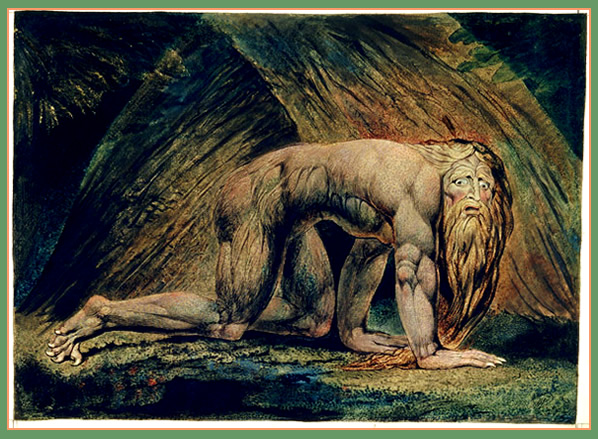
The painting
is
titled: 'Nebuchadnezzar' and is of William Blake
1795. Tate gallery. Source: Blake
Archive.
Production: Filognostic
Association
of The
Order of Time

Feed-back | Links | Downloads | Music | Pictures | What's New | Search | Donations





 Text
1
Text
1