

Canto
8
Chapter 15: Bali Mahârâja Conquers the Heavenly Places
(1-2) The king said: 'Why did the Lord, the Controller of all living beings, like a poor man beg Bali for three steps of land and why did He fetter him despite his donation? We would very much like to understand all this begging of the Controller, who is so complete in Himself, as also the arrest of Bali in spite of his innocence.'
(3) S'rî S'uka said: 'Bali, being defeated by Indra and deprived of his opulence and his life [see 8.11], was resuscitated by the followers of Bhrigu [S'ukrâcârya and his pupils]. He [then] as a great soul and disciple proved his respect for them by offering in full surrender everything he had. (4) The brahmin followers of Bhrigu, who enjoyed a great authority, were very pleased with him who wanted to conquer the heavenly places [of Indra] and engaged him in a sacrifice called Vis'vajit. For that purpose they first, according to the regulations, subjected him to a great purification ritual [abhisheka]. (5) From the blazing fire, that was honored with oblations of ghee, a brilliant chariot appeared drawn by horses with the same color as those of Indra [yellow]. It was covered with gold and silk and was adorned with a banner marked with a lion. (6) There was a special gilded bow, two quivers with an inexhaustible supply of arrows and a celestial armor. His grandfather [Prahlâda] donated a garland of never fading flowers and S'ukrâcârya gave him a conch shell. (7) After he, on the advice of the brahmins, had performed the ritual and thus by their grace had obtained the fighting gear, he circumambulated the scholars, offered his obeisances and with due respect bade Prahlâda Mahârâja farewell. (8-9) Upon next having ascended the divine chariot that was donated by S'ukrâcârya, the great charioteer, decorated with his garland, covered by his armor and equipped with his bow, took up a sword and quiver of arrows. With his golden bangles on his arms and the rings in his ears that glittered with their sapphires, he from his elevated position on the chariot shone like the fire of worship on an altar. (10-11) Surrounded by his men and the other Daitya leaders equal to him in opulence, strength and beauty, they seemed to drink in the sky and burn the directions with their looks. Having gathered the greatest Asura warriors they went to the supremely wealthy capital of Indra, making the earth tremble under their feet.
(12) That place was most agreeable with orchards and gardens like the beautiful Nandana garden. It was full of pairs of chirping birds, madly humming bees and eternal trees with branches overladen with leaves, flowers and fruits. (13) They were crowded with groups of swans, cranes, cakravâka birds, ducks, lotus flowers and beautiful, sporting women protected by the godly souls. (14) The ever worshipable river goddess surrounded the city with trenches filled with celestial Ganges water outside the parapeted ramparts with the color of fire. (15) The gates that gave access to the city made of marble, the doors [of the houses] covered by golden plates and the many, carefully laid out public roads, were all constructed by Vis'vakarmâ. (16) It was replete with assembly houses, courtyards, roads, and countless opulent palaces. The crossroads were constructed with natural stone and had sitting places adorned with pillars and coral. (17) In that city one found the most beautiful, ever young women glittering like the flames of a fire, who cool, warm, round breasted and well decorated, always wore impeccably clean clothes. (18) The breezes blowing in the streets carried the fragrance of the fresh aromatic flowers that had slipped down from the hair of the demigod women. (19) The divine sweethearts passed on the streets through the white fragrant smoke of the aguru incense that was burned behind the windows with golden filigree. (20) There were canopies strewn with pearls and gold, a variety of flags that adorned the domes of the palaces and peacocks, pigeons and bees that vibrated their sounds. The women in their heavenly buildings sang thereto in chorus about their happiness. (21) The city with all its brilliance so beautiful and pleasing with the singing of the Gandharvas, the solo instruments, the dancing and the sounds of flutes, vînâs, drums, conch shells and kettledrums, all perfectly in tune, defeated the splendor of beauty personified. (22) No godless people roamed the streets there, no one was envious or of violence against other creatures, no one cheated and no one was of false prestige, lust or greed. All who moved around there were completely free from all of that. (23) And it was that city of God that from the outside on all sides was attacked by him, [Bali,] the commander of the troops provided by S'ukrâcârya, who loudly resounding his conch shell created fear among all the ladies protected by Indra.
(24) Indra, facing the situation, understood Bali's fervent zeal and addressed with the following words the spiritual master [Brihaspati] in the company of the godly souls: (25) 'Oh my lord, who gave Bali, our enemy from the past, the great fervor and prowess I am afraid we are unable to withstand? (26) There is no one to be found who can counter this [opposition of Bali]. It is as if he, having risen like the fire at the end of time, with his mouth wants to drink in and lick up the whole world and with his vision wants to set ablaze all directions. (27) Please tell us, what is the cause of the formidable prowess of our enemy? What is the source of all this energy, strength, grip and zeal?'
(28) Brihaspati said: 'Oh Indra, I know how your enemy could rise against you. He derives his power from being a disciple of the mighty brahmins who are the followers of Bhrigu. (29) Being that powerful, this strong man cannot be defeated by someone like you or by anyone belonging to you. Except for the Supreme Controller, the Lord, no one will be able to vanquish him, now that he is endowed with a superior spiritual strength. To oppose him is just as useless as to oppose the lord of death. (30) Therefore you all must give up your place in the heavenly kingdom, keep out of sight and leave for elsewhere to await the time your enemy is past his prime. (31) He who now is so very mighty as a consequence of the brahminical power invested in him, will together with all his friends and helpers find his demise because of insulting the very same power.'
(32) Thus being advised by their spiritual master on what they had to do, they, the gods who could assume any form they liked, gave up their heavenly kingdom and departed. (33) After the gods had left, Bali, the son of Virocana, took hold of the city where the residents of heaven had their stay and brought the three worlds under his control. (34) Because he was their disciple, the followers of Bhrigu, who were very pleased with the conqueror of the universe, told him to devote himself to a hundred [as'vamedha] horse sacrifices. (35) From performing those sacrifices his fame spread in all directions of the three worlds so that he shone with a glory equal to that of the moon. (36) Having won the favor of the brahmins he, enjoying an opulence and prosperity like that of the demigods, deemed himself most happy with all that he had conceived and done so greatly.'


Third revised edition, loaded July 28, 2019.
Previous Aadhar edition and Vedabase links:
The king said: 'Why did the Lord, the Controller of all living beings, like a poor man beg Bali for three steps of land and why did He fetter him despite his donation? We would very much like to understand all this begging of the Controller, who is so complete in Himself, as also the arrest of Bali in spite of his innocence.'The king said: 'Why did the Lord, the Controller of all living beings, like a poor man beg Bali for three steps of land and why did He fetter him despite of the donation? All this begging of the Controller so complete in Himself and the arrest of Bali though he was faultless, we very anxiously desire to understand.' (Vedabase)
S'rî S'uka said: 'Bali, being defeated by Indra and deprived of his opulence and his life [see 8.11], was resuscitated by the followers of Bhrigu [S'ukrâcârya and his pupils]. He [then] as a great soul and disciple proved his respect for them by offering in full surrender everything he had.
S'rî S'uka said: 'Defeated by Indra, being deprived of his opulence and his life indeed [see 8.11], was Bali brought back to life by the descendants of Bhrigu [S'ukrâcârya and his followers]. To Bhrigu's following was he, as a great soul and disciple, of worship by giving them everything he had in full surrender. (Vedabase)
The brahmin followers of Bhrigu, who enjoyed a great authority, were very pleased with him who wanted to conquer the heavenly places [of Indra] and engaged him in a sacrifice called Vis'vajit. For that purpose they first, according to the regulations, subjected him to a great purification ritual [abhisheka].
The brahmin followers of Bhrigu, very pleased with him, engaged him in a sacrifice called Vis'vajit so that he, after according the regulations being purified by the exalted souls in a great bathing ceremony [abhisheka], to his desire could conquer the heavenly worlds. (Vedabase)
From the blazing fire, that was honored with oblations of ghee, a brilliant chariot appeared drawn by horses with the same color as those of Indra [yellow]. It was covered with gold and silk and was adorned with a banner marked with a lion.
From the blazing fire worshiped with oblations of ghee was there, drawn by horses with the color of those of Indra [yellow], a chariot covered with gold and silk that was adorned with a banner marked with a lion. (Vedabase)
There was a special gilded bow, two quivers with an inexhaustible supply of arrows and a celestial armor. His grandfather [Prahlâda] donated a garland of never fading flowers and S'ukrâcârya gave him a conch shell.
There was a special gilded bow, two quivers with infallible arrows and a celestial armor. His grandfather [Prahlâda] donated a garland of never fading flowers and S'ukrâcârya gave him a conchshell. (Vedabase)
After he, on the advice of the brahmins, had performed the ritual and thus by their grace had obtained the fighting gear, he circumambulated the scholars, offered his obeisances and with due respect bade Prahlâda Mahârâja farewell.
After thus, on the advice of the brahmins performing the ritual, in the form of the fighting gear having gained their grace, circumambulated he all the scholars offering his obeisances and bade he also with due respect Prahlâda Mahârâja farewell. (Vedabase)
Upon next having ascended the divine chariot that was donated by S'ukrâcârya, the great charioteer, decorated with his garland, covered by his armor and equipped with his bow, took up a sword and quiver of arrows. With his golden bangles on his arms and the rings in his ears that glittered with their sapphires, he from his elevated position on the chariot shone like the fire of worship on an altar.
Thereupon ascending the divine chariot donated by S'ukrâcârya, did the great charioteer, decorated with his garland, covered by his armor and equipped with his bow, take up his sword and quiver of arrows. With his golden bangles on his arms and his earrings glittering like sapphires shone he, positioned on his chariot, like a fire of worship on an altar. (Vedabase)
Surrounded by his men and the other Daitya leaders equal to him in opulence, strength and beauty, they seemed to drink in the sky and burn the directions with their looks. Having gathered the greatest Asura warriors they went to the supremely wealthy capital of Indra, making the earth tremble under their feet.
Surrounded by his own men and the other daitya leaders who equaled him in opulence, strength and beauty, seemed they to drink in the sky and burn the directions with their looks. Gathering the greatest asura warriors went they to the supremely wealthy capital of Indra as shaking the entire earth. (Vedabase)
That place was most agreeable with orchards and gardens like the beautiful Nandana garden. It was full of pairs of chirping birds, madly humming bees and eternal trees with branches overladen with leaves, flowers and fruits.
It was there very pleasant with orchards and gardens like the beautiful Nandana garden, chirping pairs of birds, madly humming bees and eternal trees with branches heavy of the great weight of its leaves with flowers and fruits. (Vedabase)
They were crowded with groups of swans, cranes, cakravâka birds, ducks, lotus flowers and beautiful sporting women protected by the godly souls.
They were crowded with groups of swans, cranes, cakravâka birds, ducks, lotus flowers and beautiful sporting women protected by the godly. (Vedabase)
The ever worshipable river goddess surrounded the city with trenches filled with celestial Ganges water outside the parapeted ramparts with the color of fire.
The ever worshipable goddess surrounded them with trenches of celestial Ganges water and parapeted ramparts in the color of fire. (Vedabase)
The gates that gave access to the city made of marble, the doors [of the houses] covered by golden plates and the many, carefully laid out public roads, were all constructed by Vis'vakarmâ.
Constructed by Vis'vakarmâ, were the gates that gave access to the city made of marble, were the doors [of the houses] covered by golden plates and were the many public roads carefully laid out. (Vedabase)
It was replete with assembly houses, courtyards, roads, and countless opulent palaces. The crossroads were constructed with natural stone and had sitting places adorned with pillars and coral.
It was replete with assembly houses, courtyards, roads, and countless opulent palaces. The crossroads were made with pearls and had sitting places adorned with diamonds and coral. (Vedabase)
In that city one found the most beautiful, ever young women glittering like the flames of a fire, who cool, warm, round breasted and well decorated, always wore impeccably clean clothes.
In that city one found, like with a fire with many flames, the most beautiful, glittering, ever-young women, who cool, warm and round-breasted [of 's'yâmâ'], well-decorated always wore impeccably clean clothes. (Vedabase)
The breezes blowing in the streets carried the fragrance of the fresh aromatic flowers that had slipped down from the hair of the demigod women.
The breezes blowing in the streets carried the fragrance of the fresh aromatic flowers fallen from the hair of the sura women. (Vedabase)
The divine sweethearts passed on the streets through the white fragrant smoke of the aguru incense that was burned behind the windows with golden filigree.
On the streets passed the sura sweethearts through the white fragrant smoke of aguru incense burnt from behind windows with gold filigree. (Vedabase)
There were canopies strewn with pearls and gold, a variety of flags that adorned the domes of the palaces and peacocks, pigeons and bees that vibrated their sounds. The women in their heavenly buildings sang thereto in chorus about their happiness.
There were canopies strewn with pearls and gold, a variety of flags that adorned the domes of the palaces and peacocks, pigeons and bees that vibrated their sounds to which the women in their heavenly buildings sang in chorus the auspiciousness. (Vedabase)
The city with all its brilliance so beautiful and pleasing with the singing of the Gandharvas, the solo instruments, the dancing and the sounds of flutes, vînâs, drums, conch shells and kettledrums, all perfectly in tune, defeated the splendor of beauty personified.
The city with all its brilliance so beautiful and pleasing with the singing loves of the gods, the solo instruments, the dancing and the sounds of flutes, vînâs, drums, conchshells and kettledrums all perfectly in tune, defeated the beauty of the deity of splendor. (Vedabase)
No godless people roamed the streets there, no one was envious or of violence against other creatures, no one cheated and no one was of false prestige, lust or greed. All who moved around there were completely free from all of that.
No godless people roamed the streets, there was no one envious or of violence against other creatures, no one cheated and no one was of false prestige, lust or greed; all walking there were completely void of all that. (Vedabase)
And it was that city of God that from the outside on all sides was attacked by him, [Bali,] the commander of the troops provided by S'ukrâcârya, who loudly resounding his conch shell created fear among all the ladies protected by Indra.
And it was that city of God which from the outside at all sides was attacked by him, the commander of the troops provided by S'ukrâcârya, who, resounding his conchshell loudly, created fear with all the ladies protected by Indra. (Vedabase)
Indra, facing the situation, understood Bali's fervent zeal and addressed with the following words the spiritual master [Brihaspati] in the company of the godly souls:
Indra facing the situation understood Bali's fervent zeal and addressed in the company of the godly the spiritual master [Brihaspati] with the following words: (Vedabase)
'Oh my lord, who gave Bali, our enemy from the past, the great fervor and prowess I am afraid we are unable to withstand?
'O my Lord, who gave Bali, our enemy from the past, the great fervor and prowess I'm afraid we're unable to withstand? (Vedabase)
There is no one to be found who can counter this [opposition of Bali]. It is as if he, having risen like the fire at the end of time, with his mouth wants to drink in and lick up the whole world and with his vision wants to set ablaze all directions.
There is no one to be found who can counter this armed arrangement of his, it is as if he with his mouth wants to drink in and lick up the whole world and with his vision wants to set ablaze all directions, having risen like the fire at the end of time. (Vedabase)
Please tell us, what is the cause of the formidable prowess of our enemy? What is the source of all this energy, strength, grip and zeal?'
Please tell us what the cause of the formidable prowess of our enemy is and from where all his energy, strength, influence and this endeavor came.' (Vedabase)
Brihaspati said: 'Oh Indra, I know how your enemy could rise against you. He derives his power from being a disciple of the mighty brahmins who are the followers of Bhrigu.
Brihaspati said: 'I know the cause, o Indra, of the rise of your enemy, he got his power being a disciple of the mighty brahmins that are the followers of Bhrigu. (Vedabase)
Being that powerful, this strong man cannot be defeated by someone like you or by anyone belonging to you. Except for the Supreme Controller, the Lord, no one will be able to vanquish him, now that he is endowed with a superior spiritual strength. To oppose him is just as useless as to oppose the lord of death.
Being that powerful can the strong one not be defeated by someone like you or anyone belonging to you; except for the Supreme Controller, the Lord, will no one be able to vanquish him now he is endowed with a superior spiritual strength; to oppose him is just as useless as to oppose the lord of death. (Vedabase)
Therefore you all must give up your place in the heavenly kingdom, keep out of sight and leave for elsewhere to await the time your enemy is past his prime.
Therefore must you all leave, give up the heavenly kingdom and go elsewhere to await the time when your enemy has to face his reverse. (Vedabase)He who now is so very mighty as a consequence of the brahminical power invested in him, will together with all his friends and helpers find his demise because of insulting the very same power.'
He who now so utterly mighty flourishes by the brahminical power invested in him, will by insulting the same power find his demise together with all his friends and helpers.' (Vedabase)
Thus being advised by their spiritual master on what they had to do, they, the gods who could assume any form they liked, gave up their heavenly kingdom and departed.
Thus advised by their spiritual master on what they had to do gave they up their heavenly kingdom and departed they who were the gods who could assume any form they liked. (Vedabase)
After gods had left, Bali, the son of Virocana, took hold of the city where the residents of heaven had their stay and brought the three worlds under his control.
When all the godly this way had left took Bali, the son of Virocana, hold of the city where the divine had their stay and brought he the heavenly worlds under his control. (Vedabase)
Because he was their disciple, the followers of Bhrigu, who were very pleased with the conqueror of the universe, told him to devote himself to a hundred [as'vamedha] horse sacrifices.
Because he was their disciple instructed the followers of Bhrigu, very pleased with the conqueror of the universe, him to perform a hundred [as'vamedha] horse sacrifices. (Vedabase)
From performing those sacrifices his fame spread in all directions of the three worlds so that he shone with a glory equal to that of the moon.
From performing those sacrifices spread his fame in all directions of the three worlds and shone he with a glory equal to the moon. (Vedabase)
Having won the favor of the brahmins he, enjoying an opulence and prosperity like that of the demigods, deemed himself most happy with all that he had conceived and done so greatly.'
From winning the favor of the twiceborn deemed he, in enjoying the like of an opulence and prosperity of the demigods, himself most happy with all he had conceived and done so greatly. (Vedabase)


The
text and audio are offered under the conditions of the
Creative
Commons Attribution-Noncommercial-Share Alike
3.0
Unported License.
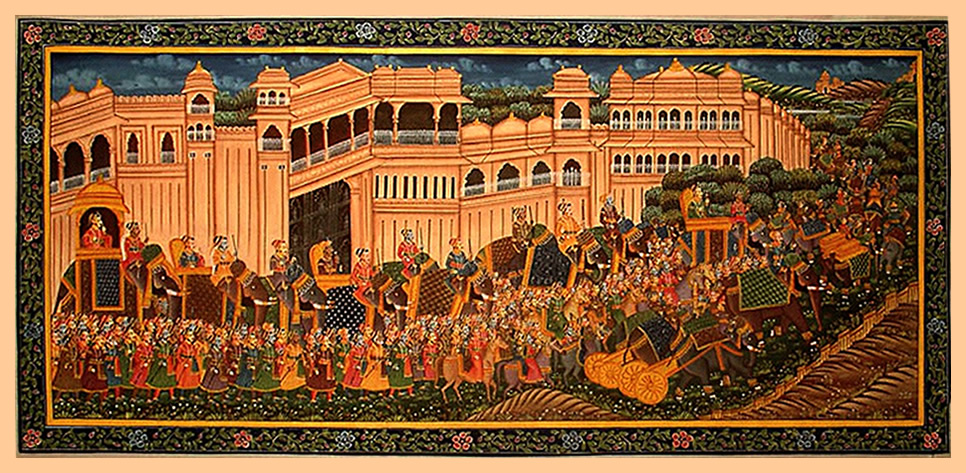
The picture is
titled: 'A military parade. Source.
Production: Filognostic
Association
of The
Order of Time

Feed-back | Links | Downloads | Music | Pictures | What's New | Search | Donations



 Text
1-2
Text
1-2