Canto
4
Chapter 12: Dhruva Mahârâja Goes Back to Godhead
(1) Maitreya said: 'Having learned that Dhruva's anger had lingered and that he had refrained from killing, Kuvera, the master of the treasury who is worshiped by the Câranas, Kinnaras [singers and indwellers of heaven] and Yakshas, appeared there and spoke to Dhruva who stood with folded hands before him. (2) The master of the treasury said: 'Oh son of the ruler, I am very glad with you, oh sinless one, because you under the instruction of your grandfather gave up the enmity that is so difficult to avoid. (3) Factually, you did not kill the Yakshas, nor did the Yakshas kill your brother; it is the Time that is the master of annihilation and generation of all living beings. (4) One's intelligence is of ignorance with the misconceptions of 'I' and 'you'. To a person following the bodily concept life appears to be just like in a dream; it [the physical approach] constitutes the cause of bondage and misfortune. (5) I wish you all good fortune, oh Dhruva, keeping that in mind, live for the worship of the Supreme Lord Beyond the Senses of all living beings and think of Him in the form of the one Supersoul residing within all that lives. (6) Be of devotion unto Him whose lotus feet deserve it to be worshiped, for they deliver you from a material existence and cut through the knot of being materially entangled. Even though He in His potency of ruling the modes is connected to them, He by His inconceivable nature is aloof from them. (7) Oh King, please ask without hesitation from me whatever you deem desirable, oh son of Uttânapâda. We heard, dear man, about your endurance at the lotus feet of Him from whose navel the lotus sprouted, and that you thus deserve the benediction.'
(8) Maitreya said: 'He, who by the treasure king of all kings [the ruler of the Yakshas] was offered a benediction, asked, as a first class intelligent and thoughtful devotee of the Lord, for the continuous remembrance by which one without difficulty crosses over the unsurpassable ocean of nescience. (9) Kuvera, the son of Idavidâ, who was very pleased with Dhruva's mentality, granted him that remembrance and next disappeared from sight. Dhruva then also returned to his capital. (10) He thereafter worshiped, by means of sacrificial ceremonies and great charities, with all that he had, he could accomplish and the divine support that he could find, the Ruler of all Sacrifices, the objective [of one's life] who awards all results. (11) Uninterruptedly rendering service unto the one infallible Soul above all, he saw all living beings as present in Him alone and Him Almighty as the one and only present within all living beings. (12) Thus endowed with godly qualities he, who as a kind protector of the principles of dharma had respect for the brahmins and the poor, was considered the father of the people. (13) During the thirty-six thousand years of his rule over the planet Earth he by enjoyment exhausted his merits and by austerity diminished his misfortune. (14) Thus free from agitating his senses the great soul [life after life] for many, many years favorably executed the three kinds of civil duties [the regulation of religion, economy and sense gratification], after which he handed the royal throne over to his son. (15) He realized that this universe, consisting of His external energy, was a phantasmagoria to the soul, something that, just like a dream, is a result of ignorance. (16) He considered everything created comprising his body, his wives, children, friends, his influence, riches, the pleasure grounds, the facilities for his women and the complete of the beauty of the earth with its oceans, as something bound to time and for that reason he left for Badarikâs'rama [the Himalayan forest]. (17) There he purified his body by bathing in pure water and, fixed in yogic postures, controlled the breathing process by withdrawing the mind from his physical senses. Concentrating on the exact form of the Lord he constantly kept in mind, he thus meditating became fully absorbed. (18) Constantly engaged in his devotion for Lord Hari, the Supreme Personality of Godhead, he was of an everlasting bliss and was time and again overcome by a stream of tears that made his heart melt and made all the hairs of his body stand on end. He no longer remembered that he had a body and was thus liberated from [also the subtlety of] being materially bound [mukta-linga].
(19) Dhruva saw a very beautiful heavenly vehicle [a vimâna] descending from the sky that illumined him and the ten directions as if the full moon itself had appeared. (20) Therein he discerned two beautiful demigods with four arms, a blackish skin, being quite young and with eyes as pink as a lotus flower. They held clubs and were attractively dressed and decorated with helmets, bracelets, necklaces and earrings. (21) Understanding them to be two servants of the Renown One, he stood up, but being puzzled he did not know anymore how to receive them with proper respect and thus he respectfully joined his hands offering his obeisances by chanting the names of the chief of these associates, the Enemy of Madhu. (22) He whose heart was always absorbed in thoughts of the feet of Lord Krishna, very humbly folded his hands and bowed his head, while Nanda and Sunanda, the two chief servants of the One with the Lotus navel, smilingly approached and addressed him. (23) Nanda and Sunanda said: 'Oh best of kings! All good fortune to you. Listen attentively to our words. You are the one who, being five years old, greatly satisfied the Lord by doing penance. (24) We, as the associates of the creator of this entire universe, of the Godhead who carries the bow named S'ârnga, have approached you to take you with us to the abode of the Lord. (25) You have achieved the world of Vishnu, so difficult to achieve that not even the greatest souls of enlightenment can reach there. Come and see the supreme abode around which to the right the moon, the sun, the other planets and the stars are circumambulating. (26) This has never been achieved by your forefathers nor by others, oh dear man, come and live there in that supreme abode of Lord Vishnu who is so worshipable for the inhabitants of the universe. (27) Oh immortal soul, you deserve it to board this unique heavenly vehicle that was sent to you by the One Praised in the Verses, the head of all living beings.'
(28) Sage Maitreya said: 'Having heard the words that like honey poured from the chief associates of the Lord, he who was so dear to Him, took a purifying bath and performed his daily duties. Thereupon he greeted the sages and accepted their blessings. (29) After with prayers having circumambulated that excellent heavenly vehicle and also having paid the two associates his obeisances, he, whose form shone with a golden effulgence, was ready to get on board. (30) The son of Uttânapâda thereupon saw death personified approaching him. He put his foot on his head and thus ascended the wonder that was as big as a house. (31) At that moment kettledrums, mridangas [drums of worship] and small drums and such resounded, while the chief heavenly singers sang and flowers showered like rain. (32) When he was about to ascend to the heavenly abode, Dhruva remembered his mother Sunîti and thought: 'How can I go to the difficult to attain world above all worlds and leave my poor mother behind?' (33) Understanding Dhruva's worries, the two superior beings of enlightenment pointed out to him that she in her divinity had preceded him on the path. (34) On his way being covered by flowers that here and there by the demigods full of praise were showered upon him from their heavenly vehicles, he passed one after the other all the heavenly spheres [or planets]. (35) In his vimâna rising above the three worlds and even going beyond the great sages, Dhruva, who had attained eternal life, then reached the abode of Lord Vishnu. (36) Radiating by its effulgence that place illumines from within all the three worlds everywhere and also makes them radiate. It can only be reached by those who constantly engage in welfare activities and not by those who are not merciful with other living beings. (37) Peaceful, equipoised, pure and pleasing to all living beings do they, who are befriended with His devotees, easily reach the abode of the Infallible One. (38) Dhruva, the son of Uttânapâda who, fully devoted to Krishna, found his purity, thus became the crown-jewel of the three worlds. (39) The sphere of the luminaries [the galaxy], being connected with great force and speed, unceasingly encircles that place, oh Kaurava [Vidura's family name], like being a herd of bulls moving around a central pole.
(40) Having observed Dhruva's glories, the wise and great lord Nârada played his stringed instrument in the sacrificial arena of the Pracetâs, chanting [the following] verses. (41) Nârada sang: 'Due to his austerity this son of Sunîti, who served her husband so devotedly, could attain that position. Not even those whom one calls the followers of the Vedas are, despite their awareness of the means, certain of such an attainment, not to mention the chances of regular human beings. (42) He who at the age of five years, aggrieved about the harsh words of the wife of his father, in pursuance of my instruction, deeply pained in his heart went to the forest, won over the Supreme Master, winning with the qualities of His devotees. (43) After pleasing the Lord of Vaikunthha he, only five or six years old, in the shortest possible time attained His protection. Any other person cannot even expect to attain, after many, many of such years [of renunciation] on earth, the exalted position that Dhruva, this kshatriya son, attained.'
(44) Maitreya said: 'I have told you everything you asked me here about the great and famous character of Dhruva, who is so very much appreciated by many [a devotee]. (45) [To hear] this bestows wealth and repute, increases one's lifespan and is so greatly sacred and auspicious that one can even attain Dhruva's heaven with it, pleasing as it is to the mind and glorious in counteracting all kinds of sin. (46) Repeatedly listening to it with faith one will develop devotional activities dear to the Infallible One and therefrom there is bound to be the full defeat of all hindrances. (47) For the one who hears it there are the qualities of his good conduct and such; the story constitutes [a source of] strength for souls seeking strength and is [a breeding ground for] the honor of those who are thoughtful. (48) Carefully sing, in the company of twice-born souls, in the morning and the evening, the glories of the sacred renown and great character of Dhruva. (49-50) At the time of a full moon or a new moon, on the day after Ekâdas'î [the twelfth day of a lunar month], when the S'ravana star appears, at the end of a tithi [a lunar day], on a day called Vyatîpâta, at the end of the month or on a holiday [relative to the sun] you should recount the story to a receptive audience without desiring remuneration and take shelter of the lotus feet of Him who is the Refuge of the Seeker. You will find your mind then pacified by the soul and thus become perfect. (51) He who imparts this knowledge to souls unaware of the original reality, walks the path of truth and immortality and will be blessed by the gods for being a kind protector of the seekers. (52) Oh best among the Kurus, thus was my description of the activities, the fame and the great purity of Dhruva who, as a child forsaking his toys and his mother, left home and found the shelter of Lord Vishnu.' "


Third revised edition, loaded June 8, 2024.

Previous Aadhar edition and Vedabase links:
Maitreya said: 'Having learned that Dhruva's anger had lingered and that he had refrained from killing, Kuvera, the master of the treasury who is worshiped by the Câranas, Kinnaras [singers and indwellers of heaven] and Yakshas, appeared there and spoke to Dhruva who stood with folded hands before him.Maitreya said: 'Having learned that Dhruva, with his anger lingered, had refrained from killing, did Kuvera, the master of the treasury, worshiped by the Câranas, Kinnaras [singers and indwellers of heaven] and Yakshas, then appear there and spoke he to Dhruva who stood with folded hands before him. (Vedabase)
The master of the treasury said: 'Oh son of the ruler, I am very glad with you, oh sinless one, because you under the instruction of your grandfather gave up the enmity that is so difficult to avoid.
The master of the treasury said: 'O son of the ruler, I am very glad with you o sinless one, because under the instruction of your grandfather you gave up the enmity that is so difficult to avoid.. (Vedabase)
Factually, you did not kill the Yakshas, nor did the Yakshas kill your brother; it is the Time that is the master of annihilation and generation of all living beings.
Nor did you kill the Yakshas, nor did the Yakshas kill your brother; for it is the Time that is really the master of annihilation and generation of all the living. (Vedabase)
One's intelligence is of ignorance with the misconceptions of 'I' and 'you'. To a person following the bodily concept life appears to be just like in a dream; it [the physical approach] constitutes the cause of bondage and misfortune.
With the misconceptions of 'I' and 'you' appears it, from ignorance, to the intelligence of a person who follows the bodily concept just to be like in a dream; it is that which is the cause of bondage and misery. (Vedabase)
I wish you all good fortune, oh Dhruva, keeping that in mind, live for the worship of the Supreme Lord Beyond the Senses of all living beings and think of Him in the form of the one Supersoul residing within all that lives.
Therefore come Dhruva - all good fortune to you - to the respect for the Supreme Lord Beyond the Senses of all living beings and think of Him as the form of the one Supersoul in all that lives. (Vedabase)
Be of devotion unto Him whose lotus feet deserve it to be worshiped, for they deliver you from a material existence and cut through the knot of being materially entangled. Even though He in His potency of ruling the modes is connected to them, He by His inconceivable nature is aloof from them.
Be in devotion unto Him whose lotus feet are worth the worship, as they deliver from the material existence and cut the knot of material entanglement; although He, to His potency of the modes, is connected with it, is He aloof by His inconceivable potency. (Vedabase)
Oh King, please ask without hesitation from me whatever you deem desirable, oh son of Uttânapâda. We heard, dear man, about your endurance at the lotus feet of Him from whose navel the lotus sprouted, and that you thus deserve the benediction.'
O King, please ask without hesitation from me whatever you deem desirable, o son of Uttânapâda; since having heard, o dearest, about your enduring at the lotus feet of Him from whose navel the lotus sprouted, you are worthy the benediction.' (Vedabase)
Maitreya said: 'He, who by the treasure king of all kings [the ruler of the Yakshas] was offered a benediction, asked, as a first class intelligent and thoughtful devotee of the Lord, for the continuous remembrance by which one without difficulty crosses over the unsurpassable ocean of nescience.
Maitreya said: 'He, by the king of the Yakshas being offered a benediction, asked, as a first class intelligent and thoughtful devotee of the Lord, for the continuous remembrance by which one without difficulty crosses over the unsurpassable ocean of nescience. (Vedabase)
Kuvera, the son of Idavidâ, who was very pleased with Dhruva's mentality, granted him that remembrance and next disappeared from sight. Dhruva then also returned to his capital.
Kuvera, the son of Idavidâ, being very pleased with Dhruva's mentality, granted him that remembrance and thereafter disappeared out of his sight, after which Dhruva also returned to his capital. (Vedabase)
He thereafter worshiped, by means of sacrificial ceremonies and great charities, with all that he had, he could accomplish and the divine support that he could find, the Ruler of all Sacrifices, the objective [of one's life] who awards all results.
He subsequently, by sacrificial ceremonies and great charities, worshiped, with all he had, could do and find support from, the Ruler of all Sacrifice, the objective who awards all results. (Vedabase)
Uninterruptedly rendering service unto the one infallible Soul above all, he saw all living beings as present in Him alone and Him Almighty as the one and only present within all living beings.
Unrelenting rendering service unto the one infallible Soul above all, saw he only Him, the Almighty One, the Supreme Spirit situated in all living beings. (Vedabase)
Thus endowed with godly qualities he, who as a kind protector of the principles of dharma had respect for the brahmins and the poor, was considered the father of the people.
He thus endowed with godly qualities, of respect for the brahmins and the poor and being the kind protector of the principles of religion, was considered the father of the people. (Vedabase)
During the thirty-six thousand years of his rule over the planet Earth he by enjoyment exhausted his merits and by austerity diminished his misfortune.
For the thirty-six thousand years of his rule over the planet Earth, he by enjoyment diminished the effects of the good deeds and by austerity diminished the consequences of the inauspicious. (Vedabase)
Thus free from agitating his senses the great soul [life after life] for many, many years favorably executed the three kinds of civil duties [the regulation of religion, economy and sense gratification], after which he handed the royal throne over to his son.
Thus the great soul after the passage of many, many years, free from agitated senses, favorably executed the three kinds of worldly action [the regulation of religion, economy and gratification] and then handed the royal throne over to his son. (Vedabase)
He realized that this universe, consisting of His external energy, was a phantasmagoria to the soul, something that, just like a dream, is a result of ignorance.
He realized that this universe made of the external energy was to the living being a phantasmagoria prepared by ignorange like in a dream. (Vedabase)
He considered everything created comprising his body, his wives, children, friends, his influence, riches, the pleasure grounds, the facilities for his women and the complete of the beauty of the earth with its oceans, as something bound to time and for that reason he left for Badarikâs'rama [the Himalayan forest].
He considered all the created, of himself, his wives, children, friends, his influence, riches, the pleasure grounds and the upkeep for the women and the complete of the beauty of the earth with its oceans, as something bound to time and thus he left for Badarikâs'rama [the Himalayan forest]. (Vedabase)
There he purified his body by bathing in pure water and, fixed in yogic postures, controlled the breathing process by withdrawing the mind from his physical senses. Concentrating on the exact form of the Lord he constantly kept in mind, he thus meditating became fully absorbed.
There he purified his body, bathing in pure water and controlled he, fixed in yogic postures, the breathing process by withdrawing the mind from his physical senses. Concentrating on the exact form of the Lord became he so meditating, constantly keeping Him in mind, fully absorbed. (Vedabase)
Constantly engaged in his devotion for Lord Hari, the Supreme Personality of Godhead, he was of an everlasting bliss and was time and again overcome by a stream of tears that made his heart melt and made all the hairs of his body stand on end. He no longer remembered that he had a body and was thus liberated from [also the subtlety of] being materially bound.
Engaged in constant devotion unto Lord Hari, the Supreme Personality of Godhead, he was in an everlasting bliss and again and again overcome by a stream of tears that made his heart melt and all the hairs of his body stand on end; he no longer remembered he had a body and was thus liberated from [also the subtlety of] the material bond [mukta-linga]. (Vedabase)
Text 19
Dhruva saw a very beautiful heavenly vehicle [a vimâna] descending from the sky that illumined him and the ten directions as if the full moon itself had appeared.
Dhruva saw a very beautiful chariot descending from the sky that illumined him and the ten directions as if the full moon itself was appearing. (Vedabase)
Therein he discerned two beautiful demigods with four arms, a blackish skin, being quite young and with eyes as pink as a lotus flower. They held clubs and were attractively dressed and decorated with helmets, bracelets, necklaces and earrings.
There he then saw two beautiful demigods in it with four arms, a blackish skin, being quite young and with eyes reddish like a lotus flower, holding clubs, attractively decorated with helmets, bracelets, necklaces and earrings. (Vedabase)
Understanding them to be two servants of the Renown One, he stood up, but being puzzled he did not know anymore how to receive them with proper respect and thus he respectfully joined his hands offering his obeisances by chanting the names of the chief of these associates, the Enemy of Madhu.
Understanding them to be two servants of the One of Renown, he stood up, but being puzzled he forgot the proper way to behave and thus he respectfully joined his hands offering his respects by chanting the names of the chief of these associates, the Enemy of Madhu. (Vedabase)
He whose heart was always absorbed in thoughts of the feet of Lord Krishna, very humbly folded his hands and bowed his head, while Nanda and Sunanda, the two chief servants of the One with the Lotus navel, smilingly approached and addressed him.
He whose heart was always absorbed in thoughts about the feet of Lord Krishna, very humbly with the folding of his hands bowed his head while they, Nanda and Sunanda, the two confidential servants of the One of the Lotusnavel, smiling approached and addressed him. (Vedabase)
Nanda and Sunanda said: 'Oh best of kings! All good fortune to you. Listen attentively to our words. You are the one who, being five years old, greatly satisfied the Lord by doing penance.
Nanda and Sunanda said: 'O best of kings! All good fortune to you. Listen attentively to our words. You are the one who, being five years old, greatly satisfied God by penance. (Vedabase)
We, as the associates of the creator of this entire universe, of the Godhead who carries the bow named S'ârnga, have approached you to take you with us to the abode of the Lord.
As the associates of the creator of this entire universe, of the Godhead who carries the bow named S'ârnga, have we approached you to take you with us to where the Lord resides. (Vedabase)
You have achieved the world of Vishnu, so difficult to achieve that not even the greatest souls of enlightenment can reach there. Come and see the supreme abode around which to the right the moon, the sun, the other planets and the stars are circumambulating.
The position of Vishnu, so difficult to reach that not even the greatest of enlightenment can achieve it, has been conquered by you. Come and simply see the supreme which the moon, the sun, the other planets and the stars circumambulate to the right. (Vedabase)
This has never been achieved by your forefathers nor by others, oh dear man, come and live there in that supreme abode of Lord Vishnu who is so worshipable for the inhabitants of the universe.
Never ever was this achieved by your forefathers or even others, o dear one; come and live there in that supreme position of Lord Vishnu who is so worshipable for the inhabitants of the universe. (Vedabase)
Oh immortal soul, you deserve it to board this unique heavenly vehicle that was sent to you by the One Praised in the Verses, the head of all living beings.'
O immortal soul, you are worthy to board this unique heavenly chariot that was sent to you by the Praised One, the head of all living beings.' (Vedabase)
Sage Maitreya said: 'Having heard the words that like honey poured from the chief associates of the Lord, he who was so dear to Him, took a purifying bath and performed his daily duties. Thereupon he greeted the sages and accepted their blessings.
The sage Maitreya said: 'After hearing the speeches pouring like honey from the chief associates of the Lord, took the one so dear to Him, offering the sages his obeisances and accepting their blessings, a purifying bath and performed he his daily duties. (Vedabase)
After with prayers having circumambulated that excellent heavenly vehicle and also having paid the two associates his obeisances, he, whose form shone with a golden effulgence, was ready to get on board.
In worship having circumambulated that best of positions and also having proved his respects to the two of them, he with his form lighting up like gold, was ready to board the heavenly vehicle. (Vedabase)
The son of Uttânapâda thereupon saw death personified approaching him. He put his foot on his head and thus ascended the wonder that was as big as a house.
Then the son of Uttânapâda could see death personified approaching him and putting his feet on his head, he ascended that wonder as big as a house. (Vedabase)
At that moment kettledrums, mridangas [drums of worship] and small drums and such resounded, while the chief heavenly singers sang and flowers showered like rain.
At that moment kettledrums and mridangas [drums of worship] and small drums and such resounded while the singers of liberation sang and flowers showered like rain. (Vedabase)
When he was about to ascend to the heavenly abode, Dhruva remembered his mother Sunîti and thought: 'How can I go to the difficult to attain world above all worlds and leave my poor mother behind?'
As he was about to ascend to the abode of heaven, Dhruva instantly remembered Sunîti and thought: 'How can I go to the world over the worlds leaving behind my poor mother?' (Vedabase)
Understanding Dhruva's worries, the two superior beings of enlightenment pointed out to him that she in her divinity had preceded him on the path.
Understanding Dhruva's worries, showed the two superior ones of enlightenment him how she, ahead of him, was on the path of reaching her divinity. (Vedabase)
On his way being covered by flowers that here and there by the demigods full of praise were showered upon him from their heavenly vehicles, he passed one after the other all the heavenly spheres [or planets].
On his way passing one after another all the heavenly spheres around, was he covered by even more flowers, here and there showered on him by the ones enlightened from their own elevated positions. (Vedabase)
In his vimâna rising above the three worlds and even going beyond the great sages, Dhruva, who had attained eternal life, then reached the abode of Lord Vishnu.
Surpassing the three worlds traveling by God, he even went beyond the great sages, after which the accomplished Dhruva then achieved the refuge of Vishnu. (Vedabase)
Radiating by its effulgence that place illumines from within all the three worlds everywhere and also makes them radiate. It can only be reached by those who constantly engage in welfare activities and not by those who are not merciful with other living beings.
For certain are it only those who constantly engage in welfare activities who reach that place which, radiating by its self-effulgence, illumines everywhere all the three worlds; not the ones who didn't manage to be merciful with other living beings. (Vedabase)
Peaceful, equipoised, pure and pleasing to all living beings do they, who are befriended with His devotees, easily reach the abode of the Infallible One.
Peaceful, equipoised, pure and pleasing to all living beings they easily reach, befriended with His devotees, the abode of the Infallible One. (Vedabase)
Dhruva, the son of Uttânapâda who, fully devoted to Krishna, found his purity, thus became the crown-jewel of the three worlds.
Thus became Dhruva, the son of Uttânapâda, on the supreme path of Krishna, as pure as the summit-jewel of the three worlds. (Vedabase)
The sphere of the luminaries [the galaxy], being connected with great force and speed, unceasingly encircles that place, oh Kaurava [Vidura's family name], like being a herd of bulls moving around a central pole.
With great force and speed unceasingly connected encircles the sphere of the luminaries [the galaxy] that place, o Kaurava [Vidura's family name], like a herd of bulls around a central pole. (Vedabase)
Having observed Dhruva's glories, the wise and great lord Nârada played his stringed instrument in the sacrificial arena of the Pracetâs, chanting [the following] verses.
Observing Dhruva's glories was the saintly and great lord Nârada, playing his stringed instrument, chanting verses in the sacrificial arena of the Pracetâs. (Vedabase)
Nârada sang: 'Due to his austerity this son of Sunîti, who served her husband so devotedly, could attain that position. Not even those whom one calls the followers of the Vedas are, despite their awareness of the means, certain of such an attainment, not to mention the chances of regular human beings.
Nârada sang: 'Thanks to especially the austerity of this son of Sunîti, who is so devoted to her husband, we see the way to that position, whereas of what one calls the followers of the Vedas one is never certain of being eligible, not to mention the normal protectors of the people. (Vedabase)
He who at the age of five years, aggrieved about the harsh words of the wife of his father, in pursuance of my instruction, deeply pained in his heart went to the forest, won over the Supreme Master, winning with the qualities of His devotees.
He who at the age of five years, aggrieved about the harsh words of the wife of his father, in pursuance of my instruction, so very much pained in his heart went to the forest, won over the Supreme Master, winning with the qualities of His devotees. (Vedabase)
After pleasing the Lord of Vaikunthha he, only five or six years old, in the shortest possible time attained His protection. Any other person cannot even expect to attain, after many, many of such years [of renunciation] on earth, the exalted position that Dhruva, this kshatriya son, attained.'
Within a short while after pleasing the Lord of Vaikunthha he attained that refuge being only five or six years old, whereas any other person cannot even expect to attain after many, many of such years on earth the exalted position of Dhruva, this son of a kshatriya.' (Vedabase)
Maitreya said: 'I have told you everything you asked me here about the great and famous character of Dhruva, who is so very much appreciated by many [a devotee].
Maitreya said: 'Whatever you asked me here about the great and uplifting character of Dhruva, whose reputation is hailed by the great devotees, I have explained to you. (Vedabase)
[To hear] this bestows wealth and repute, increases one's lifespan and is so greatly sacred and auspicious that one can even attain Dhruva's heaven with it, pleasing as it is to the mind and glorious in counteracting all kinds of sin.
It bestows wealth and repute, increases one's lifespan and is so sacred and auspicious that one can even attain to Dhruva's heaven with it, pleasing as it is to the mind and glorious in counteracting all kinds of sin. (Vedabase)
Repeatedly listening to it with faith one will develop devotional activities dear to the Infallible One and therefrom there is bound to be the full defeat of all hindrances.
Hearing this repeatedly with faith one develops devotional activities dear to the Infallible One, from which there's bound to be the full defeat of all hindrances. (Vedabase)
For the one who hears it there are the qualities of his good conduct and such; the story constitutes [a source of] strength for souls seeking strength and is [a breeding ground for] the honor of those who are thoughtful.
For the hearers who desire greatness, high character and the qualities is this the process in which the prowess is found as well as the adoration so desired by those who are thoughtful. (Vedabase)
Carefully sing, in the company of twice-born souls, in the morning and the evening, the glories of the sacred renown and great character of Dhruva.
One should carefully recite in the morning and the evening in the company of the converted, the sacred renown and great character of Dhruva. (Vedabase)
At the time of a full moon or a new moon, on the day after Ekâdas'î [the twelfth day of a lunar month], when the S'ravana star appears, at the end of a tithi [a lunar day], on a day called Vyatîpâta, at the end of the month or on a holiday [relative to the sun] you should recount the story to a receptive audience without desiring remuneration and take shelter of the lotus feet of Him who is the Refuge of the Seeker. You will find your mind then pacified by the soul and thus become perfect.
On a full moon or a new moon, on the day after Ekâdas'î [the twelfth of a lunar month], when the S'ravana star appears, at the end of the tithi [the fifteenth day], at a day called Vyatipâta, at the end of the month or on a holiday, one should recite it to a receptive audience, taking shelter of the lotus feet of the Refuge of the Seeker, without desiring remuneration; then one will find one's mind pacified by the soul and will one thus become perfect. (Vedabase)
He who imparts this knowledge to souls unaware of the original reality, walks the path of truth and immortality and will be blessed by the gods for being a kind protector of the seekers.
He who imparts this knowledge to the ones unaware of the reality, is on the path of truth and immortality and will, being a kind protector of the seekers, be blessed by the gods. (Vedabase)
Oh best among the Kurus, thus was my description of the activities, the fame and the great purity of Dhruva who, as a child forsaking his toys and his mother, left home and found the shelter of Lord Vishnu.' "
O great one among the Kurus, thus was my description of the activities, the fame and the very pure of Dhruva, who as a child, giving up his playthings and his mother, went away from his home and found the shelter of Lord Vishnu'." (Vedabase)


The text and audio are offered under the conditions of
the
Creative
Commons Attribution-Noncommercial-Share Alike
3.0
Unported License.
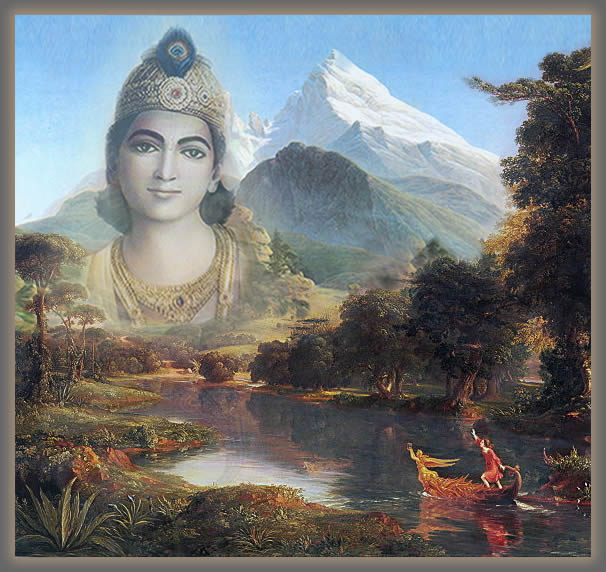
The picture is a
digitally produced collage by Anand Aadhar of
a popular
vintage
picture of Krishna and two classical western
paintings titled:
'The Voyage of Life Youth' by Thomas Cole (1801–1848) (Source)
against the backdrop of the mountains of 'Der Watzmann' by Caspar David Friedrich 1824-1825 (Source).
Production: Filognostic
Association
of The
Order of Time

Feed-back | Links | Downloads | Music | Pictures | What's New | Search | Donations