
Canto 11
Canto 11
Chapter 25: The Three Modes of Nature and Beyond
(1) The Supreme Lord said: 'Oh best of persons, try to understand what I am about to say concerning the way someone is influenced by a certain mode of My material nature [*]. (2-5) With the basic quality of goodness one finds equanimity, sense control, tolerance, discrimination, penance, truthfulness, compassion, remembrance, contentment, renunciation, freedom from desire, faithfulness, modesty and pleasure within. With the mode of passion there is lust, endeavor, conceit, dissatisfaction, false pride, a desire for blessings, separatism, sense gratification, rashness, love of praise, ridicule, display of valor and hard sanctioning. With the natural quality of ignorance one runs into intolerance, greed, deceitfulness, violence, attention seeking, hypocrisy, listlessness, quarrel, lamentation, delusion, the suffering of depression, sloth, false expectations, fear and indolence. These, one after the other described by Me, constitute the majority of the effects of the modes. Hear now about their combinations [see also B.G. 14]. (6) Oh Uddhava, the notion of 'I am this way' and 'that is a trait of mine' that people have [in relation to these qualities] when they are engaged with their mind, senses, sense objects and life breath, reflects a combination of the modes [see also 11.23: 49, 11.24: 7, 11.24: 13]. (7) In case a person is fixed in his religiosity, economic development and sense gratification, [also] the resultant faith, wealth and enjoyment is an expression of the interaction of the different modes. (8) When a person in family life is of a dedication characterized by sense gratification and thereafter performs his religious duties, a combination of the modes is a fact. (9) From someone's self-control can be deduced that he is endowed with goodness and so on, his lust is indicative of the mode of passion and such, and from his anger etcetera one may conclude that he is caught in ignorance. (10) When someone worships Me with devotion and indifference about the results of his labor, such a person should be understood to be of a practice of goodness, whether he is a man or a woman. (11) When one in the fulfillment of one's duties worships Me hoping for benedictions, such devotion must be understood as being of the nature of passion, and when one does so with violent intentions one is of ignorance [see also B.G. 17: 20-22]. (12) The modes of sattva, tamas and rajas influence the [conditioned] individual but not Me; one is bound to them because they manifest in the mind and lead to attachment to life-forms and sense-objects [see also B.G. 4: 14]. (13) When the mode of goodness - which is pure, luminous and auspicious - predominates over the other two [of passion and ignorance], a person will be blessed with happiness, religiosity, knowledge and other good qualities [see also B.G. 14: 11, 18: 37]. (14) When passion defeats goodness and ignorance one gets attached, wants to make a difference and tends to impermanence, because of which one becomes unhappy by profit minded actions and striving for a good name and wealth [see also B.G. 14: 12, 18: 38]. (15) When ignorance dominates passion and goodness one's discrimination is defeated, one's consciousness is covered, one's initiative is lost and one becomes endowed with bewilderment, complaints, sleeping too much, violence and false hopes [see also B.G. 14: 13, 18: 39]. (16) When one's consciousness clears up and the senses are not distracted, one achieves physical self-confidence and a detached mind; know that to be the goodness of My refuge. (17) When the intelligence is disturbed by too much activity, when one fails to disengage from one's senses, when one is not at ease with one's body and when the mind is unsteady, you should understand that to be the symptoms of passion. (18) Failing in the higher functions of consciousness, getting dull, being unable to focus, not being mindful, not understanding things and being gloomy, you should recognize as the mode of ignorance. (19) When goodness increases the strength of the gods increases, when passion increases the demons grow stronger, and when ignorance increases, Uddhava, the wild men will get on top. (20) Know that one is wakeful in the mode of goodness, that one is sleepy in passion, that one is not aware in the ignorant mode of the living entity, and that the fourth [transcendental] state [of consciousness turîya] pervades the three [see also 7.7: 25 and B.G. 6: 16]. (21) In the mode of goodness spiritual [Vedic] persons reach higher and higher, in the mode of ignorance one reaches head first lower and lower [births], and in the mode of passion one is stuck in between [in attachments, see also B.G. 6: 45, 16: 19]. (22) Those who die in goodness go to heaven, those who die in passion go to the human world and those who die in ignorance go to hell. They however who are free from the modes come to Me [see also B.G. 9: 25, 14: 18]. (23) Work dutifully done as a sacrifice unto Me without desiring the fruits is in the mode of goodness, work done with a profit motive is of the mode of passion and work performed with violence and pressure and such, is of the mode of ignorance [B.G. 17: 20-22]. (24) Spiritual knowledge of detachment is of the mode of goodness, fostering opinions one is of the mode of passion, and a materialistic conviction belongs to the mode of ignorance. Spiritual knowledge focussed on Me [however] is considered to be free from the modes [see also 6.14: 2]. (25) To have one's residence in the forest is of the mode of goodness, to reside in a town is said to be of the mode of passion, to reside in a gambling house is of the mode of ignorance, but My residence is elevated above the modes [see also 7.12: 22, 11.18: 25]. (26) A worker free from attachment is of the mode of goodness, blinded by personal desire one is of the mode of passion, having lost one's memory one speaks of the mode of ignorance [see 11.22: 38-39], [but] the one who has taken shelter of Me is free from the modes. (27) In the mode of goodness one believes in spiritual matters, in the mode of passion one believes in fruitful activities, in the mode of ignorance one is irreligious, but one is transcendental to the modes with faith in My devotional service. (28) Food that is wholesome, pure and attained effortlessly is considered to be of the mode of goodness, [strongly] catering to the senses it is of the mode of passion, and impure food that makes one suffer is of ignorance [see also B.G. 17: 7-10]. (29) Happiness derived from the soul is of the mode of goodness, generated by sense objects it is of passion, happiness derived from delusion and depravity is of the mode of ignorance, but free from the modes happiness is found in Me [see 11.15: 17 & B.G. 5: 21, but also 6: 7].
(30) Material substance, the place, the fruit of action, time, knowledge, activity, the performer, faith, the state of consciousness, and the species and destinations of life thus all belong to the three gunas. (31) Oh best among men, all that exists, being seen, heard or pictured in one's mind, is a composition of the three basic qualities that was established by the unseen [Original] Enjoyer. (32) These forms of existence [and stages of life] of the [repeatedly incarnating] living being, are bound to the operation of the modes. Oh gentle one, the individual soul who, dedicated to Me in bhakti-yoga, conquers these natural qualities that manifest themselves in the mind, qualifies for My transcendental love. (33) They who obtained this human body by which one acquires knowledge and develops wisdom, should therefore be as smart to shake off their attachment to the natural modes and worship Me. (34) A learned man should worship Me free from attachment; attentively having subdued his senses a sage should take to the mode of goodness and conquer the modes of passion and ignorance. (35) With his intelligence pacified he, being connected [in bhakti] without any [other] dependency, should also conquer the mode of goodness. The embodied soul who [thus] freed from the modes gives up the cause of his conditioning, reaches Me. (36) The living entity, who as an individual soul by Me thus was liberated from the basic qualities of nature that nestled in his mind, achieves thus, by dint of the Absolute Truth, complete fulfillment and will neither internally nor externally, any longer wander around.'


Third revised edition, loaded July 24, 2022.
Previous Aadhar edition and Vedabase links:
The Supreme Lord said: 'Oh best of persons, try to understand what I am about to say concerning the way someone is influenced by a certain mode of My material nature [*].The Supreme Lord said: 'O best of persons, try to understand what I'm about to say about the way someone is influenced by a certain mode of My material nature [*]. (Vedabase)
With the basic quality of goodness one finds equanimity, sense control, tolerance, discrimination, penance, truthfulness, compassion, remembrance, contentment, renunciation, freedom from desire, faithfulness, modesty and pleasure within. With the mode of passion there is lust, endeavor, conceit, dissatisfaction, false pride, a desire for blessings, separatism, sense gratification, rashness, love of praise, ridicule, display of valor and hard sanctioning. With the natural quality of ignorance one runs into intolerance, greed, deceitfulness, violence, attention seeking, hypocrisy, listlessness, quarrel, lamentation, delusion, the suffering of depression, sloth, false expectations, fear and indolence. These, one after the other described by Me, constitute the majority of the effects of the modes. Hear now about their combinations [see also B.G. 14].
With the mode of goodness one finds equanimity, sense control, tolerance, discrimination, penance, truthfulness, compassion, remembrance, contentment, renunciation, freedom from desire, faithfulness, modesty and pleasure within. With the mode of passion there is lust, endeavor, conceit, dissatisfaction, false pride, the quest for blessings, separatism, sense-gratification, rashness, love of praise, ridicule, display of valor and hard sanctioning. With the mode of ignorance one runs into intolerance, greed, deceitfulness, violence, attention seeking [in particular with women], hypocrisy, listlessness, quarrel, lamentation, delusion, the suffering of depression, sloth, false expectations, fear and indolence. These I one after the other described, constitute the majority of effects of the modes. Now learn about their combinations [see also B.G. 14]. (Vedabase)
Oh Uddhava, the notion of 'I am this way' and 'that is a trait of mine' that people have [in relation to these qualities] when they are engaged with their mind, senses, sense objects and life breath, reflects a combination of the modes [see also 11.23: 49, 11.24: 7, 11.24: 13].
The notion that people have of 'I' and 'mine' o Uddhava, is in fact based upon a combination of the modes. The normal activities of their mind, senses and vital airs in relation to their sense objects are ruled by the modes [see also 11.23: 49, 11.24: 7, 11.24: 13]. (Vedabase)
In case a person is fixed in his religiosity, economic development and sense gratification, [also] the resultant faith, wealth and enjoyment is an expression of the interaction of the different modes.
When a person is fixed in his religiosity, economic development and sense gratification, the resultant faith, wealth and enjoyment is also a display of the interaction of the different modes. (Vedabase)
When a person in family life is of a dedication characterized by sense gratification and thereafter performs his religious duties, a combination of the modes is a fact.
In case someone as a householder [rajas] is of a devotion that is characterized by a materially motivated practice [tamas] and he as a consequence thereof sticks to his [religious] duties [sattva] is one clearly dealing with a combination of modes. (Vedabase)
From someone's self-control can be deduced that he is endowed with goodness and so on, his lust is indicative of the mode of passion and such, and from his anger etcetera one may conclude that he is caught in ignorance.
From a person his calm one can tell that he is endowed with goodness, his lust is indicative of the mode of passion and from his anger one may conclude that he is caught in ignorance. (Vedabase)
When someone worships Me with devotion and indifference about the results of his labor, such a person should be understood to be of a practice of goodness, whether he is a man or a woman.
When someone, with the fulfillment of his duties, worships Me irrespective the results, such a man, or woman also, should be understood as being established in the nature of goodness. (Vedabase)
When one in the fulfillment of one's duties worships Me hoping for benedictions, such devotion must be understood as being of the nature of passion, and when one does so with violent intentions one is of ignorance [see also B.G. 17: 20-22].
When one with one's duties worships Me hoping for benedictions such devotion should be understood as being of the nature of passion, and when one does it with the intention to be violent is one of ignorance [see also B.G. 17: 20-22]. (Vedabase)
The modes of sattva, tamas and rajas influence the [conditioned] individual but not Me; one is bound to them because they manifest in the mind and lead to attachment to life-forms and sense-objects [see also B.G. 4: 14].
One may conclude that the modes of sattva, tamas and rajas relate to the individual soul and not to Me; one is bound to them because they, the way they manifest in the mind, lead to one's attachment to material results [see also B.G. 4: 14]. (Vedabase)
When the mode of goodness - which is pure, luminous and auspicious - predominates over the other two [of passion and ignorance], a person will be blessed with happiness, religiosity, knowledge and other good qualities [see also B.G. 14: 11, 18: 37].
When the mode of goodness - which is pure, luminous and auspicious - predominates over the other two, a man will be graced with happiness, religiosity, knowledge and other good qualities [see also B.G. 14: 11, 18: 37]. (Vedabase)
When passion defeats goodness and ignorance one gets attached, wants to make a difference and tends to impermanence, because of which one becomes unhappy by profit minded actions and striving for a good name and wealth [see also B.G. 14: 12, 18: 38].
When passion defeats both goodness and ignorance one is caught in fruitive labor, in defending one's reputation and in being opulent, because one then out of one's attachment is of separatism and impermanence and thus unhappy [see also B.G. 14: 12, 18: 38]. (Vedabase)
When ignorance dominates passion and goodness one's discrimination is defeated, one's consciousness is covered, one's initiative is lost and one becomes endowed with bewilderment, complaints, sleeping too much, violence and false hopes [see also B.G. 14: 13, 18: 39].
When ignorance outdoes passion and goodness one has lost one's discrimination, one's consciousness is covered, one loses one's initiative and one lands in bewilderment and complaining, with sleeping too much, violence and false hopes [see also B.G. 14: 13, 18: 39]. (Vedabase)
When one's consciousness clears up and the senses are not distracted, one achieves physical self-confidence and a detached mind; know that to be the goodness of My refuge.
When one's consciousness clears up and the senses are no longer distracted, one is physically self-confident and of a detached mind; in that case one may speak of the goodness of My refuge. (Vedabase)
When the intelligence is disturbed by too much activity, when one fails to disengage from one's senses, when one is not at ease with one's body and when the mind is unsteady, you should understand that to be the symptoms of passion.
Passion you can recognize by the following symptoms: the intelligence is disturbed by too much activity, one fails to disengage from one's senses, one is not at ease with one's body and the mind is unsteady. (Vedabase)
Failing in the higher functions of consciousness, getting dull, being unable to focus, not being mindful, not understanding things and being gloomy, you should recognize as the mode of ignorance.
Failing in the higher functions of consciousness, growing dull, being unable to focus, losing one's mind, groping in the dark and being gloomy you should understand to be of the mode of ignorance. (Vedabase)
When goodness increases the strength of the gods increases, when passion increases the demons grow stronger and when ignorance increases Uddhava, the wild man will get on top.
With an increase of the mode of goodness the strength of the God-conscious increases, with an increase of passion the unenlightened get stronger and when the mode of ignorance increases, o Uddhava, the wild man steps forward. (Vedabase)
Know that one is wakeful in the mode of goodness, that one is sleepy in passion, that one is not aware in the ignorant mode of the living entity, and that the fourth [transcendental] state [of consciousness turîya] pervades the three [see also 7.7: 25 and B.G. 6: 16].
Know that the wakeful state of consciousness is there by the mode of goodness, that sleep is indicative of passion, that the deep of sleep is there by the ignorance of the living entity, while the fourth state [turîya, the transcendental] pervades the three [see also 7.7: 25 and B.G. 6: 16]. (Vedabase)
In the mode of goodness spiritual [Vedic] persons reach higher and higher, in the mode of ignorance one reaches head first lower and lower [births], and in the mode of passion one is stuck in between [in attachments, see also B.G. 6: 45, 16: 19].
In the mode of goodness spiritual persons reach higher and higher, in the mode of ignorance one goes, head first, lower and lower and in the mode of passion one is stuck in between [see also B.G. 6: 45, 16: 19]. (Vedabase)
Those who die in goodness go to heaven, those who die in passion go to the human world and those who die in ignorance go to hell. They however who are free from the modes come to Me [see also B.G. 9: 25, 14: 18].
Those who die in goodness go to heaven, those who die in passion go to the human world and those who die in ignorance go to hell. They however who are free from the modes come to Me [see also B.G. 9: 25, 14: 18]. (Vedabase)
Work dutifully done as a sacrifice unto Me without desiring the fruits is in the mode of goodness, work done with a profit motive is of the mode of passion and work performed with violence and pressure and such, is of the mode of ignorance [B.G. 17: 20-22].
Work dutifully done as a sacrifice for Me without desiring the results is in the mode of goodness, work done with an expectation of some result is in the mode of passion and when one engages with violence or jealousy and such, one is of the mode of ignorance [B.G. 17: 20-22]. (Vedabase)
Spiritual knowledge of detachment is of the mode of goodness, fostering opinions one is of the mode of passion, and a materialistic conviction belongs to the mode of ignorance. Spiritual knowledge focussed on Me [however] is considered to be free from the modes [see also 6.14: 2].
Knowledge in the mode of goodness is emancipatory [of enlightenment], of passion one is opinionated and in ignorance one is of a materialistic conviction. Spiritual knowledge on the other hand that is focussed upon Me is considered to be free from the modes [see also 6.14: 2]. (Vedabase)
To have one's residence in the forest is of the mode of goodness, to reside in a town is said to be of the mode of passion, to reside in a gambling house is of the mode of ignorance, but My residence is elevated above the modes [see also 7.12: 22, 11.18: 25].
To have one's residence in the forest [to be a recluse] is of the mode of goodness, to reside among man [family] is of passion one says, and to reside in a gambling house is of the mode of ignorance, but My residence is above the modes [see also 7.12: 22, 11.18: 25]. (Vedabase)
A worker free from attachment is of the mode of goodness, blinded by personal desire one is of the mode of passion, having lost one's memory one speaks of the mode of ignorance [see 11.22: 38-39], [but] the one who has taken shelter of Me is free from the modes.
A worker free from attachment is of the mode of goodness, blinded by personal desire one is a man of passion, and a performer who lost his vision one considers a man of ignorance [see 11.22: 38-39]. He [though] who has taken shelter of Me is free from the modes. (Vedabase)
In the mode of goodness one believes in spiritual matters, in the mode of passion one believes in fruitful activities, in the mode of ignorance one is irreligious, but one is transcendental to the modes with faith in My devotional service.
Being of the soul one's faith is of goodness, but being of passion one has put faith in fruitive activities, in karma. To be irreligious is of the mode of ignorance, but that faith which is of service to Me is transcendental to the modes. (Vedabase)
Food that is wholesome, pure and attained effortlessly is considered to be of the mode of goodness, [strongly] catering to the senses it is of the mode of passion, and impure food that makes one suffer is of ignorance [see also B.G. 17: 7-10].
Beneficial, pure and attained effortlessly is food considered to be of the mode of goodness, [strongly] catering to the senses it is of the mode of passion and impure foodstuff which makes one suffer is of ignorance [see also B.G. 17: 7-10]. (Vedabase)
Happiness derived from the soul is of the mode of goodness, generated by sense objects it is of passion, happiness derived from delusion and depravity is of the mode of ignorance, but free from the modes happiness is found in Me [see 11.15: 17 & B.G. 5: 21, but also 6: 7].
Happiness derived from the soul is of the mode of goodness but generated from sense objects it is of passion. Happiness derived from delusion and depravity is of ignorance, but the happiness that is free from the modes one finds in Me [see 11.15: 17 & B.G. 5: 21, but also 6: 7]. (Vedabase)
Material substance, the place, the fruit of action, time, knowledge, activity, the performer, faith, the state of consciousness and the species and destinations of life thus all belong to the three gunas.
And thus the material substance, the place, the fruit of action, the time, the knowledge, the activity, the performer, the faith, the state of consciousness and the species and destinations of life all belong to the three gunas. (Vedabase)
Oh best among men, all that exists, being seen, heard or pictured in one's mind, is a composition of the three basic qualities that was established by the unseen [Original] Enjoyer.
All states of existence, whether seen, heard or pictured in one's mind, are, being composed of the gunas, regulated and guarded by the enjoyer who is of a subtle nature, o best among men [see also linga]. (Vedabase)
These forms of existence [and stages of life] of the [repeatedly incarnating] living being, are bound to the operation of the modes. Oh gentle one, the individual soul who, dedicated to Me in bhakti-yoga, conquers these natural qualities that manifest themselves in the mind, qualifies for My transcendental love.
These forms of existence [and stages of life] of the enjoyer result from the karma one has with the modes of nature. O gentle one, the modes that manifest themselves in the mind are conquered by the individual soul who is dedicated to Me in bhakti-yoga. Such a soul qualifies for My transcendental love. (Vedabase)
They who obtained this human body by which one acquires knowledge and develops wisdom, should therefore be as smart to shake off their attachment to the natural modes and worship Me.
For that reason they who obtained this human body should be as smart to discard the modes and worship Me, the source of knowledge and wisdom. (Vedabase)
A learned man should worship Me free from attachment; attentively having subdued his senses a sage should take to the mode of goodness and conquer the modes of passion and ignorance.
A learned and unbewildered man of wisdom should worship Me free from attachment and, with his senses under control taking to the mode of goodness, conquer the modes of passion and ignorance. (Vedabase)
With his intelligence pacified he, being connected [in bhakti] without any [other] dependency, should also conquer the mode of goodness. The embodied soul who [thus] freed from the modes gives up the cause of his conditioning, reaches Me.
And also the mode of goodness he must conquer thus being connected [in devotion]. The individual whose intelligence found peace in being indifferent about the modes, is liberated from them by giving up on that what constituted the cause of the covering of his soul and reaches Me. (Vedabase)
The living entity, who as an individual soul by Me thus was liberated from the basic qualities of nature that nestled in his mind, achieves thus, by dint of the Absolute Truth, complete fulfillment and will neither internally nor externally, any longer wander around.'
The living entity who as an individual soul by Me thus was liberated from the modes of nature that nestled in his mind, thus finds, by dint of the Absolute Truth, the completeness and must no longer wander, nor to the internal nor to the external of his existence.' (Vedabase)
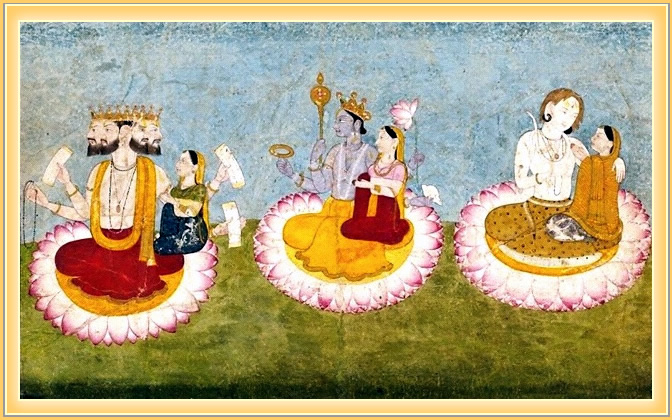
*: The word nature can also be taken literally as the modes in the sense of the seasons and their primary demigods. Krishna says that Vishnu, who is the original controller above the modes, the best of the gods [10.89: 14-17], is of goodness [11.15: 15], the purest mode [B.G. 14: 6], leading to the godliness of Him [B.G. 14: 14], and that of the seasons He is the season of spring [B.G. 10: 35]. Autumn/Spring is as such His season of balance and of the mode of goodness. The same way the inertia of cold is representative for the mode of ignorance that is ruled by S'iva, and the hyperactivity and heat of the summer is a display of the mode of passion that is ruled by Brahmâ.

The
text and audio are offered under the conditions of the
Creative
Commons
Attribution-Noncommercial-Share
Alike 3.0 Unported License.
The picture
is titled: 'Brahmâ, Vishnu and Shiva' seated on lotuses with
their consorts,
Sarasvati, Lakshmi and Parvati respectively. ca 1770. Guler,
India.
source: V&A
Museum.
Production: Filognostic
Association of The Order of Time

Feed-back | Links | Downloads | Music | Pictures | What's New | Search | Donations



 Text 1