Canto 10
Canto 10
Chapter 68: The Marriage of Sâmba and the Kuru City Dragged Trembling of His Anger
(1) S'rî S'uka said: 'Oh King, the daughter of Duryodhana named Lakshmanâ was by Sâmba ['with the mother'], the son of Jâmbavatî who was always victorious in battle, abducted from her svayamvara. (2) The Kauravas became angry and said: 'How ill-behaved this boy is, insulting us with his by force taking the maiden against her will. (3) Arrest him who is so undisciplined. What can the Vrishnis do against it? By our grace they enjoy the land that we gave them! (4) When the Vrishnis find out that their son has been captured, they will come here. Then we will break their pride so that they will find peace, just as the senses do when they are firmly controlled.'
(5) Having said this, Karna, S'ala, Bhûri, Yajñaketu [or Bhûris'ravâ] and Duryodhana, with the permission of the eldest Kuru [Bhîshma], set out to fight Sâmba. (6) The moment the great warrior Sâmba saw the followers of Dhritarâshthra rushing at him, he took up his splendid bow and single-handedly stood his ground like a lion. (7) Determined to capture him, they who were headed by Karna filled with anger said: 'You there stop, stand and fight!', upon which the bowmen, getting in front of him, showered him with arrows. (8) He, the descendant of the Yadus, oh best of the Kurus, unjustly attacked by the Kurus [all against one], as the son of the Inconceivable One [Krishna], could not accept that any more than a lion would tolerate an attack from lower animals. (9-10) Twanging his wonderful bow, the hero all by himself, in one move, pierced the six warriors of Karna in their chariots with as many arrows. Four arrows he employed for each team of four horses and one arrow for each its charioteer and warrior. For that feat of arms he thereupon was honored by the great bowmen. (11) But then four of them pierced his horses, one pierced his charioteer and one split his bow. Thus they drove him out of his chariot. (12) Now that the Kurus in the fight had gotten the young boy out of his chariot, they tied him up with difficulty, and, with their girl, victoriously returned to their city.
(13) Hearing about this from Nârada Muni, oh King, [the Yadus] got very angry with the Kurus [see also 10.49: 27], and prepared for war on the command of Ugrasena. (14-15) But Balarâma, He who purifies the Age of Quarrel [Kali-yuga], calmed down the Vrishni heroes who already had put on their armor, for he did not wish a quarrel between the Vrishnis and the Kurus. On His chariot that shone like the sun, going to Hastinâpura surrounded by the brahmins and the elders of the family, He looked like the moon surrounded by the seven planets [then known, see also 5.22]. (16) After reaching Hastinâpura, Balarâma remained outside in a park and sent Uddhava ahead to find out what Dhritarâshthra had in mind. (17) According to the rules offering his respects to the son of Ambikâ [Dhritarâshthra], to Bhîshma and Drona, Bâhlika and Duryodhana, he informed them that Balarâma had arrived. (18) Extremely pleased to hear that He, Balarâma, their Dearest Friend had arrived, they all, after duly having paid Uddhava their respects, went to meet Him with auspicious offerings in their hands. (19) Meeting Balarâma they, as was proper, presented cows and water to welcome Him. They who knew about His [true] power bowed down their heads to Him. (20) Asking each other whether their relatives were hale and hearty, Balarâma next straight from His heart spoke the words: (21) 'After with undivided attention having taken notice of what Ugrasena our master, the ruler of the rulers of the earth, asks of you, you without delay should act accordingly. [He tells you:] (22) As for now I have tolerated that you in defiance of the rules, with the many of you have defeated and tied up but a single man who did respect the codes [of war], for I wish to keep the unity among my relatives... .'
(23) Hearing the words of Baladeva that befitting His power were filled with potency, courage and strength, the Kauravas answered angrily: (24) 'Look how wondrously inescapable Time moves on. That what is a shoe now wants to step on a head that is ornamented with a crown! (25) These Vrishnis who are connected to us by marital ties, share with us our beds, seats and meals. We treated them as equals and gave them their thrones. (26) Because we looked the other way, they could enjoy the yak-tail fan, the conch shell, the white sunshade, the crown, the throne and the royal bed [compare 10.60: 10-20]. (27) The Yadus no longer should be allowed to carry the divine insignia of kings. Those symbols work as much to the disadvantage of the giver [who we are] as when one gives nectar to a snake! The Yadus now assuming the command, could prosper through our grace. They have lost all shame! (28) How would even Indra dare to appropriate what was not granted by Bhîshma, Drona, Arjuna or the other Kurus? It is like a sheep claiming a lion's kill!'
(29) The son of Vyâsa said: 'Oh best of the Bharatas, the low men intoxicated by their birth, relations and the opulence that gave them their status, thus used these harsh words against Balarâma and then entered their city. (30) Faced with the bad character of the Kurus and hearing their unbecoming words, the Infallible Lord became angry and then said, while He repeatedly laughed and not bothered to present Himself nicely: (31) 'Given the big mouth these impudent losers have to their various passions, they clearly do not aim at peace. They apparently need to be pacified by walloping, like animals that one has to beat with a stick! (32-33) Oh, looking for peace with these people, I have come here, after tactfully having calmed the Yadus who boiled with anger, as also Krishna who was mad. And those very same dull-headed people addicted to quarreling, now full of conceit, in their wickedness of not respecting Him - Me thus -, have the audacity to use harsh words! (34) And Ugrasena would not be fit to command the Bhojas, Vrishnis and Andhakas, while S'akra ['the powerful one' or Indra] and other rulers follow his orders?? (35) And He [Krishna], sitting in the Sudharmâ [the heavenly council-hall], thanks to Whom the pârijâta tree is enjoyed that was brought down from the immortals [see 10.59: 38-39], not even He would deserve an elevated seat??? (36) He, the Ruler of the Complete Whole, whose two feet are worshiped by the Goddess of Fortune herself, He, truly the Lord of S'rî, would not even deserve the paraphernalia of a human king?!?! (37) He of whom all the exalted rulers of the world hold the dust of His lotuslike feet on their helmet, the feet that constitute the place of worship of all holy places and of whom Brahmâ, S'iva and also I, next to the goddess, as portions of a portion, also constantly carry the dust with care... where would His royal throne stand?????! (38) The Vrishnis may enjoy whatever small piece of land granted to them by the Kurus and... We would be the so-called shoes, while the Kurus would be the head?!!!? (39) Ah, those proud madmen intoxicated by their would-be power of rule..., which man in command can tolerate their inconsistent, dismal drivel? (40) Today I will rid the earth of the Kauravas!', and speaking thus He enraged took His plow and rose up as if to set fire to the three worlds.
(41) With the tip of His plow He infuriated pulled up the city of Hastinâpura and dragged her along with the intention to throw her into the Ganges. (42-43) When the Kauravas saw how the city, about to fall in the Ganges, being dragged tumbled about like a raft, they got very agitated and, in order to save their lives, together with their families went to the Master for shelter. Led by Lakshmanâ and Sâmba they folded their hands: (44) 'Râma, oh Balarâma, oh Foundation of Everything [Akhilâdhâra], we, the infatuated, who poor of understanding do not know Your Majesty, beg You to forgive us our offense. (45) You alone are the unique, original cause of the generation, continuation and reuniting [of this universe]. Oh Lord, one says that the worlds are the playthings You play with. (46) You, oh Unlimited One, playfully carry on Your head the globe of the earth, oh Thousand-headed One [see also 5.25], and when the creation ends, You, the One Without a Second, withdraw the universe into Your body, remain alone and lie down [see also 6.16: 29-64]. (47) Your anger is meant for the instruction of everyone, oh Bhagavân, Sustainer of the Mode of Goodness. It is not there out of hatred or envy, but is there for the purpose of maintaining and protecting the living being. (48) We bow down to you, oh Soul of All Beings, oh Holder of [the symbols of] All Energies, oh Inexhaustible One and Maker of the Universe, our obeisances for You whom we sought for shelter.'
(49) S'rî S'uka said: 'Lord Bala being propitiated by the surrendered souls in distress because of their trembling place of refuge, thus being satisfied relieved them of their fear by the words: 'Do not be afraid.' (50-51) As a dowry for his daughter, Duryodhana as a loving father gave away twelve hundred sixty-year-old elephants and hundred and twenty thousand horses, sixty thousand golden chariots shining like the sun, and a thousand maidservants with jeweled lockets around their necks. (52) The Supreme Lord, the chief of the Sâtvatas, accepted all of that and then departed together with His son and daughter-in-law, being bid farewell by His well-wishers. (53) After entering His city and having met the relatives who carried Him, the Wielder of the Plow, in their hearts, He in the midst of the assembly of the Yadu leaders related everything that had passed between Him and the Kurus. (54) And truly, even today this city shows the signs of Balarâma's prowess. It can be seen where it is being prominently elevated to the south, down by the Ganges.'


Third revised edition, loaded August 11, 2021
Previous Aadhar edition and Vedabase links:
S'rî S'uka said: 'Oh King, the daughter of Duryodhana named Lakshmanâ was by Sâmba ['with the mother'], the son of Jâmbavatî who was always victorious in battle, abducted from her svayamvara.S'rî S'uka said: 'O King, the daughter of Duryodhana named Lakshmanâ was by Sâmba ['with the mother'], the son of Jâmbavatî who was always victorious in battle, abducted from her svayamvara. (Vedabase)
The Kauravas became angry and said: 'How ill-behaved this boy is, insulting us with his by force taking the maiden against her will.
The Kauravas said angered: 'How ill-behaved this boy insulting us is, in his by force taking the maiden against her will. (Vedabase)
Arrest him who is so undisciplined. What can the Vrishnis do against it? By our grace they enjoy the land that we gave them!
Arrest him who is so undisciplined; what can the Vrishnis do against it? By our grace they acquired the land we gave them to enjoy! (Vedabase)
When the Vrishnis find out that their son has been captured, they will come here. Then we will break their pride so that they will find peace, just as the senses do when they are firmly controlled.'
If the Vrishnis, learning that their son was captured, get over here, will we break their pride so that they will find peace the way the senses will when they're properly brought under control.' (Vedabase)
Having said this, Karna, S'ala, Bhûri, Yajñaketu [or Bhûris'ravâ] and Duryodhana, with the permission of the eldest Kuru [Bhîshma], set out to fight Sâmba.
Having said this set Karna, S'ala, Bhûri, Yajñaketu [or Bhuris'ravâ] and Duryodhana, with the permission of the Kuru-eldest [Bhîshma], out to fight Sâmba. (Vedabase)
The moment the great warrior Sâmba saw the followers of Dhritarâshthra rushing at him, he took up his splendid bow and single-handedly stood his ground like a lion.
As soon as the great warrior Sâmba saw the followers of Dhritarâshthra rushing toward him, took he up his splendid bow and stood he singlehanded his ground like a lion. (Vedabase)
Determined to capture him, they who were headed by Karna filled with anger said: 'You there stop, stand and fight!', upon which the bowmen, getting in front of him, showered him with arrows.
Determined to capture him said they who were headed by Karna full of anger: 'You stand, stand and fight', upon which the bowmen, getting before him, showered him with arrows. (Vedabase)
He, the descendant of the Yadus, oh best of the Kurus, unjustly attacked by the Kurus [all against one], as the son of the Inconceivable One [Krishna], could not accept that any more than a lion would tolerate an attack from lower animals.
He the son of the Yadus, o best of the Kurus, unjustly by the Kurus [- by the lot of them -] attacked, could, as the child of the Inconceivable One [Krishna], not tolerate that anymore than a lion would tolerate such a thing of lower animals. (Vedabase)
Twanging his wonderful bow, the hero all by himself, in one move, pierced the six warriors of Karna in their chariots with as many arrows. Four arrows he employed for each team of four horses and one arrow for each its charioteer and warrior. For that feat of arms he thereupon was honored by the great bowmen.
Twanging his wonderful bow pierced the hero all by himself, in one move, six warriors of Karna using as many arrows for their chariots: four arrows were there for each team of four horses and one arrow for each its charioteer and warrior. For that feat of arms was he by the great bowmen then honored. (Vedabase)
But then four of them pierced his horses, one pierced his charioteer and one split his bow. Thus they drove him out of his chariot.
With four of them striking his horses, one his charioteer and one splitting his bow, drove they him out of his chariot. (Vedabase)
Now that the Kurus in the fight had gotten the young boy out of his chariot, they tied him up with difficulty, and, with their girl, victoriously returned to their city.
Once they in the fight had the young boy out of his chariot, tied the Kurus him up and turned they, with their girl, victoriously back to their city. (Vedabase)
Hearing about this from Nârada Muni, oh King, [the Yadus] got very angry with the Kurus [see also 10.49: 27], and prepared for war on the command of Ugrasena.
When they heard from Nârada Muni about this o King, got they [the Yadus] angry with the Kurus [see also 10.49: 27] and prepared they, on the command of Ugrasena, for war. (Vedabase)
But Balarâma, He who purifies the Age of Quarrel [Kali-yuga], calmed down the Vrishni heroes who already had put on their armor, for he did not wish a quarrel between the Vrishnis and the Kurus. On His chariot that shone like the sun, going to Hastinâpura surrounded by the brahmins and the elders of the family, He looked like the moon surrounded by the seven planets [then known, see also 5.22].
But Râma, He who purifies the Age of Quarrel [Kali-yuga], not wishing a quarrel between the Vrishnis and Kurus, calmed down the Vrishni heroes and went with His chariot, that shone like the sun, to Hastinâpura. Surrounded by the brahmins and the elders of the family looked He like the moon with the seven planets [then known, see also 5.22]. (Vedabase)
After reaching Hastinâpura, Balarâma remained outside in a park and sent Uddhava ahead to find out what Dhritarâshthra had in mind.
Reaching Hastinâpura remained Râma outside in a park and sent He Uddhava ahead to find out what Dhritarâshthra had in mind. (Vedabase)
According to the rules offering his respects to the son of Ambikâ [Dhritarâshthra], to Bhîshma and Drona, Bâhlika and Duryodhana, he informed them that Balarâma had arrived.
He, offering his respects to the son of Ambikâ [Dhritarâshthra], to Bhîshma and Drona, Bâhlika and Duryodhana, informed them that Râma had arrived. (Vedabase)
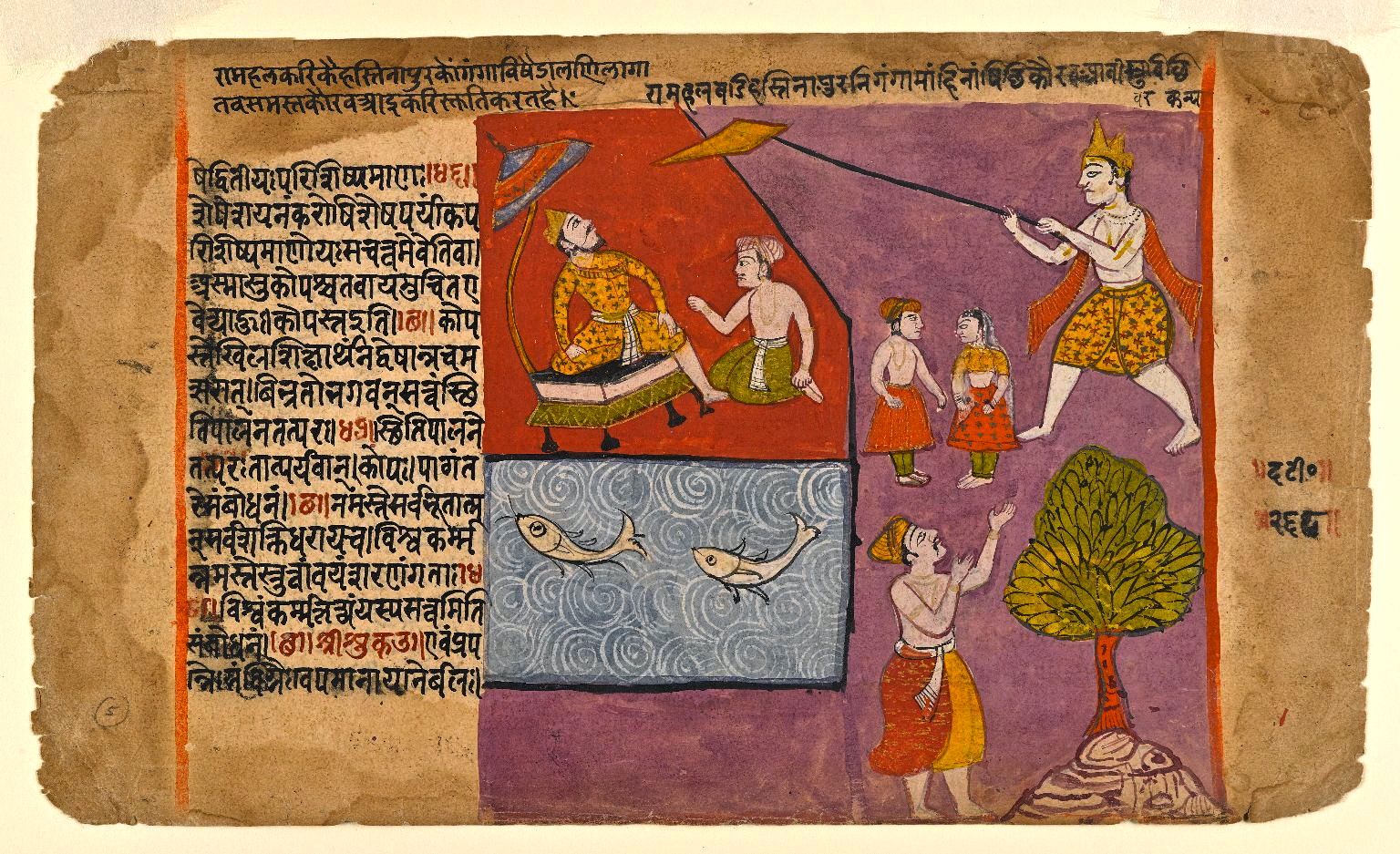
Extremely pleased to hear that He, Balarâma, their Dearest Friend had arrived, they all, after duly having paid Uddhava their respects, went to meet Him with auspicious offerings in their hands.
They, extremely pleased to hear that He, Balarâma, their Dearest Friend had arrived, all, after duly paying him their respects, went forth to meet Him with auspicious offerings in their hands. (Vedabase)
Meeting Balarâma they, as was proper, presented cows and water to welcome Him. They who knew about His [true] power bowed down their heads to Him.
Going up to Balarâma presented they, as was proper, cows and water to welcome Him and bowed they who knew of His power their heads down. (Vedabase)
Asking each other whether their relatives were hale and hearty, Balarâma next straight from His heart spoke the words:
Inquiring with one another whether their relatives were hale and hearty spoke Râma next straight from His heart the words: (Vedabase)
'After with undivided attention having taken notice of what Ugrasena our master, the ruler of the rulers of the earth, asks of you, you without delay should act accordingly. [He tells you:]
'With undivided attention having taken notice of what Ugrasena our master, the ruler of the rulers of the earth, has demanded of you, should you without delay act accordingly. [He has said:] (Vedabase)
As for now I have tolerated that you in defiance of the rules, with the many of you have defeated and tied up but a single man who did respect the codes [of war], for I wish to keep the unity among my relatives... .'
'Your in defiance of the rules with the many of you defeating and tying up but a single man who did follow the codes [of war], do I, wishing to keep unity among relatives, tolerate... [but I do not wish to see that continued and thus want you to release Sâmba].' (Vedabase)
Hearing the words of Baladeva that befitting His power were filled with potency, courage and strength, the Kauravas answered angrily:
Hearing the words of Baladeva that befitting His own power were filled with potency, courage and strength answered the Kauravas enraged: (Vedabase)
'Look how wondrously inescapable Time moves on. That what is a shoe now wants to step on a head that is ornamented with a crown!
'Oh what a great wonder the inescapable movement of Time is; now is that what is a shoe trying to climb on top of the head that is ornamented with a crown! (Vedabase)
These Vrishnis who are connected to us by marital ties, share with us our beds, seats and meals. We treated them as equals and gave them their thrones.
With these Vrishnis who are connected to us by marriage ties, we share our beds, seats and meals. We treated them as equals and gave them their thrones. (Vedabase)
Because we looked the other way, they could enjoy the yak-tail fan, the conch shell, the white sunshade, the crown, the throne and the royal bed [compare 10.60: 10-20].
Because we looked the other way could they enjoy the pair of yak-tail fans, the conchshell, the white sunshade, the crown, the throne and the royal bed [compare: (Vedabase)
The Yadus no longer should be allowed to carry the divine insignia of kings. Those symbols work as much to the disadvantage of the giver [who we are] as when one gives nectar to a snake! The Yadus now assuming the command, could prosper through our grace. They have lost all shame!
Enough with us allowing the Yadus the symbols of the gods among men. Those symbols work as much to the disadvantage of the giver [that we are] as giving nectar to snakes. The Yadus, who could prosper by our grace, now assuming the command have lost all shame indeed. (Vedabase)
How would even Indra dare to appropriate what was not granted by Bhîshma, Drona, Arjuna or the other Kurus? It is like a sheep claiming a lion's kill!'
How would even Indra dare to appropriate what is not given by Bhîshma, Drona, Arjuna or the other Kurus: it's like a sheep claiming a lions kill!' (Vedabase)
The son of Vyâsa said: 'Oh best of the Bharatas, the low men intoxicated by their birth, relations and the opulence that gave them their status, thus used these harsh words against Balarâma and then entered their city.
The son of Vyâsa said: 'They who in their arrogance over the birth, relations and the opulences that made them great, o best of the Bharatas, as rude men with harsh words made this clear to Râma, then returned to the city. (Vedabase)
Faced with the bad character of the Kurus and hearing their unbecoming words, the Infallible Lord became angry and then said, while He repeatedly laughed and not bothered to present Himself nicely:
Faced with the bad character of the Kurus and hearing their unbecoming words said the Infallible Lord infuriated, repeatedly laughing and without presenting Himself nicely: (Vedabase)
'Given the big mouth these impudent losers have to their various passions, they clearly do not aim at peace. They apparently need to be pacified by walloping, like animals that one has to beat with a stick!
'Driven by their various passions having a big mouth are these dishonest people truly not desiring the peace. They evidently need to be pacified with physical punishment like animals one has to beat with a stick! (Vedabase)
Oh, looking for peace with these people, I have come here, after tactfully having calmed the Yadus who boiled with anger, as also Krishna who was mad. And those very same dull-headed people addicted to quarreling, now full of conceit, in their wickedness of not respecting Him - Me thus -, have the audacity to use harsh words!
Oh, looking for peace with these people I came here, tactfully having calmed the Yadus who boiled with anger as also Krishna who was mad; and those very same dull-headed people addicted to quarreling now full of conceit have the audacity to use, in their wickedness of not repecting Him - Me thus -, this kind of harsh words! (Vedabase)
And Ugrasena would not be fit to command the Bhojas, Vrishnis and Andhakas, while S'akra ['the powerful one' or Indra] and other rulers follow his orders??
And Ugrasena wouldn't be fit to command the Bhojas, Vrishnis and Andhakas while S'akra ['the powerful one' or Indra] and other rulers follow his orders?? (Vedabase)
And He [Krishna], sitting in the Sudharmâ [the heavenly council-hall], thanks to Whom the pârijâta tree is enjoyed that was brought down from the immortals [see 10.59: 38-39], not even He would deserve an elevated seat???
And He [Krishna], sitting in Sudharmâ [the heavenly council-hall], thanks to whom the pârijâta tree brought down from the immortals is enjoyed [see 10.59: 38-39], that same One wouldn't even be fit an elevated seat??? (Vedabase)
He, the Ruler of the Complete Whole, whose two feet are worshiped by the Goddess of Fortune herself, He, truly the Lord of S'rî, would not even deserve the paraphernalia of a human king?!?!
He, the Ruler of the Complete, whose two feet the Goddess of Fortune herself worships; He, truly the Lord of S'rî, wouldn't deserve the paraphernalia of a human king?!?! (Vedabase)
He of whom all the exalted rulers of the world hold the dust of His lotuslike feet on their helmet, the feet that constitute the place of worship of all holy places and of whom Brahmâ, S'iva and also I, next to the goddess, as portions of a portion, also constantly carry the dust with care... where would His royal throne stand?????!
He of whom all the exalted rulers of the world on their helmets hold the dust of His lotuslike feet; the place of worship of all holy places of whom Brahmâ, S'iva and I also next to the goddess, as portions of a portion, also constantly carry the dust with care; where would His royal throne be?????! (Vedabase)
The Vrishnis may enjoy whatever small piece of land granted to them by the Kurus and... We would be the so-called shoes, while the Kurus would be the head?!!!?
The Vrishnis would enjoy but a small piece of land granted to them by the Kurus? And We to that would be the so-called shoes, while the Kurus would be the head then?!!!? (Vedabase)
Ah, those proud madmen intoxicated by their would-be power of rule..., which man in command can tolerate their inconsistent, dismal drivel?
Ah those proud madmen intoxicated by their would-be power of rule, what man in command can tolerate their inconsistent, dismal drivel? (Vedabase)
Today I will rid the earth of the Kauravas!', and speaking thus He enraged took His plow and rose up as if to set fire to the three worlds.
Today I'll rid the earth of the Kauravas!', and thus speaking took He enraged His plow and rose He up as if he would set fire to the three worlds. (Vedabase)
With the tip of His plow He infuriated pulled up the city of Hastinâpura and dragged her along with the intention to throw her into the Ganges.
With the tip of His plow He infuriated tore close the city of Hastinâpura and dragged her along with the intention to throw her into the Ganges. (Vedabase)
When the Kauravas saw how the city, about to fall in the Ganges, being dragged tumbled about like a raft, they got very agitated and, in order to save their lives, together with their families went to the Master for shelter. Led by Lakshmanâ and Sâmba they folded their hands:
When the Kauravas saw how the city, about to fall in the Ganges, being dragged tumbled about like a raft, became they very agitated and went they, in order to save their lives, with their families to the Master for shelter. With Lakshmanâ and Sâmba put in front folded they their hands: (Vedabase)
'Râma, oh Balarâma, oh Foundation of Everything [Akhilâdhâra], we, the infatuated, who poor of understanding do not know Your Majesty, beg You to forgive us our offense.
'Râma, o Râma, o Foundation of Everything [Akhilâdhâra], us the infatuated, who poor of understanding do not know Your Majesty, You should forgive the offense. (Vedabase)
You alone are the unique, original cause of the generation, continuation and reuniting [of this universe]. Oh Lord, one says that the worlds are the playthings You play with.
Of the generation, continuation and reuniting [of this universe] are You alone the unique cause; the worlds accordingly are, so one says, the playthings of Your playing, o Heavenly Lord. (Vedabase)
You, oh Unlimited One, playfully carry on Your head the globe of the earth, oh Thousand-headed One [see also 5.25], and when the creation ends, You, the One Without a Second, withdraw the universe into Your body, remain alone and lie down [see also 6.16: 29-64].
You alone, o Unlimited one, carry on Your head playfully the globe of the earth, o Thousand-headed One [see also 5.25] and when the creation ends are You the One who lies down to remain the One Without a Second who within His own body has withdrawn the universe [see also 6.16: 29-64]. (Vedabase)
Your anger is meant for the instruction of everyone, oh Bhagavân, Sustainer of the Mode of Goodness. It is not there out of hatred or envy, but is there for the purpose of maintaining and protecting the living being.
The anger of You meant for the instruction of everyone, o Bhagavân, Sustainer of the Mode of Goodness, is not there out of hatred or envy but is there for the purpose of sustaining and protecting the living being. (Vedabase)
We bow down to you, oh Soul of All Beings, oh Holder of [the symbols of] All Energies, oh Inexhaustible One and Maker of the Universe, our obeisances for You whom we sought for shelter.'
I offer You my obeisances, o Soul of All Beings, o Holder of [the symbols of] All Energies, o Inexhaustible One, Maker of the Universe; let there be the reverence for You whom we sought for shelter.' (Vedabase)
S'rî S'uka said: 'Lord Bala being propitiated by the surrendered souls in distress because of their trembling place of refuge, thus being satisfied relieved them of their fear by the words: 'Do not be afraid.'
S'rî S'uka said: 'Lord Bala thus propitiated by the surrendered souls who were distressed because of the trembling of their place of residence, then relieved them very calm and graciously of their fear with the words: 'Do not fear'. (Vedabase)
As a dowry for his daughter, Duryodhana as a loving father gave away twelve hundred sixty-year-old elephants and hundred and twenty thousand horses, sixty thousand golden chariots shining like the sun, and a thousand maidservants with jeweled lockets around their necks.
As a dowry for his daughter gave Duryodhana as a loving father away twelve hundred sixty-year-old elephants and hundred and twenty thousand horses, sixty thousand golden chariots shining like the sun and a thousand maidservants with jeweled lockets around their necks. (Vedabase)
The Supreme Lord, the chief of the Sâtvatas, accepted all of that and then departed together with His son and daughter-in-law, being bid farewell by His well-wishers.
The Supreme Lord, the chief of all the Sâtvatas, after accepting that gift then departed with His son and daughter-in-law, bid farewell by His well-wishers. (Vedabase)
After entering His city and having met the relatives who carried Him, the Wielder of the Plow, in their hearts, He in the midst of the assembly of the Yadu leaders related everything that had passed between Him and the Kurus.
After reaching His city and having met the relatives who carried Him, the Wielder of the Plow, in their hearts, related He in the midst of the assembly of leaders of the Yadus everything that had passed between Him and the Kurus. (Vedabase)
And truly, even today this city shows the signs of Balarâma's prowess. It can be seen where it is being prominently elevated to the south, down by the Ganges.'
And truely, even today shows this city the signs of Râma's prowess, the way it can be seen down by the Ganges being prominently elevated to the south.' (Vedabase)

The text and audio
are offered under the conditions of the
Creative
Commons Attribution-Noncommercial-Share Alike 3.0 Unported
License.
The first picture shows Balarâma with the plow over His
shoulder. Source Unknown.
The second
picture is titled: Balarama pulling Hastinapur toward the
Ganges.
Page from a Bhagavata Dasamskanda series. Mid 17th century.
Bron: Brooklyn
Museum.
Production: Filognostic
Association of The Order of Time.

Feed-back | Links | Downloads | Music | Pictures | What's New | Search | Donations



 Text 1