

Canto 1
Chapter 19: The Appearance of S'ukadeva Gosvâmî
(1) Sûta said: "The king felt that what he had done was something abominable and thought most depressed: 'Alas, it was uncivilized and evil what I did to the faultless, grave and powerful brahmin. (2) Because of the contempt of what I did against that godly person, I undoubtedly very soon will meet with a very troublesome calamity. I certainly hope that that will happen so that I will be relieved of my sins and never do anything like that again. (3) May I, on this very day, burn with my kingdom, strength and wealth of riches in the fire ignited by the brahmin community, so that the inauspiciousness of sinful thinking against the Lord, the twice-born souls and the cows, may never happen to me again.' (4) Thus pondering, the message reached him of the curse of death pronounced by the sage's son. That curse in the form of the fire of a snake bird, he accepted as auspicious because that impending happening would be the consequence of his indifference about worldly affairs. (5) He decided to forsake this world as also the next, for he already had concluded that both worlds were inferior compared to a life of service at the feet of Krishna he considered the greatest achievement. So he sat down at the bank of the transcendental river [the Ganges] in order to fast. (6) That river, always flowing mixed with tulasî leaves [a plant used in worship], consists of the auspicious water carrying the dust from the feet of Lord Krishna that sanctifies both the worlds [inside and outside] and even the Lord of Destruction [Lord S'iva]. Which person destined to die would not turn to that river? (7) In a spirit not deviating from the vows of the sages he would free himself from all kinds of material attachments. With that decision he, the worthy descendant of the Pândavas, sitting down at the river which flows from the feet of Vishnu, surrendered himself to the mercy of Mukunda till he died.
(8) All the great minds and thinkers who together with their pupils are capable of purifying the entire world, then came to gather there on the plea of making a pilgrimage. It is because of their personal presence that the holy places enjoy their status of sanctity. (9-10) Atri, Cyavana, S'aradvân, Arishthanemi, Bhrigu, Vasishthha, Parâs'ara, Vis'vâmitra, Angirâ, Paras'urâma, Uthathya, Indrapramada, Idhmavâhu, Medhâtithi, Devala, Ârshthisena, Bhâradvâja, Gautama, Pippalâda, Maitreya, Aurva, Kavasha, Kumbhayoni, Dvaipâyana and the great personality Nârada arrived. (11) Also many other divine personalities, saintly brahmins, the best saintly advisors of the most prominent nobles and many other sages like Aruna appeared to the occasion. All the heads of the dynasties of sages assembling there were respectfully welcomed by the emperor bowing his head. (12) After they all sat comfortably he, again having offered them his obeisances, thereupon humbly spoke about his decision to fast, with folded hands standing before them as someone whose mind is detached from worldly affairs. (13) The king said: 'We are truly grateful to be the most fortunate of all the kings trained to receive the favors granted by the greatest of souls, for at the feet of the brahmins the royal orders are but refuse to be kept at a distance because of their reprehensible actions. (14) Because of my sins, the Controller of the transcendental and mundane worlds in the form of that brahmin's curse, very soon will be the cause of my detachment from them, I who, always thinking of family matters, was affected by fear. (15) Therefore, oh brahmins, just accept me as someone who with the Lord in his heart has taken shelter of the Ganges, the divine mother. Let the snakebird, or whatever magical thing the twice-born soul called for, bite me forthwith. And you, please continue with the stories about Vishnu. (16) And, again, let it be so that wherever that I, in relation to the Supreme, Unlimited Lord and the association He attracts in the material world, may take birth, I will find friendly relations everywhere with obeisances unto the twice-born souls.'
(17) And thus it came to pass that the king, having arrived at that resolve, fully self-controlled seated himself on kus'a grass laid to the east, while facing the north from the southern bank of the wife of the sea [the Ganges]. The charge of his administration he had handed over to his son. (18) To that occasion the gods, who from the sky had seen that the king would fast until his end, all in praise scattered the earth with flowers, continually beating celestial drums in pleasure. (19) All the great sages who had assembled there praised him for the wisdom he had thus shown. In approval they, from the power of their goodness for the living beings, a quality of heart equal to the character of Him praised in the scriptures, thereupon said: (20) 'It is not astonishing at all that you, oh saintly king, oh chief of all of us who strictly follow Krishna, being seated on the throne that is decorated with the helmets of kings, as immediate like this gave up your life in your desire to achieve association with the Fortunate One. (21) We will all stay at this place for as long as it takes this foremost devotee to give up his body and return to the world of the Supreme One, where he will be completely free from worldly concerns and lamentation.'
(22) After having heard the assembled sages speak thus impartially, sweet to hear, grave and perfectly true, Parîkchit complimented them all with their appropriate show of respect and said, desirous to hear about the activities of Vishnu: (23) 'You from all directions have assembled here as embodiments of the Vedic knowledge maintained above the three worlds, with no other intention in this world or a world hereafter but to act for the good of others according to your innate nature. (24) Therefore I beg you, trustworthy Vedic men of learning, to tell me which of all the different duties for each person and especially for those who are about to die, you consider to be the proper one [for me].'
(25) At that moment the powerful son of Vyâsa, S'ukadeva Gosvâmî appeared. Dressed like a mendicant he, satisfied in self-realization, freely traveled around the earth surrounded by children and without distinguishing marks of identity or any concern about material comforts. (26) Sixteen years of age, he had a body with delicate legs, hands, thighs, arms, shoulders and forehead. His eyes were beautifully wide in a face with a high nose, similar ears, nice eyebrows and a neck as shapely as a conch shell. (27) With a fleshy collarbone, a broad chest and a deep navel he had nice folds in his abdomen. Stark naked with curly, scattered hair and long arms he had the hue of the best among the gods [of Krishna; a dark complexion]. (28) Even though he covered his nakedness the sages, who had a keen eye for physiognomy, recognized the symptoms of the blackish skin, the eternal beauty of his tender age and the attraction for the fair sex with his beautiful smiles. And so they all stood up from their seats. (29) To welcome the new guest, he who is always protected by Vishnu [Parîkchit] bowed before him to offer his obeisances, whereupon his less educated following of boys and women immediately withdrew as he took his exalted seat in regard of the respect shown. (30) Surrounded there by the greatest of the great saints among the brahmins, the kings and the godly souls, S'ukadeva shone, as the greatest lord, as resplendent as the moon surrounded by the planets, heavenly bodies and stars. (31) Calm, intelligent and self-assured sitting down, the sage was approached by the great devotee, the king, who properly bowing down with folded hands asked him questions in a polite and friendly manner.
(32) Parîkchit said: 'Oh brahmin, what a blessing it is for us, kshatriya friends, by the mercy of you being our guest to have been been chosen today as a servant of the devotee, by the visit of your good self to be allowed to find our way. (33) Thinking of your person, immediately all the places we inhabit are purified, not even mentioning what it means to see you, touch you, wash your feet and offer you a seat! (34) By your presence, oh great mystic, a person's gravest sins are immediately vanquished, like what happens to nonbelievers in the presence of Vishnu. (35) Finally Krishna, the Supreme Lord so dear to the sons of Pându, is satisfied with me and has, from His affection for His cousins, [by your visit] accepted me, their descendant, as one of theirs. (36) How else could it be possible that you, out of your own, especially for someone in his last hours before death, have appeared here to meet us, while you normally, all-perfect as you are, move unseen among the common people? (37) Therefore I beg you as the supreme spiritual master of all ascetics, what for a person in this life would be the path of perfection, and especially what that would mean for someone about to die. (38) Please explain what a person should attend to and meditate on, oh master, what he should do, what he should think of and should serve, as also what would be against the principle. (39) This I ask you because, oh supreme devotee, one at the homes of the householders rarely sees you staying longer than the exact time of milking a cow.' "
(40) Sûta said: "Thus pleasantly being addressed and questioned by the king, the supreme son of Vyâsadeva, so well versed in the knowledge of one's actual duty, began his reply."
Thus the first Canto of the S'rîmad Bhâgavatam ends named: Creation.
Read the inspiration to this chapter by Anand Aadhar.


Third revised edition, loaded April 26, 2023.
Previous Aadhar edition and Vedabase links:Sûta said: "The king felt that what he had done was something abominable and thought most depressed: 'Alas, it was uncivilized and evil what I did to the faultless, grave and powerful brahmin.Sûta said: "While going home the king thought that the act of what he had done was abominable and he was very depressed saying to himself: 'Alas, it was uncivilized and evil what I did to the faultless, grave and powerful brahmin. (Vedabase)
Because of the contempt of what I did against that godly person, I undoubtedly very soon will meet with a very troublesome calamity. I certainly hope that that will happen so that I will be relieved of my sins and never do anything like that again.
For sure is it because of going against the injunctions that very soon I will meet with a very troublesome calamity. I certainly hope that that will happen as soon as possible, so that I shall be relieved of my sins and never do something like that again. (Vedabase)
May I, on this very day, burn with my kingdom, strength and wealth of riches in the fire ignited by the brahmin community, so that the inauspiciousness of sinful thinking against the Lord, the twice-born souls and the cows, may never happen to me again.'
May I, on this very day, burn with my kingdom, strength and wealth of riches in the fire ignited by the brahmin community, so that the inauspiciousness of sinning against the Lord, the culture and the cows may not return to me.' (Vedabase)
Thus pondering, the message reached him of the curse of death pronounced by the sage's son. That curse in the form of the fire of a snake bird, he accepted as auspicious because that impending happening would be the consequence of his indifference about worldly affairs.
Thus pondering reached him the message of the curse of death pronounced by the sage's son. That curse in the form of the fire of a snake bird he accepted as something auspicious because that expected happening would be the logical consequence of the indifference of an all too attached person. (Vedabase)
He decided to forsake this world as also the next, for he already had concluded that both worlds were inferior compared to a life of service at the feet of Krishna he considered the greatest achievement. So he sat down at the bank of the transcendental river [the Ganges] in order to fast.
He gave up on this and the next world, for he already had concluded that the both of them were inferior compared to a life of service at the feet of Krishna. Therefore he sat down at the bank of the transcendental river [the Ganges] in order to fast, that was to his opinion the best thing he could do. (Vedabase)
That river, always flowing mixed with tulasî leaves [a plant used in worship], consists of the auspicious water carrying the dust from the feet of Lord Krishna that sanctifies both the worlds [inside and outside] and even the Lord of Destruction [Lord S'iva]. Which person destined to die would not turn to that river?
That river, always flowing mixed with tulasî leaves [a plant used in worship], consists of the auspicious water carrying the dust from the feet of Lord Krishna that sanctifies both the worlds inside and outside and even the Lord of Destruction [Lord S'iva]. What person destined to die would not turn to that river? (Vedabase)
In a spirit not deviating from the vows of the sages he would free himself from all kinds of material attachments. With that decision he, the worthy descendant of the Pândavas, sitting down at the river which flows from the feet of Vishnu, surrendered himself to the mercy of Mukunda till he died.
Thus having decided sat he, the worthy descendant of the Pândavas, down at the river flowing from the feet of Vishnu to surrender himself to the mercy of Mukunda till he died. Without deviating from the spirit of the vows of the sages would he complete his fasting, free from all kinds of material attachment. (Vedabase)
All the great minds and thinkers who together with their pupils are capable of purifying the entire world, then came to gather there on the plea of making a pilgrimage. It is because of their personal presence that the holy places enjoy their status of sanctity.
At that place gathered on the plea of a pilgrimage all the great minds and thinkers who together with their pupils are capable of elevating the entire world. It is because of their personal presence that the holy places enjoy their status of sancticity. (Vedabase)
Atri, Cyavana, S'aradvân, Arishthanemi, Bhrigu, Vasishthha, Parâs'ara, Vis'vâmitra, Angirâ, Paras'urâma, Uthathya, Indrapramada, Idhmavâhu, Medhâtithi, Devala, Ârshthisena, Bhâradvâja, Gautama, Pippalâda, Maitreya, Aurva, Kavasha, Kumbhayoni, Dvaipâyana and the great personality Nârada arrived.
Atri, Cyavana, S'aradvân, Arishthanemi, Bhrigu, Vasishthha, Parâs'ara, Vis'vâmitra, Angirâ, Paras'urâma, Uthathya, Indrapramada, Idhmavâhu, Medhâtithi, Devala, Ârshthisena, Bhâradvâja, Gautama, Pippalâda, Maitreya, Aurva, Kavasha, Kumbhayoni, Dvaipâyana and the great personality Nârada arrived there. (Vedabase)
Also many other divine personalities, saintly brahmins, the best saintly advisors of the most prominent nobles and many other sages like Aruna appeared to the occasion. All the heads of the dynasties of sages assembling there were respectfully welcomed by the emperor bowing his head.
Also many other divine personalities, saintly brahmins, the best saintly advisors of the most prominent nobles and many other sages like Aruna appeared to the occasion. All the heads of the dynasties of sages assembling there were respectfully welcomed by the emperor bowing his head. (Vedabase)
After they all sat comfortably he, again having offered them his obeisances, thereupon humbly spoke about his decision to fast, with folded hands standing before them as someone whose mind is detached from worldly affairs.
With all sitting down comfortably and after again having offered them his obeisances, he thereupon humbly spoke about his decision to fast, with folded hands present before them as someone whose mind is detached from worldly affairs. (Vedabase)
The king said: 'We are truly grateful to be the most fortunate of all the kings trained to receive the favors granted by the greatest of souls, for at the feet of the brahmins the royal orders are but refuse to be kept at a distance because of their reprehensible actions.
The king said: 'We indeed are grateful to be the most fortunate of all the kings who are trained to be receptive to the favors granted by the greatest of souls, for to the feet of the brahmins are the royal orders because of their reprehensible actions but refuse to be kept at a distance. (Vedabase)
Because of my sins, the Controller of the transcendental and mundane worlds in the form of that brahmin's curse, very soon will be the cause of my detachment from them, I who, always thinking of family matters, was affected by fear.
Because of my sins, pronounced the Controller of the transcendental and mundane worlds a curse against me via that brahmin, because I out of attachment always was thinking about family affairs. Assuming that form will He, inspiring with fear, very soon overtake my mundane attachment. (Vedabase)
Therefore oh brahmins, just accept me as someone who with the Lord in his heart has taken shelter of the Ganges, the divine mother. Let the snakebird, or whatever magical thing the twice-born soul called for, bite me forthwith. And you, please continue with the stories about Vishnu.
Therefore just accept me, o brahmins, as someone who in surrender has taken to the divine mother Ganges with the Lord in his heart. Let the snakebird, or whatever magical thing the twice-born called for, bite me forthwith; You please continue with reciting the deeds of Lord Vishnu. (Vedabase)
And, again, let it be so that wherever that I, in relation to the Supreme, Unlimited Lord and the association He attracts in the material world, may take birth, I will find friendly relations everywhere with obeisances unto the twice-born souls.'
And, again, let it be so that wherever that I in relation to the Supreme, Unlimited Lord and the association He attracts in the material world may take birth, I will find friendly relations everywhere in obeisance to the twice-born.' (Vedabase)
And thus it came to pass that the king, having arrived at that resolve, fully self-controlled seated himself on kus'a grass laid to the east, while facing the north from the southern bank of the wife of the sea [the Ganges]. The charge of his administration he had handed over to his son.
And thus it so passed that the king, with the same perseverance as he had shown before, fully selfcontrolled sat himself down on kus'a-grass laid down to the east, facing the north from the southern bank of the wife of the sea [the Ganges]. The charge of his administration he had given over to His son. (Vedabase)
To that occasion the gods, who from the sky had seen that the king would fast until his end, all in praise scattered the earth with flowers, continually beating celestial drums in pleasure.
To that, from the sky seeing that the king would fast until his end, all the gods in praise scattered the earth with flowers, continually beating celestial drums in pleasure. (Vedabase)
All the great sages who had assembled there praised him for the wisdom he had thus shown. In approval they, from the power of their goodness for the living beings, a quality of heart equal to the character of Him praised in the scriptures, thereupon said:
All the great sages that had assembled there thus praised him for the wisdom he had shown and approvingly said, from the power of their goodness to the living beings, a goodness that in its quality is as beautifull as the divine praised in the scriptures: (Vedabase)
'It is not astonishing at all that you oh saintly king, oh chief of all of us who strictly follow Krishna, being seated on the throne that is decorated with the helmets of kings, as immediate like this gave up your life in your desire to achieve association with the Fortunate One.
'It is not astonishing that this saintly king, the chief of all of us who are strict in following Krishna, being seated on the throne that is decorated with the helmets of kings, immediately gave up his life in his desire to achieve association with the Fortunate One. (Vedabase)
We will all stay at this place for as long as it takes this foremost devotee to give up his body and return to the world of the Supreme One, where he will be completely free from worldly concerns and lamentation.'
We all will stay as long at this place as it takes the king to give up his body and return to the world of the Supreme, where this foremost devotee will be completely free from worldly concerns and lamentation.' (Vedabase)
After having heard the assembled sages speak thus impartially, sweet to hear, grave and perfectly true, Parîkchit complimented them all with their appropriate show of respect and said, desirous to hear about the activities of Vishnu:
After having heard the assembled sages speak thus impartially, sweet to hear, grave and perfectly true, complimented Parîkchit them all with their appropriate show of respect and said he, desirous to hear about the activities of Vishnu: (Vedabase)
'You from all directions have assembled here as embodiments of the Vedic knowledge maintained above the three worlds, with no other intention in this world or a world hereafter but to act for the good of others according to your innate nature.
'You all have assembled here as the representatives of the One above the three worlds [Brahmâ], with no other intention in this world or a world hereafter but to act, according your innate nature, for the good of others. (Vedabase)
Therefore I beg you, trustworthy Vedic men of learning, to tell me which of all the different duties for each person and especially for those who are about to die, you consider to be the proper one [for me].'
Therefore I beg you, as trustworthy vedic men of learning, to tell me now, after due deliberation, what out of all the different duties of each and especially of those who are about to die, to your opinion would be the proper and befitting conduct.' (Vedabase)
At that moment the powerful son of Vyâsa, S'ukadeva Gosvâmî appeared. Dressed like a mendicant he, satisfied in self-realization, freely traveled around the earth surrounded by children and without distinguishing marks of identity or any concern about material comforts.
At that moment appeared, as if called for, the powerful son of Vyâsa, S'ukadeva Gosvâmî, who, satisfied in self-realization, freely traveled around in the company of children without any concern about material comfort or an identity and with the looks of a mendicant[, he was naked]. (Vedabase)
Sixteen years of age, he had a body with delicate legs, hands, thighs, arms, shoulders and forehead. His eyes were beautifully wide in a face with a high nose, similar ears, nice eyebrows and a neck as shapely as a conch shell.
He, only sixteen years old, had delicate legs, hands, thighs, arms, shoulders, forehead and body. His eyes were beautifully wide and with a high nose and similar ears had he a face with nice brows and a neck as shapely as a conchshell. (Vedabase)
With a fleshy collarbone, a broad chest and a deep navel he had nice folds in his abdomen. Stark naked with curly, scattered hair and long arms he had the hue of the best among the gods [of Krishna; a dark complexion].
With a fleshy collarbone, a broad chest and a deep navel there were nice folds in his abdomen. Stark naked with curly, scattered hair and long arms had he the hue of the best among the gods [Krishna; a dark complexion]. (Vedabase)
Even though he covered his nakedness the sages, who had a keen eye for physiognomy, recognized the symptoms of the blackish skin, the eternal beauty of his tender age and the attraction for the fair sex with his beautiful smiles. And so they all stood up from their seats.
Even though he covered his nakedness, recognized the sages, who had a keen eye for physiognomy, the symptoms of the blackish skin, the beauty of his tender age and the attraction for the fair sex with his beautiful smiles - and so stood they all up from their seats. (Vedabase)
To welcome the new guest, he who is always protected by Vishnu [Parîkchit] bowed before him to offer his obeisances, whereupon his less educated following of boys and women immediately withdrew as he took his exalted seat in regard of the respect shown.
To welcome the new guest, bowed he who is always protected by Vishnu [Parîkchit] before him offering his obeisances, whereupon his less educated following of boys and women withdrew the moment he in regard of the respect took his exalted seat. (Vedabase)
Surrounded there by the greatest of the great saints among the brahmins, the kings and the godly souls, S'ukadeva shone, as the greatest lord, as resplendent as the moon surrounded by the planets, heavenly bodies and stars.
S'ukadev, surrounded there by the greatest of the great saints among the brahmins, the kings and the godly ones, formed a supreme and able presence in which he shone as resplendent as the moon surrounded by the planets, heavenly bodies and stars. (Vedabase)
Calm, intelligent and self-assured sitting down, the sage was approached by the great devotee, the king, who properly bowing down with folded hands asked him questions in a polite and friendly manner.
Calm, intelligent and self-assured sitting down was the sage approached by the great devotee, the king, who properly bowing down with folded hands asked him questions in a polite and friendly manner. (Vedabase)
Parîkchit said: 'Oh brahmin, what a blessing it is for us, kshatriya friends, by the mercy of you being our guest to have been been chosen today as a servant of the devotee, by the visit of your good self to be allowed to find our way.
Parîkchit said: 'O brahmin, today have we from the ruling class become eligible to serve the devotee as friends being united by your mercy, for by making your presence as a guest, does your good self bring about all the good qualities. (Vedabase)
Thinking of your person, immediately all the places we inhabit are purified, not even mentioning what it means to see you, touch you, wash your feet and offer you a seat!
When we think of your person purifies that immediately all the places we inhabit, not to mention what it means to see you, touch you, wash your feet and offer you a seat. (Vedabase)
By your presence, oh great mystic, a person's gravest sins are immediately vanquished, like what happens to nonbelievers in the presence of Vishnu.
Through your presence, o great mystic, are our gravest sins immediately vanquished, even as nonbelievers are in the presence of Vishnu. (Vedabase)
Finally Krishna, the Supreme Lord so dear to the sons of Pându, is satisfied with me and has, from his affection for His cousins, [by your visit] accepted me, their descendant, as one of theirs.
Finally has Krishna, the Supreme Lord so dear to the sons of Pându, mercy with me and has He, for the satisfaction of His cousins and brothers, accepted me, their descendant, as one of theirs. (Vedabase)
How else could it be possible that you, out of your own, especially for someone in his last hours before death, have appeared here to meet us, while you normally, all-perfect as you are, move unseen among the common people?
Otherwise, how could you, specially for someone in his last hours before death, out of your own free will appear here to meet us, while you normally, all-perfect as you are, cannot be found among the common people? (Vedabase)
Therefore I beg you as the supreme spiritual master of all ascetics, what for a person in this life would be the path of perfection, and especially what that would mean for someone about to die.
Therefore I beg you, as the supreme spiritual master of all ascetics, what for a person in this life would be the perfection, the final beatitude, and what all for someone about to die would be the duty. (Vedabase)
Please explain what a person should attend to and meditate on, oh master, what he should do, what he should think of and should serve, as also what would be against the principle.
Please explain what the people in general, o master, should hear and chant about, what they should do, what they should remember and share, as also what would be against the principle. (Vedabase)
This I ask you because, oh supreme devotee, one at the homes of the householders rarely sees you staying longer than the exact time of milking a cow.' "
This because, o supreme devotee, in the house of the householders one rarely sees you staying for longer than the exact time of milking a cow'." (Vedabase)
Sûta said: "Thus pleasantly being addressed and questioned by the king, the supreme son of Vyâsadeva, so well versed in the knowledge of one's actual duty, began his reply."
Sûta said: "Thus pleasantly being addressed and questioned by the king, began the supreme son of Vyâsadeva so well versed in the knowledge of the true duty, with his reply." (Vedabase)


The text and audio are offered
under the conditions of the
Creative Commons
Attribution-Noncommercial-Share Alike 3.0 Unported License.
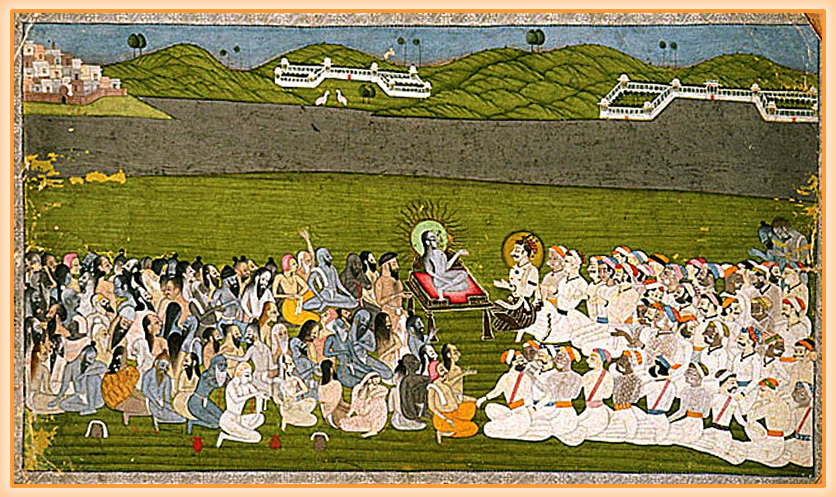
The image is titled: "S'ukadeva
Reciting the Bhâgavata Purâna
(Ancient Stories of the Lord) to Savant Singh" (Reigned
1748-1757),
1750-1775 India, Rajasthan, Kishangarh, South Asia.
Courtesy: LACMA.
Production: Filognostic
Association of The Order of Time

Feed-back | Links | Downloads | Music | Pictures | What's New | Search | Donations



 Text 1