

Canto 1 |
|
Chapter 12: The Birth of Emperor Parîkchit
(1) S'aunaka said: "The [embryo in the] womb of Uttarâ, which was tormented by the enormous heat of the invincible weapon released by As'vatthâmâ, was by the Lord again awarded a life. (2) How did the birth take place of him [Emperor Parîkchit] who was so highly intelligent and what where the activities of this great soul? How exactly did his demise take place and what destination did he achieve? (3) If you think you can tell us this that we, so very faithful, all want to hear, please speak to us then about the transcendental knowledge that was delivered by S'uka."
(4) Sûta said: "King Yudhishthhira brought wealth, the way his father did, by pleasing his subjects in continuous service of Krishna's feet without any ulterior motive for material gain or sensual pleasure. (5) The fame of his wealth, sacrifices, what he stood for, his queens, his brothers and his sovereignty over the planet earth where we are living, even spread to the heavenly worlds. (6) But, just as only food may satisfy a hungry man and nothing else, he, in his hunger as someone aware of the Redeemer, Mukunda, oh brahmins, was not moved by all those earthly desirables that are aspired by even the God-fearing souls.
(7) At the time Parîkchit the great fighter, as a child in his mother's womb, was suffering from the heat of the brahmâstra weapon, oh son of Bhrigu, he could observe the Purusha [the original person] in a shining appearance. (8) In the blaze he saw at the size of not more than a thumb the transcendental, infallible Lord beautiful with a dark skin, a golden helmet and lightening clothes. (9) With the riches of His four arms, earrings of the purest gold, bloodshot eyes and a club in His hands, He was moving about, constantly whirling the club around like it was a torch. (10) As He was vanquishing the radiation of the brahmâstra like the sun evaporating dew drops, He was observed by the child who wondered who He was. (11) He saw how the all-pervading Supersoul, the Supreme Lord and protector of righteousness, took away the glare. Next the Lord who stretches in all directions all of a sudden disappeared from his sight. (12) Thereupon, when the good signs of a favorable position of the stars gradually evolved, he who would prove himself to be of a prowess equal to that of Pându, took birth as the heir apparent of Pându. (13) King Yudhishthhira being fully satisfied had priests like Dhaumya and Kripa perform the birth ritual with the recitation of auspicious hymns. (14) Knowing where, when and how, he in charity rewarded to the occasion of that birth the brahmins with good food and gifts of gold, cows, land, housing, elephants and horses. (15) The brahmins happily addressed the king, the chief of the Pûrus, communicating that they felt most obliged to the line of the descendants of [their ancestor King] Pûru. (16) They said: 'This son has been given to you by the all-pervasive and all-powerful Lord to show you His mercy in countering his destruction by the irresistible, supernatural weapon. (17) Therefore he shall be known all over the world as Vishnu-râta, 'Given by Vishnu'. He will no doubt be a most fortunate, supreme devotee endowed with all good qualities.'
(18) The good king said: 'Oh best of the truthful, will he follow in the footsteps of all the great souls of this family of saintly kings? Will he be just as meritorious and glorious in his achievements?'
(19) The brahmins answered: 'Oh son of Prithâ [Kuntî], he will be the maintainer of all living entities, exactly like King Ikshvâku, the son of Manu, and he will be faithful to his promises and be of respect for the brahmins, just like Râma, the son of Das'aratha. (20) He will be as charitable as King S'ibi of Us'înara and protect the ones of surrender, and will, just like Bharata, the son of Dushyanta who performed many sacrifices, spread the name and fame of his family. (21) Among the archers he will be as good as the two Arjunas [his grandfather and the king of Haihaya, see 9:15: 17-19], he will be as irresistible as fire and as unsurpassable as the ocean. (22) As powerful as a lion and as worthy for taking shelter as the Himalayas, he will be as forbearing as the earth and as tolerant as his parents. (23) With a spirit as good as that of the original father Brahmâ, he will be as generous and equanimous as Lord S'iva and be the refuge of all living beings as good as the Supreme Lord who is the refuge of the goddess of fortune. (24) Following in the footsteps of Krishna he will be the majesty of all divine virtues, he will have the greatness of King Rantideva and be as pious as Yayâti. (25) Being as patient as Bali Mahârâja this child will be as devoted as Prahlâda was unto Krishna, he will perform many As'vamedha [horse] sacrifices and be faithful to the elderly and experienced souls. (26) He will father a line of saintly kings, will chastise the upstarts and, as a source of righteousness in the world, crush the quarrelsome. (27) After being informed about his personal death, as caused by a snakebird which was sent by the son of a brahmin, he will free himself from his attachments and take to the shelter of the Lord. (28) From the son of sage Vyâsa having inquired about the proper self-knowledge, oh King, he will abandon his material life on the bank of the river Ganges and attain the state of fearlessness.'
(29) The brahmins learned in matters of astrology and birth ceremonies, thus having informed the king, were generously rewarded and then all returned to their homes. (30) He, oh master [S'aunaka], acquired fame in this world as Parîkchit, the examiner, because he, constantly keeping Him in mind whom he had seen before his birth, would examine all men. (31) Just like the waxing moon day by day soon becomes full, the royal prince under the care of his protective parents day by day grew to become soon the one he would be.(32) King Yudhishthhira, desiring to perform a horse sacrifice to be freed from the burden of having fought his kinsmen, thought about acquiring funds because all he received stemmed from collecting taxes and fines. (33) In respect of his mindful wishes, his brothers on the advise of the Infallible One went north to collect sufficient riches. (34) With the result of those collected riches Yudhishthhira, the anxious, pious king, managed to conduct three horse sacrifices, by means of which he worshiped Lord Hari perfectly. (35) The Supreme Lord being invited by the king, had the brahmins perform the sacrifices for him and then stayed a few months longer to satisfy the desires of His friends. (36) Then, dear brahmins, He, with the permission of the king, Draupadî and His relatives, went back to Dvârakâ, accompanied by Arjuna and other members of the Yadu dynasty."
Read the inspiration to this chapter by Anand Aadhar.


Third revised edition, loaded March 9, 2023.
Previous Aadhar edition and Vedabase links:
S'aunaka said: "The [embryo in the] womb of Uttarâ, which was tormented by the enormous heat of the invincible weapon released by As'vatthâmâ, was by the Lord again awarded a life.
S'aunaka said: "The [embryo in the] womb of Uttarâ, that was tormented by the enormous heat of the invincible weapon released by As'vatthâmâ, was brought back to life by the Lord. (Vedabase)
How did the birth take place of him [Emperor Parîkchit] who was so highly intelligent and what where the activities of this great soul? How exactly did his demise take place and what destination did he achieve?
How did the birth of Emperor Parîkchit, who was highly intelligent and proved to be a great soul, take place? How excactly took his demise place and where did that death take him? (Vedabase)
If you think you can tell us this that we, so very faithful, all want to hear, please speak to us then about the transcendental knowledge that was delivered by S'uka.
Please tell it us, we all want to hear everything about what you deem worth mentioning about him; we are of the greatest respect for you to whom S'ukadeva Gosvâmî delivered the knowledge of the Supreme." (Vedabase)
Sûta said: "King Yudhishthhira brought wealth, the way his father did, by pleasing his subjects in continuous service of Krishna's feet without any ulterior motive for material gain or sensual pleasure.
Sûta said: "King Yudhishthhira brought wealth the way his father did, in pleasing his subjects without, in his observance of Krishna's feet, being motivated for the ulterior of any material gain or sense gratification. (Vedabase)
The fame of his wealth, sacrifices, what he stood for, his queens, his brothers and his sovereignty over the planet earth where we are living, even spread to the heavenly worlds.
The fame of his wealth, sacrifices, what he stood for, his queens, his brothers and his sovereignty over the planet earth where we are living, even spread to the heavens. (Vedabase)
But, just as only food may satisfy a hungry man and nothing else, he, in his hunger as someone aware of the Redeemer, Mukunda, oh brahmins, was not moved by all those earthly desirables that are aspired by even the God-fearing souls.
But, just as only food may satisfy a hungry man and nothing else, was also he in his hunger as a God-fearing person, o brahmins, not moved by all those earthly desirables for which even the denizens of heaven aspire. (Vedabase)
At the time Parîkchit the great fighter, as a child in his mother's womb, was suffering from the heat of the brahmâstra weapon, oh son of Bhrigu, he could observe the Purusha [the original person] in a shining appearance.
At the time Parîkchit the great fighter, as a child in his mother's womb, was suffering from the heat of the brahmâstra weapon, o son of Bhrigu, could he see the purusha [the original person] in a shining appearance. (Vedabase)
In the blaze he saw, at the size of not more than a thumb, the transcendental, infallible Lord beautiful with a dark skin, a golden helmet and lightening clothes.
In the blaze saw he at the size of no more than a thumb the transcendental, infallible Lord beautiful with a dark skin, a golden helmet and lightening clothes. (Vedabase)
With the riches of His four arms, earrings of the purest gold, bloodshot eyes and a club in His hands, He was moving about, constantly whirling the club around like it was a torch.
With the riches of His four arms, earrings of the purest gold, bloodshot eyes and a club in His hands, was He moving about constantly circling the club around like it was a torch. (Vedabase)
As He was vanquishing the radiation of the brahmâstra like the sun evaporating dew drops, He was observed by the child who wondered who He was.
Vanquishing the radiation of the brahmâstra like the sun evaporating dew drops, He was observed by the child that wondered who He was. (Vedabase)
He saw how the all-pervading Supersoul, the Supreme Lord and protector of righteousness, took away the glare. Next the Lord who stretches in all directions all of a sudden disappeared from his sight.
Seeing how the all-pervading Supersoul, the Supreme Lord and protector of righteousness, took away the glare, disappeared from his sight all of a sudden the Lord who stretches in all directions. (Vedabase)
Thereupon, when the good signs of a favorable position of the stars gradually evolved, he who would prove himself to be of a prowess equal to that of Pându, took birth as the heir apparent of Pându.
Thereupon, with the gradual evolving of the good signs of a favorable position of the stars, took, as the heir apparent of Pându, he his birth who would prove himself as being of a prowess equal to that of Pându. (Vedabase)
King Yudhishthhira being fully satisfied had priests like Dhaumya and Kripa perform the birth ritual with the recitation of auspicious hymns.
King Yudhishthhira, gladdened, had priests like Dhaumya and Kripa perform the birth ritual with the recitation of auspicious hymns. (Vedabase)
Knowing where, when and how, he in charity rewarded to the occasion of that birth the brahmins with good food and gifts of gold, cows, land, housing, elephants and horses.
He, knowing where, when and how, rewarded with gifts of gold, cows, land, housing, elephants and horses, in charity, together with good food, the learned ones for the occasion. (Vedabase)
The brahmins happily addressed the king, the chief of the Pûrus, communicating that they felt most obliged to the line of the descendants of [their ancestor King] Pûru.
Gladdened addressed the brahmins the king, the chief amongst the Purus, communicating that they felt very obliged to the descent in the line of the Purus [of the decendants of their ancestor King Puru]. (Vedabase)
They said: 'This son has been given to you by the all-pervasive and all-powerful Lord to show you His mercy in countering his destruction by the irresistible, supernatural weapon.
They said: 'For the purpose of obliging you to Him has this son by the all-pervasive and all-powerful Lord been saved from being destroyed by the irresistible, supernatural weapon. (Vedabase)
Therefore he shall be known all over the world as Vishnu-râta, 'Given by Vishnu'. He will no doubt be a most fortunate, supreme devotee endowed with all good qualities.'
Therefore he shall become well known in all the worlds as being protected by Vishnu; no doubt will he be a most fortunate, supreme devotee endowed with all good qualities.' (Vedabase)
The good king said: 'Oh best of the truthful, will he follow in the footsteps of all the great souls of this family of saintly kings? Will he be just as meritorious and glorious in his achievements?'
The good king said: 'O best of the truthful, will he follow in the footsteps of all the great souls of this family of saintly kings, will he, answering to their name, be meritorious and true to his word in his achievements?' (Vedabase)
The brahmins answered: 'Oh son of Prithâ [Kuntî], he will be the maintainer of all living entities, exactly like King Ikshvâku, the son of Manu, and he will be faithful to his promises and be of respect for the brahmins, just like Râma, the son of Das'aratha.
The brahmins answered: 'O son of Prithâ [Kuntî], he will be the maintainer of all living entities, exactly like King Ikshvâku, the son of Manu, and he will be faithful to his promises and respectful with the learned just like Râma, the son of Das'aratha, was. (Vedabase)
He will be as charitable as King S'ibi of Us'înara and protect the ones of surrender, and will, just like Bharata, the son of Dushyanta who performed many sacrifices, spread the name and fame of his family.
He will be as charitable as King S'ibi of Us'înara and protect the ones of surrender, and like Bharata, the son of Dushyanta who performed many sacrifices, he will spread the name and fame of his family. (Vedabase)
Among the archers he will be as good as the two Arjunas [his grandfather and the king of Haihaya, see 9:15: 17-19], he will be as irresistible as fire and as unsurpassable as the ocean.
Amongst the archers he will be as good as the two Arjunas [his grandfather and the king of Haihaya], being as well as irresistible as fire as as unsurpassable as the ocean. (Vedabase)
As powerful as a lion and as worthy for taking shelter as the Himalayas, he will be as forbearing as the earth and as tolerant as his parents.
As powerful as a lion and as worthy for taking shelter as the Himalayas, will he be as forbearing as the earth and as tolerant as his parents. (Vedabase)
With a spirit as good as that of the original father Brahmâ, he will be as generous and equanimous as Lord S'iva and be the refuge of all living beings as good as the Supreme Lord who is the refuge of the goddess of fortune.
With a spirit as good as that of the original father Brahmâ, will he be as generous and equanimous as Lord S'iva and be the refuge of all living beings as good as the Supreme Lord with whom the Goddess of Fortune resides. (Vedabase)
Following in the footsteps of Krishna he will be the majesty of all divine virtues, he will have the greatness of King Rantideva and be as pious as Yayâti.
Following in the footsteps of Lord Krishna will he be of the majesty of all divine virtues, he will have the greatness of King Rantideva and be as pious as Yayâti. (Vedabase)
Being as patient as Bali Mahârâja this child will be as devoted as Prahlâda was unto Krishna, he will perform many As'vamedha [horse] sacrifices and be faithful to the elderly and experienced souls.
As patient as Bali Mahârâja will this child be as devoted as Prahlâda was unto Lord Krishna and will he perform As'vamedha [horse] sacrifices and be faithful to the elderly and experienced. (Vedabase)
He will father a line of saintly kings, will chastise the upstarts and, as a source of righteousness in the world, crush the quarrelsome.
He will bring forth kings as good as sages, will chastise the upstarts and crush the quarrelsome for the sake of worldpeace and the religion. (Vedabase)
After being informed about his personal death, as caused by a snakebird which was sent by the son of a brahmin, he will free himself from his attachments and take to the shelter of the Lord.
After having heard of his personal death, as caused by a snakebird sent by the son of a brahmin, will he free himself from his attachments and take to the shelter of the Lord. (Vedabase)
From the son of sage Vyâsa having inquired about the proper self-knowledge, oh King, he will abandon his material life on the bank of the river Ganges and attain the state of fearlessness.'
Having inquired about the right self-knowledge from the son of the sage Vyâsa he, o King, will abandon his material life on the banks of the river the Ganges and will attain a life of fearlessness.' (Vedabase)
The brahmins learned in matters of astrology and birth ceremonies, thus having informed the king, were generously rewarded and then all returned to their homes.
After they thus had informed the king and generously were rewarded, returned the ones learned in matters of astrology and birth ceremonies to their homes. (Vedabase)
He, oh master [S'aunaka], acquired fame in this world as Parîkchit, the examiner, because he, constantly keeping Him in mind whom he had seen before his birth, would examine all men.
He, o master [S'aunaka], would become famous in this world as Parîkchit, the examiner, because he, from what he had seen before his birth, constantly would be examining all men, keeping Him in mind. (Vedabase)
Just like the waxing moon day by day soon becomes full, the royal prince under the care of his protective parents day by day grew to become soon the one he would be.
Under the care of his protective parents grew the royal prince day by day soon up to what he would be, as certain as the waxing moon is growing day by day. (Vedabase)
King Yudhishthhira, desiring to perform a horse sacrifice to be freed from the burden of having fought his kinsmen, thought about acquiring funds because all he received stemmed from collecting taxes and fines.
King Yudhishthhira, desiring to perform a horse-sacrifice to be freed from the burden of having fought his kinsmen, thought about acquiring funds because he only received from collecting taxes and fines. (Vedabase)
In respect of his mindful wishes, his brothers on the advise of the Infallible One went north to collect sufficient riches.
In respect of his mindful wishes his brothers, advised by the Infallible One, went north to collect sufficient riches. (Vedabase)
With the result of those collected riches Yudhishthhira, the anxious, pious king, managed to conduct three horse sacrifices, by means of which he worshiped Lord Hari perfectly.
With the result of that collected wealth managed the pious king Yudhishthhira who was so anxious, to conduct three horse-sacrifices, by which he worshiped Lord Hari perfectly. (Vedabase)
The Supreme Lord being invited by the king, had the brahmins perform the sacrifices for him and then stayed a few months longer to satisfy the desires of His friends.
The Supreme Lord, by whose help the twice-born could perform the sacrifices, then stayed, thereto by the king invited, for a few months more to please the one's who loved Him. (Vedabase)
Then, dear brahmins, He, with the permission of the king, Draupadî and His relatives, went back to Dvârakâ, accompanied by Arjuna and other members of the Yadu dynasty."
Thereafter, dear brahmins, went He, with the permission of the king, Draupadî and His relatives, back to Dvârakâ accompanied by Arjuna and other members of the Yadu-dynasty." (Vedabase)


The text and audio are offered under the
conditions of
the
Creative Commons
Attribution-Noncommercial-Share Alike
3.0
Unported License.
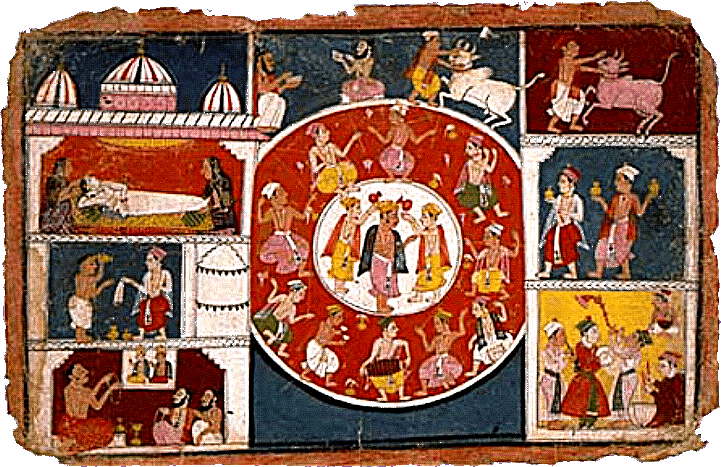
The image showing birthday celebrations is titled:
"Scenes from the Life of Krishna: Celebrations in Honor of
Krishna's
Birth"
Central India, 1680-90. Source: Virginia
Museum
of
Fine
Art.
Production:
Filognostic Association
of
The Order of
Time.

Feed-back | Links | Downloads | Music | Pictures | What's New | Search | Donations



 Text
1
Text
1